 Follow Us on Google News
 Follow Us on Google Discover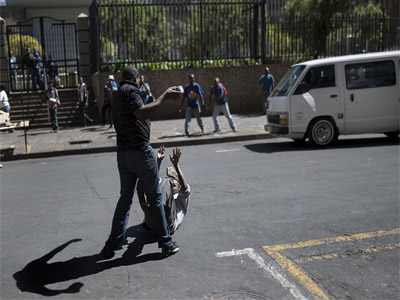
• Reps urge Jonathan to recall Nigerian ambassador
• We’ll rescue Nigerians if situation demands, says minister
THE United States has joined the South African government and other civil society leaders in condemning the violence against foreigners taking place in KwaZulu-Natal and other parts of the former apartheid enclave that has led to the killing of some migrants.
They stated their concern at the loss of innocent lives, destruction of property, and impact on families and communities, and urge those involved to refrain from all forms of violence, exercise restraint, and rely on peaceful dialogue to resolve any differences.
Likewise, the House of Representatives in Nigeria has urged President Goodluck Jonathan to recall the country’s High Commissioner from South Africa as a result of the recent xenophobic attacks targeted at Nigerians and other African nationals.
The parliament at its plenary session yesterday said the action was necessary to pave way for urgent diplomatic consultations with the government of South Africa. The House also called the country’s President, Jacob Zuma to immediately commence an investigation into the matter with a view to adequately addressing the situation.
Foreign Affairs Minister, Aminu Wali, has assured that the Federal Government is prepared to bring Nigerians back home if they are found to be under threat from South Africans in the recent attacks. But he confirmed that so far no Nigerian citizen has been affected.
U.S. Ambassador to South Africa, Patrick H. Gaspard said: “The U.S. government has long recognised the challenges posed by an influx of migrants and refugees throughout southern Africa and provides various forms of assistance in South Africa,’’ noting ‘‘that as an immigrant to my own country, my heart goes out to those who have been attacked for being different.”
Gaspard noted that the United States government is ready to help, stressing that it is the largest single donor to the UN High Commissioner for Refugees (UNHCR), International Organisation for Migration (IOM) and the International Committee of the Red Cross and Red Crescent (ICRC), directly funding approximately 40% of these organisations’ budgets in the Africa region.
Also in the House of Representatives resolution over a motion of urgent public importance moved by Chairman of the Committee on Nigerians in the Diaspora, Abike Dabiri-Erewa, on the floor yesterday, the House said Nigeria should apply diplomatic reciprocity if South Africa continues to frustrate Nigerian businesses in the country by doing same to her interests in Nigeria.
As members took turns to condemn the recent attacks, which, according to them was not the first specifically targeted at Nigerians, the House called on the President of the African Union (AU), Mrs. Nkosazana Dlamini-Zuma, who incidentally is a South African, to decisively intervene, as it described the incident as “cruelty being meted out to fellow black migrants.”
Leading debate on the motion, Dabiri-Erewa recalled that there have been constant, unwarranted xenophobic attacks against African migrants in South Africa, whereby Africans in South Africa are being slaughtered like animals, adding that the recent attacks, which has left many dead, businesses and shops vandalised, many beaten up mercilessly, was incited by a statement allegedly made by South African Zulu King, Goodwill Zwelithini, who told African migrants to go home as they are no longer welcome in South Africa.
President Jacob Zuma, in his remark to the South African Parliament said: “Let us work together to provide support to all foreign nationals who have been affected by this violence.”
“Son of President Zuma, Edward, allegedly echoed the same statement. This ignited a strong debate, and worse still, immediate backlash of violent reactions among the Zulus in Kwazulu, who unleashed terror on foreign immigrants including Nigerians in Jo-bourg, Durban and Pretoria. They steal, break into their homes, businesses, take their properties, killing them. At least five have been killed in Durban, hundreds stranded and unable to return home,” the lawmaker stated.
Speaking to State House correspondents, Wali said: “With the discussions I have been having with Nigeria’s Head of Mission in Pretoria, no Nigeria has so far been affected. They informed me that they have called the Nigerian community and told them to close their shops, stay home and keep out of trouble and obey the laws of South Africa.”
He added: “We are not being reactionary, because this is happening to all foreigners, not Nigerians alone. We are monitoring the situation and will now take action according to how the situation develops, but you can be rest assured that government will not shirk in its responsibilities.”
Meanwhile, President of the Nigerian Union in South Africa (NUSA), Ikechukwu Anyene, has urged the Federal Government to help halt the xenophobic attacks on Nigerians in that country.
According to News Agency of Nigeria (NAN) Anyene, who spoke on phone from Pretoria, South Africa, said that the latest spate of xenophobic attacks began three weeks ago.
Already, unconfirmed reports indicate that no fewer than 10 Nigerians may have been killed since angry South Africans launched attacks on African migrants in Johannesburg on Friday.
There are more than 800,000 Nigerians living in South Africa.
Anyene said Nigerians resident in some South African cities had gone into hiding to avoid being attacked.
“The Nigerian government should urgently intervene and save our people from the attacks. They should prevail on the South African government to stop such attacks against Nigerians. It appears nothing is being done to stop the attacks and Nigerians are worried about the situation,’’ he said.
Anyene said during the attacks in Johannesburg last week, shops owned by Nigerians were looted and their owners seriously injured by the attackers.
He said the Nigerian Union in South Africa had been in touch with local chapters in some provinces and had urged them to take precautionary measures to save themselves.
Anyene said that since Nigeria and South Africa established diplomatic relations, there had not been a single incident of xenophobic attack against South Africans living in Nigeria.
“The Nigerian government protects the lives and property of South Africans living in Nigeria. We do not understand why from time to time, South Africans attack Nigerians in their country. The Federal Government should take the issue of xenophobic attacks in South Africa very seriously because Nigerians do not carry out xenophobic attacks against fellow Africans,’’ he said.
Nigerians living in Durban, he said, had planned a protest march against the xenophobic attacks.
He, however, said they were denied permit by the South African police.

