Stakeholders at the 2025 Niger Delta Anti-Corruption Learning Summit have called for an end to the misuse of state resources by governors to sponsor political parties, warning that the practice threatens democracy and fosters impunity.
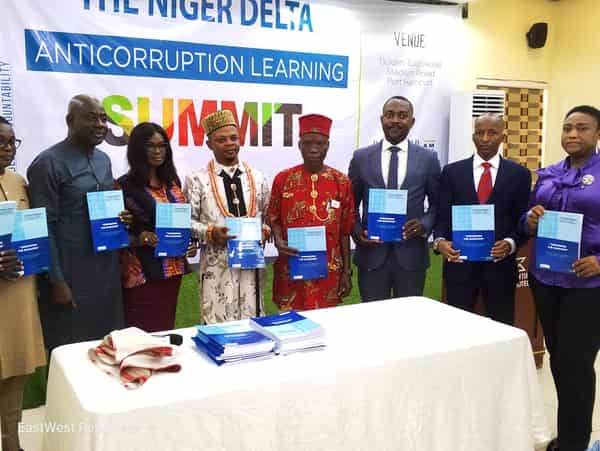
The summit, held in Port Harcourt, Rivers State, was themed “Building Stakeholders’ Resilience for Sustained Accountability and Development in the Niger Delta.”
It was convened by the Social Development Integrated Centre (Social Action) and brought together civil society organisations, traditional rulers, students, anti-graft agencies, including the EFCC and ICPC, and various NGOs to address the governance challenges afflicting the oil-rich region.
In his opening remarks, Executive Director of Social Action, Isaac Osuoka, criticised the political manipulation and resource capture prevalent in Rivers State, describing it as the “epicentre of godfatherism” in Nigeria.
“Rivers State has become the epicentre of godfatherism in Nigeria. It is undermining democracy,” Osuoka said.
“Since 1999, it has become a trend that every governor of Rivers State becomes a financier of the ruling party, whether PDP or APC. State resources are used to fund elections, often contributing to electoral malpractices across Nigeria more than any other state.”
Participants at the summit called for the institutionalisation of a needs-based assessment mechanism for federal constituency projects. They proposed the creation of community-based committees to ensure transparent and accountable management of development funds.
Environmental rights activist Celestine Akpobari underscored the necessity of identifying the actual needs of communities before project implementation.
“The current system, where lawmakers control constituency projects, is highly susceptible to abuse. We need community committees to take charge, ensuring transparency and that projects align with grassroots needs,” he said.
Also speaking, Constance Meju, Coordinator of the Centre for Media Environment and Development Communication, decried the weakening of judicial integrity and the rise of selective justice in corruption cases.
She expressed concern over lenient sentences given to individuals convicted of looting public funds, noting that this undermines the rule of law and erodes public trust in the judiciary.
“The judiciary must be held to a higher standard of accountability. The fight against corruption cannot be won if our justice system continues to treat high-profile offenders with kid gloves,” Meju emphasised.
The summit concluded with calls for sustained citizen engagement, stronger oversight mechanisms, and collaborative efforts to foster accountable governance in the Niger Delta.