 Follow Us on Google News


 Follow Us on Google Discover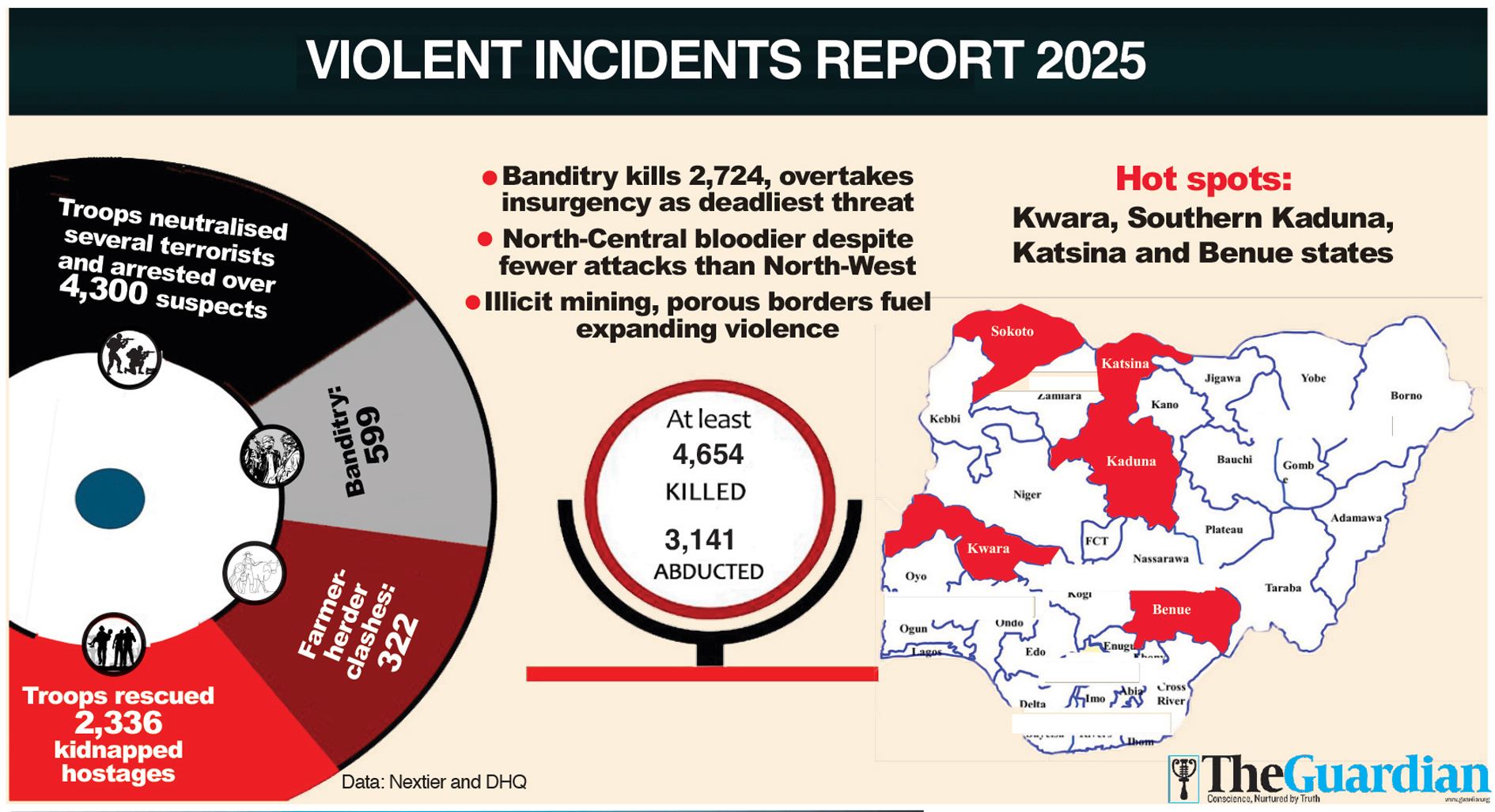
• 3,141 abducted as kidnappings hit alarming peak
• Banditry kills 2,724, overtakes insurgency as deadliest threat
• North-Central bloodier despite fewer attacks than North-West
• ACF decries worsening insecurity, urges leaders to refocus
• Illicit mining, porous borders fuel expanding violence
• Air Force vows relentless airpower, intelligence surge
Northern leaders have criticised what they describe as a growing political obsession with the 2027 elections, as a new report revealed that violent conflicts claimed 4,654 lives and left 3,141 abducted across Nigeria in 2025.
The figures are contained in the Nigeria Violent Conflicts Database 2025 report unveiled by Nextier Advisory Limited in Abuja yesterday.
The report stated that the data reflect deepening insecurity driven by terrorism, banditry and communal violence.
It came as the Arewa Consultative Forum (ACF) criticised political leaders for appearing more preoccupied with positioning for the 2027 general elections than confronting escalating violence in the region.
Chairman of the forum, Mamman Osuman, also decried worsening insecurity in Northern Nigeria and called on governments at both national and state levels to intensify efforts to address the crisis.

Osuman spoke yesterday at the 79th National Executive Committee meeting of the forum in Kaduna, where he expressed concern over the growing incidents of terrorism, banditry, insurgency and kidnapping.
He said the violence had displaced communities, disrupted livelihoods and forced the closure of schools across affected areas.
“This election season has produced convoluted groups whose focus is not on out-of-school children, hunger, poverty or frequent attacks by kidnappers and terrorists, but rather on strategies for repositioning ahead of the 2027 elections,” he said.
He urged members of the forum to demonstrate sincerity, discipline and action-driven leadership in addressing the challenges facing the region.
Osuman cited recent attacks in parts of Kwara, Southern Kaduna, Katsina and Benue states, noting that overcrowded camps and informal settlements had heightened the risks of malnutrition and mortality among displaced persons.
“Insecurity has deepened to such an extent that external military assistance has been required,” he said.
He added: “Since our last meeting on August 21, 2025, our region has continued to face grave difficulties, natural disasters, tragic loss of lives, and the harsh vicissitudes of daily existence.
“Terrorism, armed banditry, insurgency, and kidnapping are on the rise, as witnessed in Kwara, Southern Kaduna, Katsina, Benue and other locations.
“The consequences have been devastating, with families and communities violently uprooted and displaced.
“These displacements have resulted in overcrowded camps and informal settlements with limited access to basic services, increasing the risks of malnutrition and mortality among survivors.
“Repeated attacks and the climate of fear have disrupted education, leading to school closures across affected areas.
“Rural economies have been severely strained, travel has become unsafe, and access to farming, schooling, and healthcare has been hindered.
“This grim situation heightens ACF’s concern and underscores the urgent need for our State Chapters to be proactive. Our existence as a socio-cultural organisation must not be merely ceremonial or rhetorical; it must be principled, sincere, sacrificial, and action-driven.
“We must engage constructively with governments at national and subnational levels in the pursuit of peace, stability, and the civil rehabilitation of our people.
“As our region approaches a national election cycle, ACF must cooperate with relevant authorities to ensure peaceful and credible elections. We must educate and enlighten our people on their civic responsibilities and the necessity of abiding by the laws of our fatherland.”
Report: Violent conflicts claim 4,654 lives in 2025, 3,141 abducted nationwide
In the report titled Nigeria Security and Conflict Outlook 2026: When Capability Meets Resolve, Managing Partner of Nextier, Dr Ndubuisi Nwokolo, said banditry emerged as the deadliest driver of violence in the country.
Nwokolo disclosed that banditry accounted for 599 incidents and 2,724 deaths in 2025, representing a significant increase from the 256 cases and 1,585 fatalities recorded in 2024.
He noted that although the North-West witnessed the highest number of banditry attacks, the North-Central recorded more deaths, indicating an escalation in the severity of violence in the region.
He said: “Over the past five years, Nextier has operated the Nextier Nigeria Violent Conflicts Database (NNVCD) and released an annual security and conflict outlook. What began as a deliberate effort to close a critical gap in Nigeria’s conflict data ecosystem has grown into one of the country’s most consistent, methodologically rigorous, and policy-relevant conflict datasets.
“The message from this journey is clear: Nigeria’s challenge is not the absence of events, but the absence of credible, structured, and accessible data about those events. Our experience with the NNVCD has shown that bridging this gap does not always require new laws or vast bureaucracies. Sometimes, it simply requires a dedicated organisation willing to invest in rigour, consistency, and independence. That is the role Nextier has chosen to play.”
The report showed that kidnapping reached alarming levels, with 3,141 victims recorded, marking one of the highest figures in recent years. It noted a surge in mass abductions carried out by armed groups, particularly in vulnerable rural communities.
Terrorism and insurgency intensified during the year, with 43 terror-related incidents recorded. Borno State remained the epicentre, accounting for 397 casualties.
Farmer-herder clashes also rose from 58 incidents and 188 deaths in 2024 to 87 incidents and 322 fatalities in 2025.
According to the report, climate stress, ethnic tensions, political factors and banditry contributed to the escalation of farmer-herder conflicts.
Nextier identified illicit mining as a major funding source for criminal networks, alleging that a notorious bandit leader, Kachalla Mati, earns up to N300 million weekly from illegal gold sales.
The proliferation of small arms and light weapons, porous borders and instability in the Sahel region were also cited as key enablers of violence.
The organisation warned that insecurity could worsen in 2026, citing growing alliances between terrorists and bandits, expansion of armed groups into states such as Kwara and Kano, and rising political tensions ahead of the 2027 general elections.
It projected that election-related violence, cult clashes, communal disputes and gunmen attacks would remain regionally concentrated but increasingly lethal.
Nextier urged the Federal Government to strengthen intelligence coordination, community policing and collaboration with international partners to curb escalating threats.
The report identified at least 14 major threat clusters fuelling instability nationwide, including terrorism, banditry, kidnapping, secessionist unrest, communal violence and illegal mining.
It stated that Nigeria’s security challenges are interconnected and exacerbated by weak intelligence sharing, governance gaps and economic hardship.
The organisation advised the Nigerian Armed Forces and intelligence agencies to strengthen intelligence management and operational security to prevent information leaks and enhance counter-terrorism operations.
It also called on the Department of State Services and the Economic and Financial Crimes Commission to intensify financial surveillance to dismantle ransom payment networks linked to kidnapping and banditry.
On farmer-herder conflicts, the report recommended full implementation of livestock reforms, including the National Livestock Transformation Plan, alongside early warning systems and dialogue between farmers and herders.
Nextier criticised what it described as a reactive electoral security approach and called for preventive conflict strategies and reconciliation mechanisms after election violence.
On accountability, the report urged stronger internal oversight within security agencies and prosecution of rights violations, particularly extra-judicial killings.
Delivering a keynote address, Deputy Inspector-General of Police in charge of Research and Planning, Idegwu Okuoma, represented by Commissioner of Police Edwin Ogbehagha, said the report provides critical insights into Nigeria’s security realities.
He said the document challenges security agencies, policymakers and stakeholders to bridge the gap between government capacity and citizens’ security experiences.
Okuoma stated that the Nigeria Police Force is strengthening intelligence gathering, planning, training and collaboration with other security agencies.
He added that security should not be measured solely by arrests or deployments but by whether citizens feel safe.
Speaking on behalf of the Chief of Air Staff, Air Commodore Adejimi, Director of Enabling Operations, said the Nigerian Air Force remains committed to restoring peace through sustained aerial operations.
He noted that strategic discussions and research insights are vital to shaping military operations and long-term stability.
Also speaking, the Deputy Head of Delegation and Head of Political, Press and Information, Zissimo Vergos, said security requires a whole-of-society approach.
Vergos stressed that communities, traditional and religious leaders, civil society groups and the media must collaborate with security agencies to prevent violence and strengthen local resilience.
Air chief vows intensified operations against insurgents
The Chief of Air Staff, Air Marshal Sunday Aneke, has vowed that the Service will dominate the operational space through superior coordination, innovation, and professionalism.
“Every sortie, every mission, and every decision must move us closer to total security restoration,” he said, adding that the Nigerian Air Force would continue to project overwhelming airpower in support of ground forces and joint operations.
Aneke spoke during a high-level strategic meeting with Air Component Commanders at the Nigerian Air Force Headquarters in Abuja.
He commended the commanders and their personnel for their courage, endurance and operational discipline under demanding combat conditions, noting that their sacrifices had led to measurable gains in degrading insurgent capabilities and disrupting hostile networks.
The air chief reaffirmed the Nigerian Air Force’s resolve to intensify air operations against insurgent and terrorist elements, declaring that the Service remains committed to decisive, intelligence-driven action across all theatres of operation.
He said the achievements recorded so far reflect his command philosophy of building a highly motivated and mission-ready force capable of delivering decisive results.
“Our personnel remain our greatest strength. Their resilience in the face of adversity proves that the Nigerian Air Force is prepared, focused, and battle-ready,” he said.
Aneke, however, cautioned that the security environment remains fluid and requires constant adaptation. He directed commanders to strengthen intelligence-led operations, deepen inter-agency collaboration and fully deploy modern technology to counter evolving threats.
He also underscored the importance of standardised training, predictive maintenance and rapid logistics support as critical to sustained combat effectiveness.
Assuring Nigerians of the Service’s commitment, Aneke said the Nigerian Air Force would maintain operational momentum and would not cede ground to forces threatening national stability.
He said all operational decisions are guided by the protection of civilians, national assets and territorial integrity.
“The Nigerian Air Force stands as a shield over the nation. We remain vigilant, aggressive against threats, and fully aligned with our constitutional duty to safeguard the country,” he said.
Aneke added that the Service’s operational posture is designed to deliver sustained security gains, noting that it would continue to evolve, strengthen partnerships and apply decisive airpower until lasting peace is achieved.
He urged Nigerians to remain confident in the Armed Forces’ commitment, saying the path ahead is defined by resilience, professionalism and determination to protect the nation.
The meeting featured detailed operational briefings and interactive reviews, with Branch Chiefs and senior officers contributing to a unified operational roadmap.

