 Follow Us on Google News


 Follow Us on Google Discover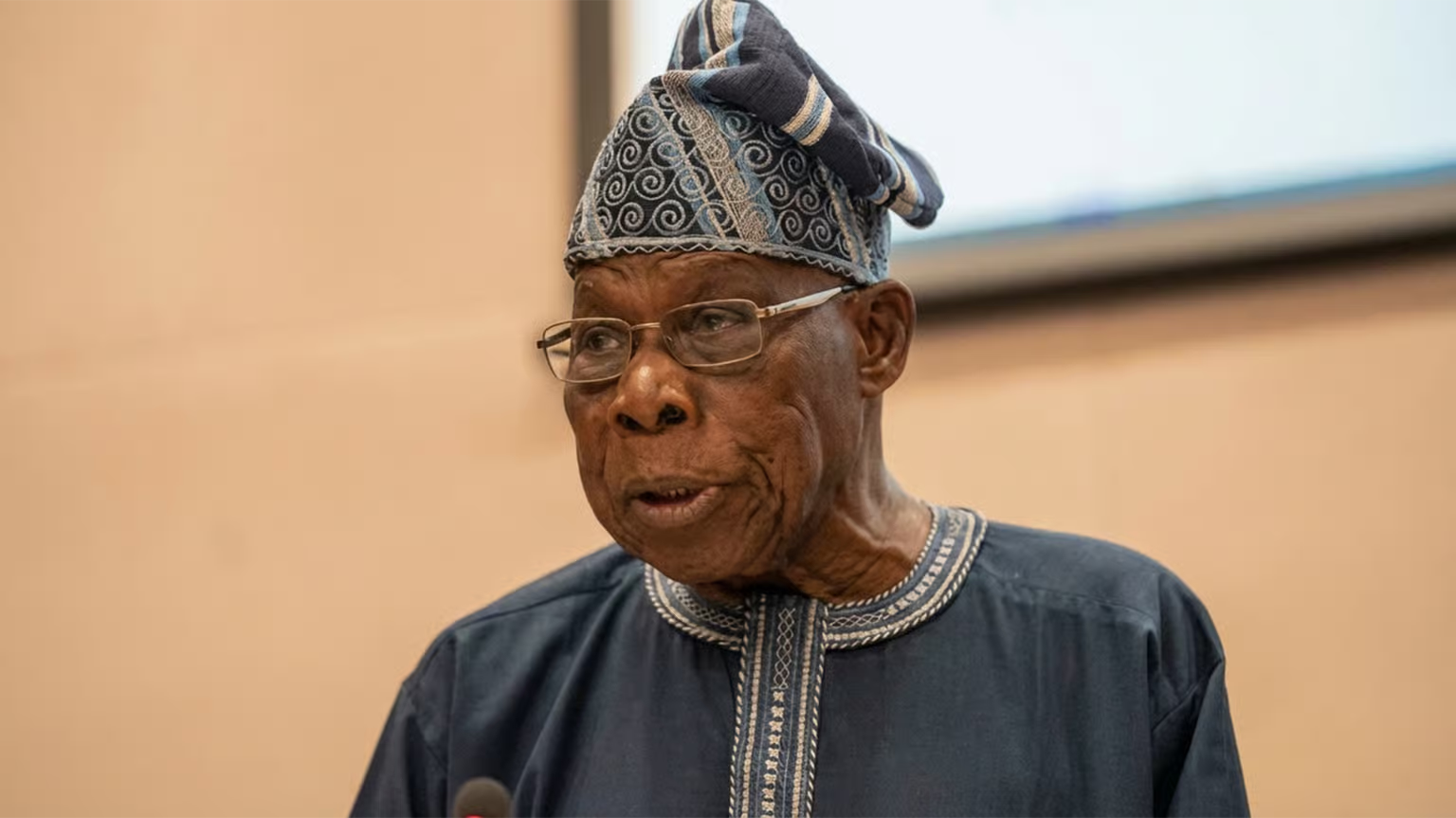
• Advocate $100b foreign exchange retention
With only 1.7 million barrels per day (bpd) of Africa’s seven million daily crude oil production refined within the continent, former President Olusegun Obasanjo and two organisations yesterday called for an end to fuel importation.
The organisations that joined Obasanjo in making the call were the African Refiners and Distributors Association (ARDA) and the African Petroleum Producers’ Organisation.
They also called for the creation of $100 billion foreign exchange retention and 2.5 million jobs.
The leaders, who gathered at the African Refiners and Distributors Association (ARDA) Week, currently going on in Cape Town, South Africa, proposed an additional three million refining capacity in Africa in strategic locations across the continent.
Delivering a keynote address, Obasanjo framed the continent’s continued reliance on imported refined petroleum products as both an economic inefficiency and a structural weakness.
He argued that exporting crude while importing refined fuels at higher prices undermined Africa’s development trajectory and exposed its economies to external shocks.

“It is not only poor economics; it is detrimental to our development and political economy,” he said, stressing that energy security remained central to industrialisation.
According to him, without reliable and affordable energy, efforts to build manufacturing capacity, infrastructure and modern agricultural systems would remain fragile.
Speaking at the conference, tagged “Fueling Africa’s Industrialisation,” the Executive Secretary of ARDA, Anibor Kragha, said the push for refining expansion must be situated within a broader industrialisation strategy.
He identified agro-processing, automotive manufacturing, minerals beneficiation and pharmaceuticals as priority sectors capable of driving structural transformation.
Kragha noted that Africa’s continued export of raw commodities such as cocoa, coffee and crude oil would continue to limit value creation and industrial growth.
He argued that strengthening downstream energy infrastructure would support manufacturing and enable countries to move up global value chains.
Kragha also decried critical infrastructure gaps, including limited refining capacity, inadequate storage facilities and weak distribution networks.
Also speaking, the President of ARDA, Marie-Josephine Sidibé, reiterated the urgency of translating Africa’s resource wealth into tangible economic benefits.
She noted that while the continent held roughly 30 per cent of global oil reserves and 40 per cent of natural gas reserves, its industrial base remained weak.
Sidibé added that discussions at ARDA Week 2026 would focus on practical pathways to achieving energy security, including harmonising fuel specifications, developing infrastructure, decarbonising, and sustainable financing.
Similarly, the Secretary General of APPO, Farid Ghezali, notes that although Africa produces about seven million bpd of crude oil, nearly 75 per cent is exported for refining abroad, while about 70 per cent of refined fuel consumed on the continent is imported.
“This is not merely an economic paradox; it is a structural imbalance,” he says, adding that the continent loses an estimated $50 billion yearly through external refining, missed industrial opportunities and job losses.
Ghezali warned that such dependence heightens Africa’s exposure to currency volatility, shipping disruptions and global market fluctuations. He argued that reversing the trend would require large-scale, commercially viable refineries integrated with petrochemical industries.

