 Follow Us on Google News


 Follow Us on Google Discover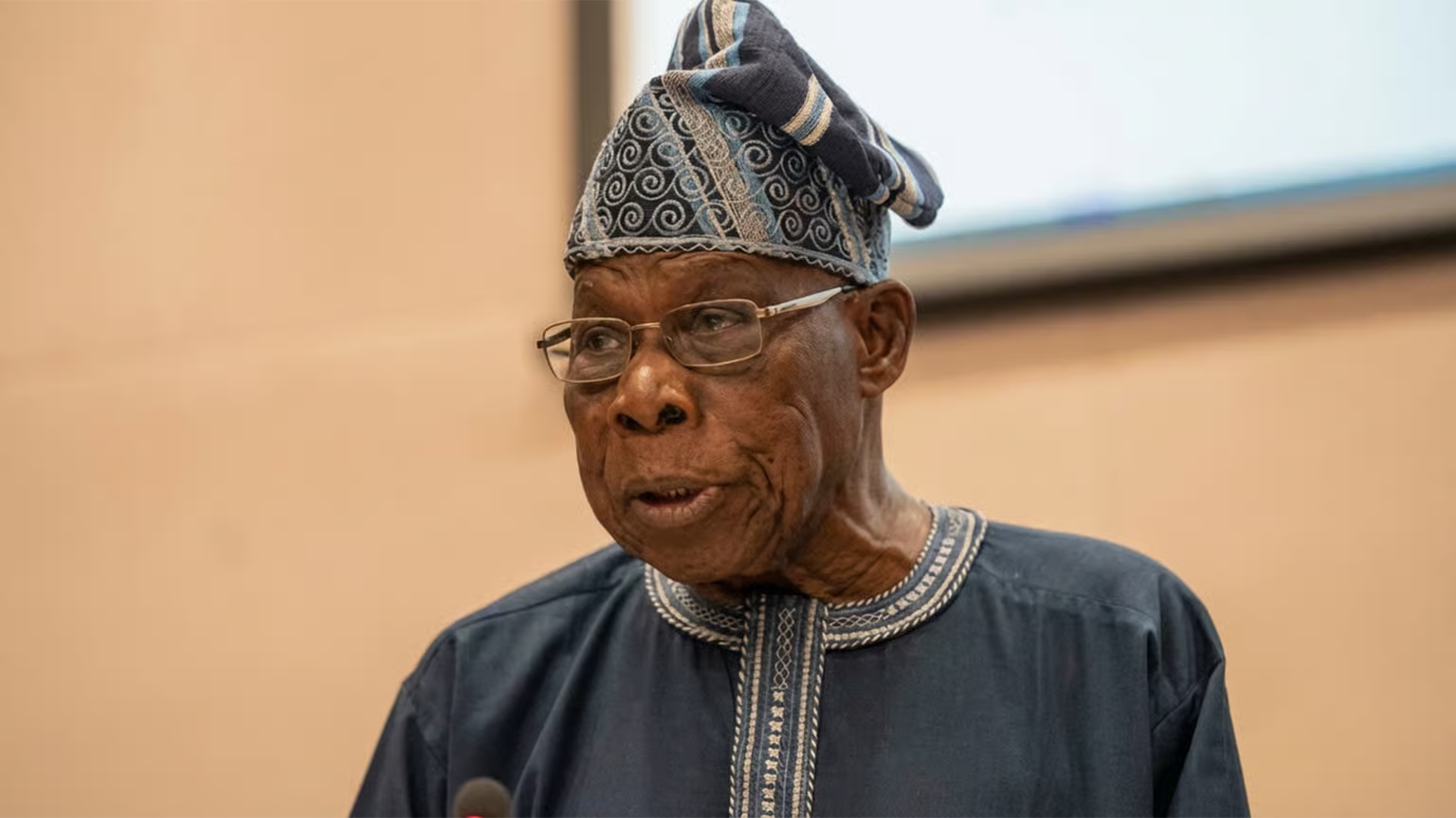
**Credits Abdulsalami with restoring democracy, helping sustain Nigeria’s democratic journey
Former President Olusegun Obasanjo on Saturday revealed how direct engagement with grassroots leaders and traditional communities helped avert a major revolt against the Land Use Act, preserving what has become one of Nigeria’s most enduring and consequential laws.
Obasanjo recounted how he embarked on a pre-dawn consultation tour of villages across Oyo State to personally persuade leaders of the Agbekoya movement to abandon planned protests against the legislation, which faced fierce opposition from different parts of the country when it was introduced during his military administration.
The former president spoke in Abuja at the public presentation of three books in honour of former Head of State, General Abdulsalami Abubakar (retd), held to mark the retired general’s 84th birthday at the State House.
Using the episode to underscore the value of consultation, dialogue and responsive leadership, Obasanjo said the Land Use Decree, now the Land Use Act, was initially unpopular across both Northern and Southern Nigeria.
“When the Land Use Act was promulgated as a decree, a colleague came to me and said nobody liked it. The North didn’t like it and the South didn’t like it,” he recalled.

According to him, intelligence reports later indicated that the Agbekoya movement was mobilising against the policy, raising fears of widespread resistance in the South-West.
Rather than confront the opposition through force, Obasanjo said he sought the counsel of elder statesman, the late Chief Adebo, who advised him to engage directly with the people.
“He told me, ‘Don’t send anybody. Go and see them yourself.’ I left Lagos around 2 am, arrived in Ibadan before dawn and moved from village to village meeting Agbekoya leaders in their homes,” Obasanjo said.
“By about 8 am, I had visited more than a dozen villages explaining the objectives of the policy and addressing their concerns.”
The former president said the personal consultations succeeded in calming tensions and winning public understanding, effectively neutralising opposition to the law.
“That was how we were able to suppress the protest against the Land Use Decree, and that is why the Land Use Act has endured until today,” he said.
Obasanjo used the occasion to advocate leadership anchored on dialogue and consensus-building, arguing that many national challenges can be resolved through direct engagement with stakeholders rather than confrontation.
The elder statesman, however, devoted much of his remarks to celebrating Abdulsalami Abubakar, whom he described as one of the military leaders whose actions profoundly shaped Nigeria’s history and democratic evolution.
He listed former Head of State General Yakubu Gowon, the late General Murtala Mohammed, the late Lt.-Col. Adekunle Fajuyi and Abdulsalami among military officers whose patriotism and leadership helped preserve Nigeria at critical moments.
According to him, Gowon’s handling of the post-1966 counter-coup crisis and the civil war ensured Nigeria’s survival as one nation, while Murtala Mohammed accelerated the country’s transition towards democratic governance and strengthened its international standing.
He also paid tribute to Fajuyi for his sacrifice during the 1966 political crisis, describing his decision to stand by the late Head of State, General Johnson Aguiyi-Ironsi, as a remarkable act of courage and loyalty.
Turning to Abdulsalami, Obasanjo said the former Head of State emerged as a stabilising force during one of Nigeria’s most turbulent political periods following the death of General Sani Abacha in June 1998.
“You sagaciously managed the confusion and uncertainty that followed Abacha’s death. You emerged from the cloud and carefully proceeded to untangle the nation,” he said.
Obasanjo recalled that one of Abdulsalami’s earliest decisions was the release of political detainees, including himself, as part of efforts to heal national divisions and restore confidence in the political process.
He disclosed that Abdulsalami also worked actively towards securing the release of the presumed winner of the June 12, 1993 presidential election, Chief MKO Abiola, and kept him regularly informed about developments.
According to him, arrangements for Abiola’s freedom had reached an advanced stage before the businessman and politician died unexpectedly in detention.
“I remember you calling me and saying, ‘Our man is dead.’ I asked, ‘Which man?’ When you mentioned Abiola, I screamed,” Obasanjo recounted.
Despite the setback, he said Abdulsalami successfully managed the aftermath of Abiola’s death and remained committed to returning the country to democratic rule.
“Within less than one year of your taking office, democracy was restored. Twenty-seven years after that restoration, democracy is still standing in Nigeria,” he said.
Obasanjo further credited Abdulsalami with helping to sustain Nigeria’s democratic transition long after leaving office.
He revealed that the former military ruler maintained regular consultations with him during his presidency, often presenting written observations and recommendations on governance and national affairs.
“Can I forget how regularly you came with a piece of paper containing all the points you wanted to discuss with me about what was going on in the country, what should be done and how you saw things?” he asked.
“We sat down and examined them one after the other. Issues that could be addressed immediately were dealt with, while others received responses within 24 hours.”
He described the practice as a rare demonstration of statesmanship and patriotism.
“That was a magnificent way of sustaining what you had initiated, and I cannot thank you enough,” Obasanjo said.
The former president also reflected on lessons he learned from respected national leaders, including the late Sultan of Sokoto, Sir Kashim Ibrahim, and Chief Adebo, saying their wisdom helped him navigate difficult policy and governance challenges.
He cited their interventions on sensitive issues such as government support for pilgrimage and women’s participation in elections, arguing that consultation remains one of the most effective tools of leadership.
Obasanjo congratulated Abdulsalami on his 84th birthday and the publication of his autobiography and two other books launched in his honour, describing the works as valuable contributions to Nigeria’s historical record and democratic memory.
He said future generations would benefit immensely from the lessons embedded in the life, service and leadership of the former Head of State.

