 Follow Us on Google News


 Follow Us on Google Discover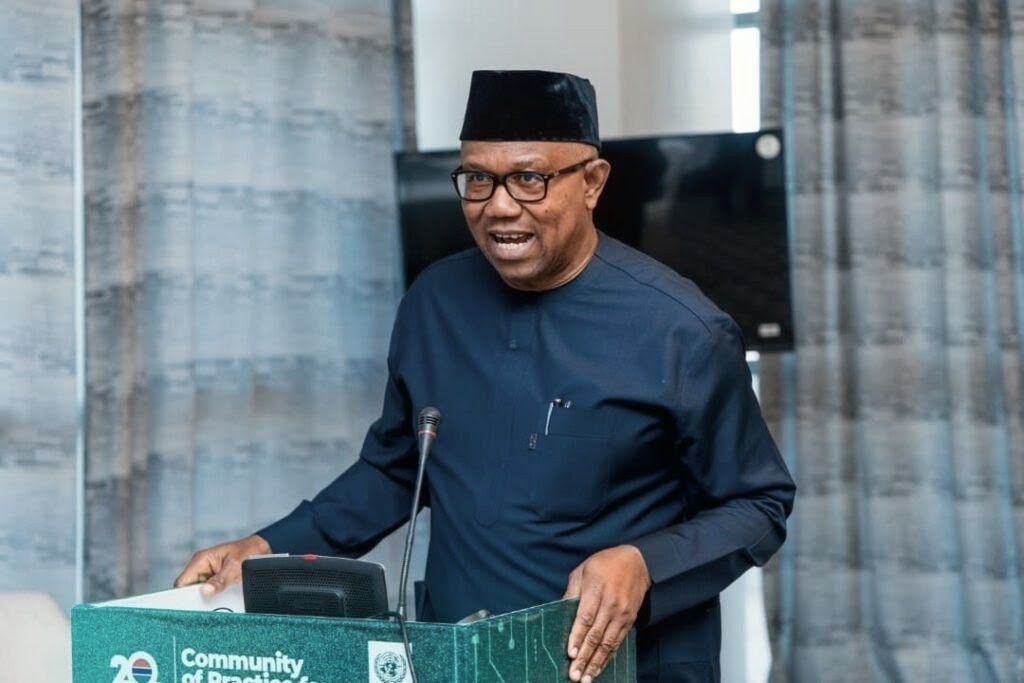
Presidential candidate of the Nigerian Democratic Coalition, Peter Obi, has outlined an ambitious blueprint for national renewal after formally accepting the party’s presidential nomination in Abuja on Saturday.
In an acceptance speech that touched on security, healthcare, education, agriculture, energy, governance and democratic reforms, Obi said Nigeria stands at a critical crossroads but remains capable of overcoming its current challenges through purposeful leadership and national unity.
The former Anambra State governor expressed gratitude to party leaders, including Seriake Dickson, members of the National Working Committee and supporters across the country, describing his emergence as a collective mission rather than a personal political project.
“This moment is not about Peter Obi,” he declared. “It is about Nigeria, about restoring hope to millions of citizens and securing a better future for our children.”
Obi argued that Nigeria’s diversity should be harnessed as a source of strength rather than division, urging citizens to reject ethnic, religious and regional tensions.
According to him, rebuilding trust among Nigerians is a prerequisite for national development, insisting that a united country would be better positioned to tackle its economic and social challenges.

The NDC candidate described the worsening security situation as one of the greatest threats facing the country, noting Nigeria’s rising position among nations most affected by terrorism.
He pledged to deploy intelligence-driven and technology-backed security strategies while strengthening coordination among security agencies and addressing root causes of insecurity such as poverty, unemployment and marginalisation.
Obi also recalled Nigeria’s historic role in international peacekeeping missions, saying the country possesses the capacity and expertise needed to restore peace and stability within its borders.
On healthcare, Obi painted a grim picture of Nigeria’s health sector, citing poor functionality of primary healthcare centres and low health insurance coverage.
He promised to more than double health insurance coverage within four years and increase healthcare spending to at least 10 per cent of GDP.
The NDC standard-bearer further pledged that every ward in the country would have a functional primary healthcare centre and that at least half of Nigeria’s approximately 30,000 primary healthcare facilities would be fully operational by the end of his first term.
Education and Human Capital Development
Obi identified education as the cornerstone of national transformation, promising significant investment in schools, teachers, technology and vocational training.
He said the goal would be to equip young Nigerians with skills that enable them not only to seek jobs but also to create employment opportunities for others.
Highlighting Nigeria’s worsening food insecurity, Obi argued that the nation’s vast agricultural potential remains underutilised.
He said large-scale investment in agriculture would form a central pillar of his administration’s economic strategy, stressing that increased production rather than dependence on imports is the key to reducing hunger and poverty.
According to him, Nigeria’s expansive arable land, particularly in the northern region, represents one of the country’s greatest economic assets.
Power Sector Overhaul
Obi also targeted Nigeria’s chronic electricity deficit, describing it as a major obstacle to industrial growth and economic development.
He pledged to increase power generation and distribution by at least 10,000 megawatts over four years, saying improved electricity supply would stimulate businesses, manufacturing and job creation.
Addressing unemployment, Obi promised targeted support for micro, small and medium enterprises through tax incentives, favourable interest rates and easier access to financing.
He further vowed to reduce corruption and the cost of governance through transparency and accountability measures, while insisting that public resources must deliver measurable value to citizens.
On democracy, he promised respect for opposition parties, adherence to the rule of law and an electoral environment free from undue government interference.
Obi concluded by reaffirming his signature message that “a New Nigeria is possible,” urging Nigerians to remain hopeful and committed to national renewal as the country heads toward the 2027 general election.

