 Follow Us on Google News


 Follow Us on Google Discover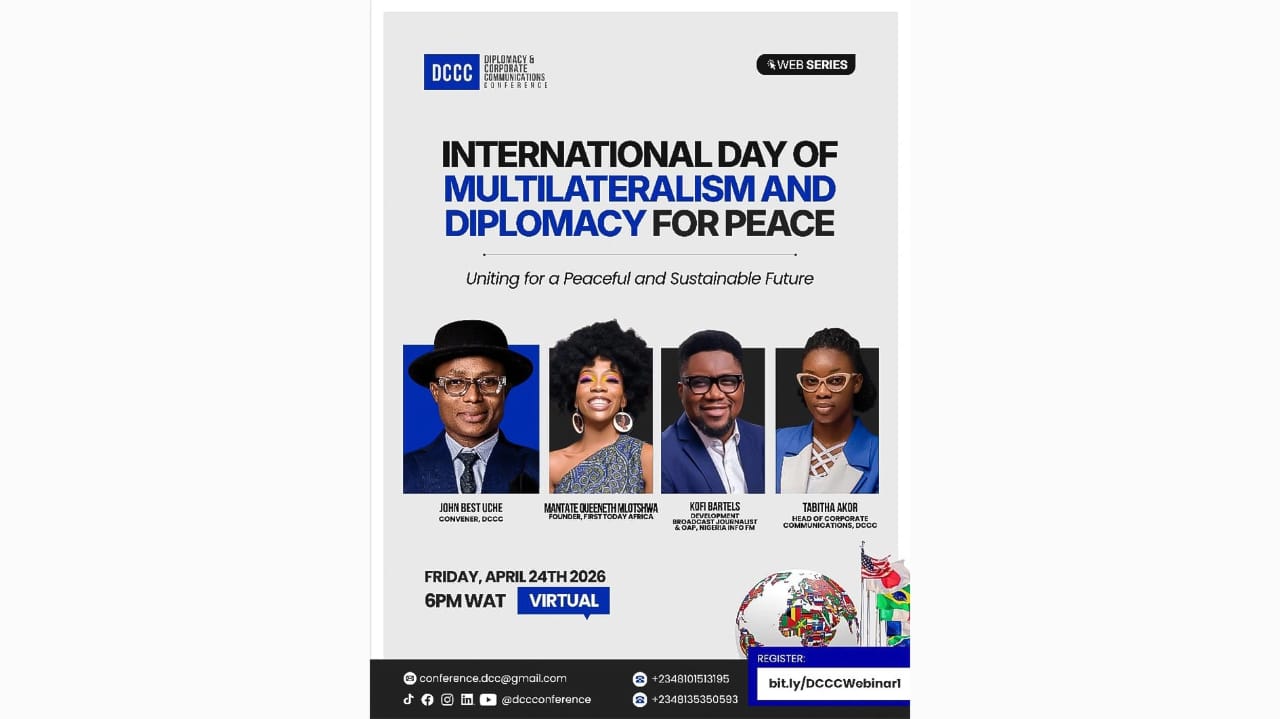
In a world increasingly defined by division, uncertainty, and complex global challenges, the question is no longer whether multilateralism matters—but how it must evolve to remain effective.
This question took centre stage as stakeholders from across Africa and beyond convened for a high-level virtual dialogue hosted by the Diplomacy and Corporate Communications Conference (DCCC), in commemoration of the International Day of Multilateralism and Diplomacy for Peace

Held under the theme, “Uniting for a Peaceful and Sustainable Future,” the conference brought together diplomats, policymakers, media professionals, development practitioners, and emerging leaders to interrogate the future of diplomacy in a rapidly changing world.
At the heart of the conversation was a powerful opening address delivered by John Best Uche, Convener of DCCC, whose message set both the tone and the direction for the engagement.
“Do not wait for big things to happen. Make big things happen—starting small is the strategy,” he said.
It was more than a statement—it was a challenge.

A challenge to governments, institutions, and individuals to move beyond passive acknowledgment of global issues and toward deliberate, strategic action. In his address, he underscored a reality that continues to shape global discourse: no nation, no matter how powerful, can succeed in isolation.
From climate change and economic disparities to conflict and social instability, the defining issues of our time are interconnected.
Addressing them requires more than policy—it requires cooperation, dialogue, and trust.

This is precisely why the observance, as recognised by the United Nations, carries such weight. It is not merely symbolic; it is a global call to action—one that demands renewed commitment to diplomacy as a practical tool for peacebuilding and sustainable development.
Yet, as the discussions unfolded, it became clear that the challenge is not only global—it is deeply local.
Across many parts of Africa, a critical gap persists in how diplomacy and strategic communication are understood and applied. Too often, diplomacy is mistaken for weakness, while dialogue is replaced with misinformation, reactionary narratives, or silence.
The consequences are far-reaching. Without trust,collaboration falters. Without collaboration, development efforts lose their impact. And without effective communication, even the most well-intentioned initiatives struggle to gain traction.
It was within this context that the insights of other speakers added depth and dimension to the conversation.
Mantate Queeneth Mlotshwa brought a dynamic perspective on the role of media and storytelling in diplomacy.
She emphasised that narratives shape perception, and perception, in turn, shapes influence. For Africa to assert itself within global diplomatic spaces, its stories must be told intentionally, authentically, and strategically.
From the lens of broadcast journalism, Kofi Bartels highlighted the critical responsibility of the media in shaping public discourse. In an era of rapid information flow and digital amplification, he noted, journalists are not just reporters—they are key actors in the diplomatic ecosystem, influencing how nations, policies, and global issues are perceived.
Adding a corporate and institutional dimension, Tabitha Akor drew attention to the expanding role of diplomacy beyond government corridors.
In today’s globalised economy, she explained, diplomacy has become an essential leadership skill within organisations, partnerships, and cross-border engagements—where communication determines trust, credibility, and long-term success.
Together, these perspectives reinforced a critical shift: diplomacy is no longer the exclusive domain of state actors. It is a shared responsibility—one that cuts across sectors, disciplines, and generations.
The discussions also aligned strongly with the vision of the African Union Agenda 2063, Africa’s strategic blueprint for a peaceful, integrated, and prosperous continent.
Achieving this vision, participants noted, will depend not only on policy frameworks, but on the strength of institutions, the clarity of communication, and the willingness to collaborate across borders.
Central to this vision is the role of young people. The conference repeatedly returned to the idea that the future of diplomacy is already unfolding—and that young Africans must be equipped not just to participate, but to lead. This requires more than academic knowledge. It demands practical skills, global awareness, and platforms that enable meaningful engagement.
This is where initiatives like DCCC are carving a unique space.
By bridging the gap between knowledge and application, the platform is fostering a new generation of leaders who understand both the theory and practice of diplomacy and communication.
It is not merely hosting conversations—it is building capacity, shaping narratives, and creating pathways for influence.
Beyond the dialogue, the message to stakeholders was clear.
Governments must invest in diplomatic education and strengthen institutions that promote dialogue and cooperation. Academic institutions must rethink curricula to reflect real-world demands.
The media must embrace its role in promoting responsible communication. And the private sector must recognise diplomacy as a strategic asset in an increasingly interconnected interconnected marketplace.
As the session drew to a close, one idea stood out above all others.
The future of multilateralism will not be defined by declarations, policies, or commemorative days—but by the choices made and the actions taken in moments like this.
For Africa, the opportunity is significant.
With its growing population, expanding influence, and increasing relevance on the global stage, the continent is not merely a participant in global diplomacy—it is a potential driver of it.
But potential alone is not enough. It must be matched with intention, investment, and action.
And if the conversations at this gathering are anything to go by, Africa is not just ready to engage the world, it is ready to help shape its future.

