 Follow Us on Google News
 Follow Us on Google Discover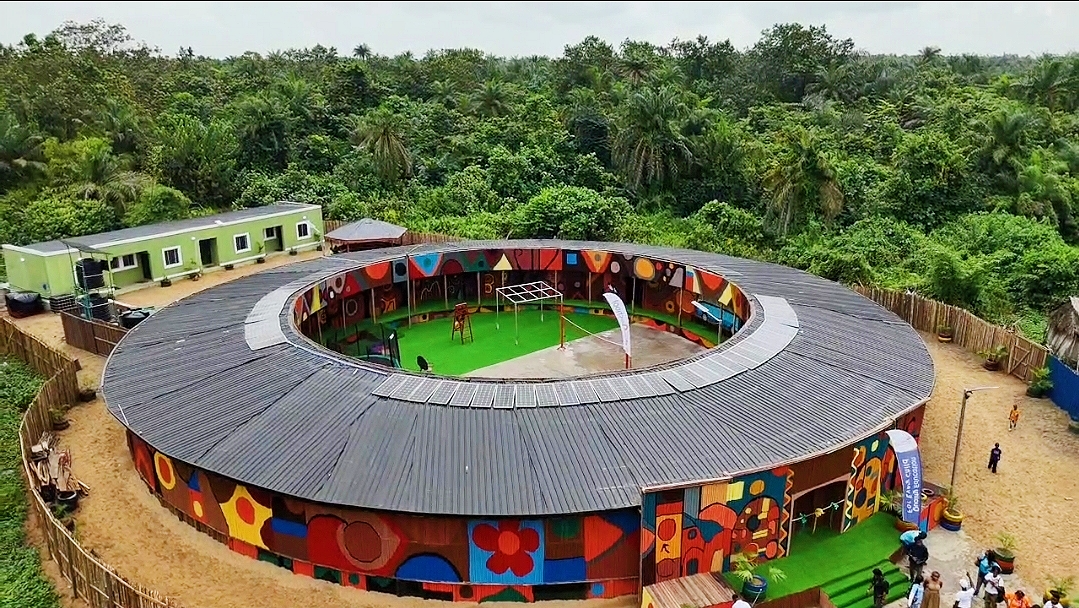
For the first time in its history, the riverine community of Saga has a school. Slum2School Africa, one of Africa’s leading educational Non-Governmental Organizations, has commissioned the Slum2School Green Academy, a fully eco-friendly school designed to bring education, clean energy, internet connectivity, and safe water to a community that had gone decades without a single classroom.
Saga community is one of many fishing islands located 15 kilometers off the Epe mainland, home to several hundred families from various tribes, including the Ijaws, Ogu, and Yoruba. For decades, the community lacked basic infrastructure: no school, no clean water, and no electricity. Children either stayed home or attempted unsafe trips across the water to distant schools. Most never enrolled.
But that changed on Saturday, 13th September 2025, when hundreds of volunteers and stakeholders from Slum2School Africa sailed in four giant wooden boats to launch the community’s first school.

The Green Academy Model
The new Green Academy is far more than a conventional school; it is a bold, transformational project intentionally designed to solve some of the deepest challenges faced by Saga and surrounding communities. For decades, children here had no safe or reliable access to education, clean water, or electricity. The Academy changes that narrative by providing space for over 250 children and families from Saga and seven neighboring riverine communities to learn in an environment built for sustainability and dignity.
Its bamboo architecture, chosen for both durability and climate resilience, stands as a model for eco-friendly construction in vulnerable environments. Powered entirely by solar energy, the school guarantees a steady supply of electricity, something the community had never experienced. Through rainwater harvesting systems and boreholes, the Academy now provides clean and safe water to families who once depended on unsafe and unreliable sources.

Equally groundbreaking is the integration of modern technology and community services. For the first time, Saga has access to satellite internet, enabling digital classrooms that connect learners to global resources, educators, and opportunities far beyond their immediate environment. Biogas digesters convert waste into clean energy, reinforcing the cycle of sustainability and innovation.
Beyond academics, the Academy incorporates health and psychosocial support services to ensure children not only learn but also thrive physically and emotionally. With fully furnished staff quarters for teachers, the Green Academy encompasses clean energy, water access, digital inclusion, and holistic child development; it is not merely a school building.
“It is more than a school,” said Orondaam Otto, Founder and Executive Director of Slum2School Africa. “It serves as a model for the future of education in Africa, integrating learning, sustainability, and community development.”
“For more than a decade, we have supported children in Saga through scholarships, mentorship, and health interventions, yet we always knew they deserved more than temporary solutions. That conviction gave birth to the Green Academy. From the start, we conceived it as more than classrooms; it would be a safe space with light, water, and opportunities for the entire community. To make these objectives possible, we deliberately sought partners who not only had resources but who were aligned with our mission and values. Together, we transformed an idea into reality. Today, the Green Academy stands as proof that with shared vision and commitment, even the most forgotten communities can experience dignity, equity, and lasting hope.”
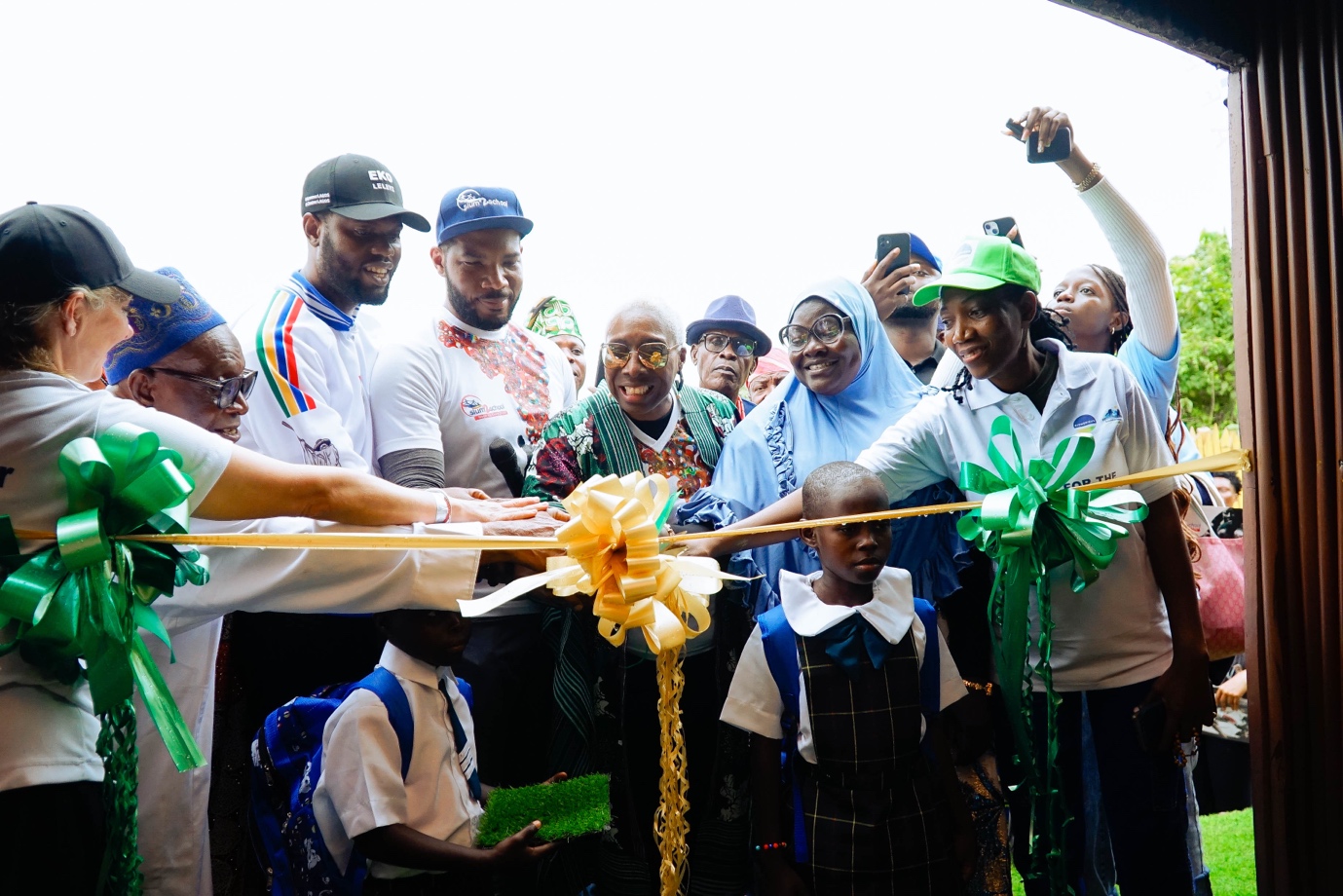
L-R: Ania Judson, Slum2School Volunteer and Educator; Alhaji Mukaila Hassan Eleru, Head of the Eleru family; Mr. Owolabi Falana, Board Member, Lagos State SUBEB; Mr. Orondaam Otto, Founder, Slum2School Africa; Mrs. Alero Ayida-Otobo, Board Chair, Slum2School Africa; Hon. Sikiru Adeniyi Owolomose, Vice Chairman of Epe Local Government; Mrs. Iyobosa Oyaide, Team lead of BioMérieux Education Team, Nigeria; Moses Testimony and Aboyewa Ekomiyenyefah, Basic1 students at the Slum2School Green Academy.
Communities Unite at the Commissioning Ceremony
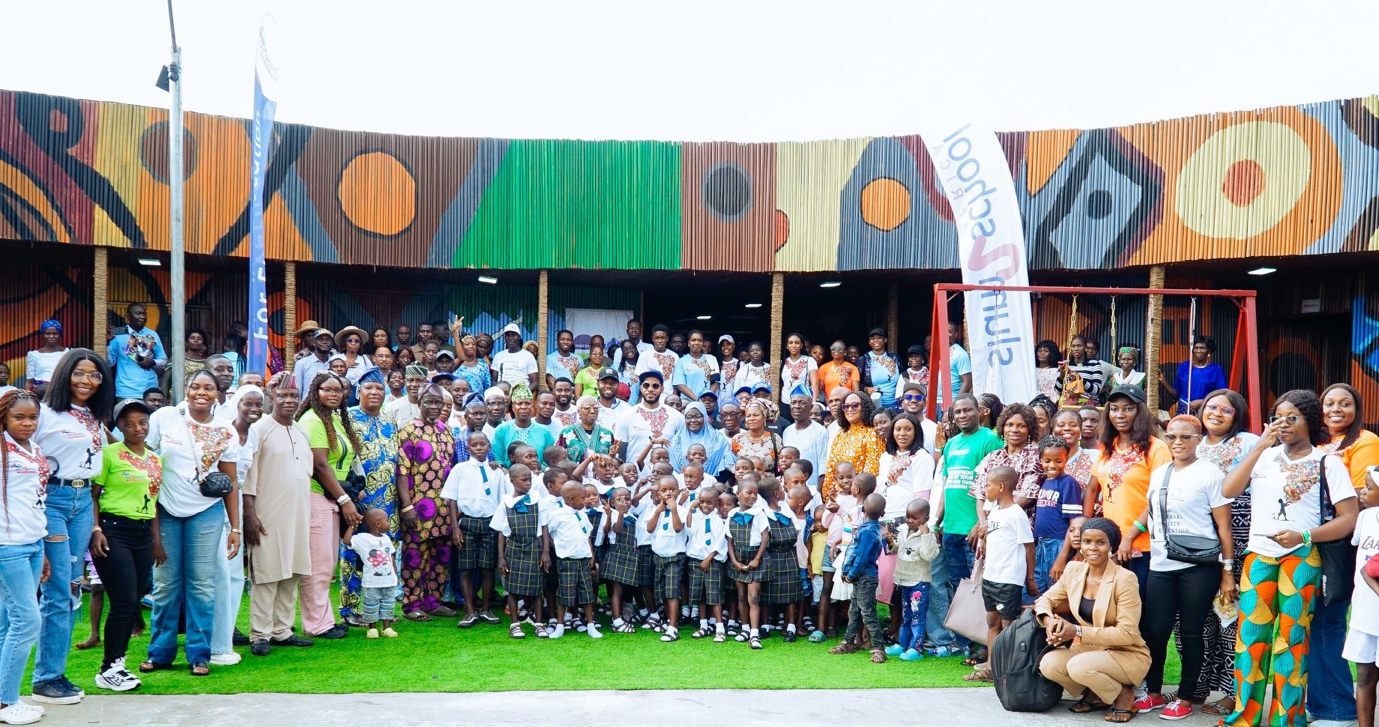
Upon hearing the news, over 400 community members and leaders, including government officials, corporate partners, philanthropists, volunteers, community leaders, and villagers, attended the commissioning. The event began with road and boat trips that highlighted Saga’s isolation. On arrival, guests were welcomed by community members and guided by children into the ceremony venue.
Government officials praised the initiative as an example of how to reach underserved communities and the power of public-private collaboration. Represented were senior leaders from the Epe Local Government Council, the Universal Basic Education Commission (UBEC), Lagos State Universal Basic Education Board (SUBEB), the Lagos State Ministry of Education, the Teachers Registration Council of Nigeria (TRCN), representatives of the House of Representatives, and several paramount chiefs and Baálẹ̀.
From the local government, Hon. Sikiru Adeniyi Owolomose, Vice Chairman of Epe Local Government, delivered a goodwill message from Hon. Princess Surah Olayemi Animashaun, the Epe Local Government Chair. The letter commended Slum2School for delivering “global-standard education” and pledged support to sustain and scale the model.
“I sincerely thank Slum2School Africa for donating a revolutionary primary school to Saga Village. This project has restored hope to our children and renewed parents’ confidence in accessing quality education within the community. It will leave a lasting impact on future generations, and we assure you that the school will be well maintained and used for its intended purpose. We deeply value your commitment to community development and pray that you continue to grow in strength and capacity to touch more lives positively.”
Hon. Owolabi Falana, Board Member of the Lagos State Universal Basic Education Board (SUBEB), said the Academy “shows what is possible when government and innovative organizations work together and is a truly transformational project that should be replicated in other communities.”
“This is equity in action,” he said. “As a native of Epe and a leader in the education sector, I am very proud to see such an innovative school in Lagos State. The government believes in collaboration, and Lagos State looks forward to partnering with Slum2School to expand opportunities across more communities.”
Other directors from SUBEB, including Engr. Banjo Adegboyega and Mrs. Abosede Ojuri, also expressed excitement. Representing the board chairman, Mrs. Ojuri reaffirmed SUBEB’s commitment to building partnerships for national growth.
Partnership and Funding
The Green Academy was made possible through a network of partners, with BioMérieux International providing the lead grant that kickstarted construction. Other contributing partners included United Airlines, HP, Triton International Paints, and Preserve Your Roots, alongside donations from hundreds of Slum2School volunteers and board members.
Speaking at the commissioning, Mrs. Alero Ayida Otobo, Board Chairperson of Slum2School Africa, was filled with joy and amazement:
“What we see right here is overwhelming and only possible when vision is matched with commitment. This Slum2School Green Academy is not just a school; it is a model that proves no child should ever be left behind because of geography or circumstance. As a board, we are proud to stand behind this mission, and we call on governments, partners, and citizens to help replicate it across Nigeria and Africa.”
Iyobosa Oyaide, Representative of BioMérieux, spoke in awe:
“This project has surpassed whatever expectations we had. What Slum2School Africa has done is overwhelming and remarkable. To believe that a year ago this was all empty space and today it is a fully completed school for over 200 children is truly unbelievable. Slum2School brought innovation, passion, resilience, and sustainability into the project, and this embodies the kind of transformation BioMérieux believes in. This is what happens when education, health, and sustainability converge.”
Volunteers and staff from Slum2School also played a crucial role. Many camped in Saga for weeks to oversee logistics and construction.
“It was not easy, but it has been worth every penny,” said Mr. Adekunle Idowu, Senior Project Manager at Slum2School Africa.
“To see the children walk into their first classroom made it unforgettable,” added Ms. Yemi Alugo, Education and Innovation Manager at Slum2School, who will lead the school’s operations.
Why It Matters
The Green Academy is already attracting attention beyond Lagos State. Development experts say it offers a replicable model for reaching hard-to-access communities with limited infrastructure. By combining education with clean energy and water, the Academy addresses multiple development challenges in one project.
Nigeria has one of the world’s highest numbers of out-of-school children, with UNICEF estimating over 20 million. Many of these children live in slums, riverine villages, or remote settlements like Saga. For them, barriers to education are not just financial but structural—distance, unsafe transport, and lack of facilities.
By creating schools that double as community hubs, organizations like Slum2School Africa can reduce those barriers and improve health, safety, and learning outcomes simultaneously.
Students at the Slum2School Green Academy exploring their new classrooms as they prepare for their school resumption.
What Comes Next
Slum2School says the Green Academy will serve as a pilot. The organization hopes to replicate the model in other marginalized, urban slums, riverine, and underserved communities across Nigeria and Africa, working with governments and private partners.
“The goal is not one school,” Orondaam Otto explained. “The goal is to show what’s possible, then scale it. Saga waited for decades. Millions of children elsewhere should not wait another day.”
To sustain the Academy, Slum2School has launched a pledge campaign inviting individuals and organizations to sponsor children, provide mentorship, or contribute to facility maintenance and scaling efforts.
A Turning Point for Saga
As the commissioning ended, parents lingered on the school grounds. They walked through the new classrooms where their children will learn. Children ran across the play areas in uniforms that still looked too new for the dust of the village.
For the community, the Academy represents more than education; it represents connection to the wider world after decades of isolation.
“This is a historic day for Saga,” said one father. “We thought we would never see this. Now, for the first time, our children will learn here at home.”
For Slum2School Africa, it is one milestone in a broader mission to end the education crisis in Africa. For Saga, it is the end of a season without a school.
About Slum2School Africa
Slum2School Africa is a volunteer-driven nonprofit dedicated to ending the education crisis in Africa by ensuring that every child, regardless of geography or economic limitation, can access quality learning and support. Through advocacy, policy reforms, and grassroots development programs, the organization builds sustainable schools, digital classrooms, and health and psychosocial services that empower children and transform communities.
Since its founding in 2012, Slum2School has reached over 715,000 children, proving that education is the most powerful bridge to dignity, equality, and Africa’s future.
For more information, partnerships, and inquiries, contact: [email protected] or visit https://slum2school.org/greenacademy

