• Says Nigeria, UAE to co-host Investopia in Lagos, seal landmark trade pact
• ‘Gold, lithium plants position Nigeria as Africa’s minerals hub’
President Bola Tinubu has signalled Nigeria’s firm commitment to a green and inclusive transition, declaring that the country is aligning climate action with energy access, economic growth and social development.
He announced that Nigeria will co-host Investopia with the United Arab Emirates (UAE) in Lagos, next month, as part of efforts to attract global investors and accelerate sustainable investment inflows into the country.
Relatedly, the Minister of Solid Minerals Development, Dr Dele Alake, affirmed that the establishment of lithium processing and gold refining plants across Nigeria positions the country as Africa’s leading minerals hub and a critical global partner in minerals essential for the transition to green energy.
Speaking at the Abu Dhabi Sustainability Week (ADSW), Tinubu said “Nigeria is moving forward with confidence and clarity of purpose,” anchored on integrated solutions across finance, technology, energy and human capital.
According to the President, the global climate challenge can no longer be treated in isolation, as its impact cuts across the economy, public health, food security and energy systems.
He noted that Nigeria views the sustainability transition as an opportunity to deliver jobs, expand energy access, and promote inclusive growth, particularly for underserved communities.
The President emphasised that sustainable development requires policy, finance, infrastructure, nature and human capital to move in unison.
Highlighting concrete steps, the President disclosed that Nigeria had strengthened its climate governance architecture through the adoption of the National Carbon Market Activation Policy and the launch of a National Carbon Registry, aimed at improving emissions reporting and verification.
He pointed to ongoing reforms in the power sector, noting that the Electricity Act of 2023 provides for decentralised and inclusive energy delivery, expanding sustainable power to rural communities, off-grid health facilities, schools, markets and other underserved areas.
On climate finance, the President said Nigeria launched climate and green industrialisation investment initiatives to unlock between $20 billion and $30 billion yearly.
He reaffirmed Nigeria’s commitment to its Energy Transition Plan, which integrates climate mitigation, industrial growth and social inclusion into a single framework, positioning the country as a reliable partner in the global push for sustainability and green investment.
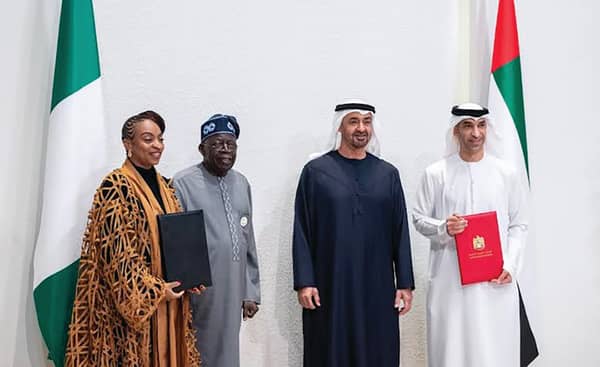
Also at the ADSW 2026, Nigeria also concluded a Comprehensive Economic Partnership Agreement (CEPA) with the UAE to deepen trade and cooperation across key sectors, including renewable energy, infrastructure, logistics and digital trade.
The agreement was signed in the presence of Tinubu; the President of the United Arab Emirates, Mohamed bin Zayed Al Nahyan; Nigeria’s Minister of Industry, Trade and Investment, Jumoke Oduwole; and the UAE Minister of Foreign Trade; and Minister in charge of Talent Attraction and Retention, Thani bin Ahmed Al Zeyoudi.
Tinubu described CEPA as a historic and strategic pact that will expand cooperation in aviation, logistics, agriculture, climate-smart infrastructure and other growth-enabling sectors, creating long-term opportunities for both countries.
He said Investopia Lagos would convene global investors, innovators, policymakers and business leaders to translate ideas into concrete investments and shared prosperity.
Addressing the summit, Tinubu stated that Nigeria aims to mobilise up to $30 billion yearly in climate and green industrial finance as it accelerates energy-transition reforms and expands nationwide electricity access.
“We are ready to work with partners across the world to ensure that the next era of development is green, inclusive, just and enduring,” he said.
Alake, at a meeting with the the Saudi Arabian Minister of Industry and Mineral Resources, Ibrahim Al-Khorayef, ahead of the Future Minerals Forum (FMF) in Riyadh, Saudi Arabia, said Nigeria’s value-addition policy was already yielding tangible results, with a gold refining plant operational in Lagos, three additional gold refineries at various stages of development, and a $600 million lithium processing plant in Nasarawa State ready for commissioning.
He commended Saudi Arabia for its pivotal role in expanding opportunities for collaboration among governments across Africa, the Middle East, Asia and Europe through the FMF, stressing that Nigeria is eager to deepen its partnership with the Kingdom by leveraging on areas of comparative advantage in solid minerals development.
In his remarks, Al-Khorayef reaffirmed Nigeria’s status as a longstanding ally of Saudi Arabia and agreed on the need for a practical and actionable agreement on solid minerals development.
He proposed to the working group to develop a draft MoU based on previous engagements for possible signing on the sidelines of the conference.