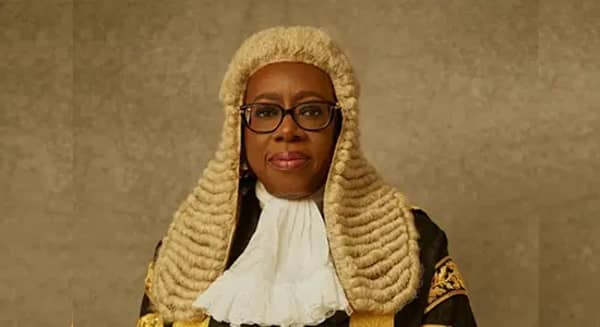
The Chief Justice of Nigeria, Justice Kudirat Kekere-Ekun, has clarified that judges are exempt from the presidential directive ordering the withdrawal of police officers assigned to Very Important Persons (VIPs), a move intended to refocus police resources on national security challenges.
The directive, issued by President Bola Ahmed Tinubu on 23 November 2025, has seen the redeployment of police officers previously assigned to ministers, VIPs, and other officials. However, the media aide to the CJN, Tobi Soniyi, emphasised that the order does not affect judicial officers.
“Judges were exempted from the directive,” he said, adding that other chief judges had yet to report any withdrawal of security personnel.
Despite the exemption, Justice Joel Agya, Chief Judge of Taraba State, stated that police orderlies assigned to judges were withdrawn on 8 December without prior notice. He described the action as a potential threat to personal security and judicial independence. “Judges handling sensitive criminal, political, terrorism and corruption cases are exposed to high risk,” he said. “Without orderlies, courtrooms can become unsafe, and proceedings may be disrupted.”
The Taraba State Commissioner of Police, Betty Isokpan, responded that court duty police officers assigned to judges’ residences or courtrooms remained in place, and that only personal escorts for VIPs had been withdrawn. “Every court is expected to have a court duty officer during proceedings. We have only withdrawn police escorts who accompany VIPs to places like Sokoto, Lagos and Kaduna,” she said.
President Tinubu, addressing the Federal Executive Council (FEC) in Abuja, reiterated that the withdrawal directive was non-negotiable. He directed ministers and senior officials to seek his approval for any police protection for official assignments and instructed the National Security Adviser, Minister of Police Affairs, and Inspector-General of Police to ensure full compliance. “If you have any problem because of the nature of your assignments, please contact the IGP and get my clearance,” he said, noting that the Nigeria Security and Civil Defence Corps (NSCDC) would provide protection where required.
The President explained that police officers are trained to protect the lives and property of citizens, particularly the most vulnerable, and that the protection of select VIPs is not their primary responsibility. He emphasised that gaps created by the redeployment would be addressed by the NSCDC and community-based security structures, including forest guards where applicable.
The directive has sparked debate among lawmakers. Clement Jimbo, a member of the House of Representatives from Akwa Ibom State, expressed concern over the exposure of politicians to potential harm. “Withdrawing security personnel from many of our colleagues—Senators, House members from the North—you are further exposing them to insecurity,” he said. Jimbo called on the President to formalise the arrangement to generate revenue, proposing recruitment of additional personnel or establishment of a private security unit. He insisted that “every Nigerian is a VIP,” and that protection should not be confined to government officials.
Senator Abdul Ningi of Bauchi Central also protested the selective application of the directive, noting that while his only police orderly had been withdrawn, other political figures and elites continued to enjoy full police protection. Deputy Senate President Barau Jibrin assured that the issue was being reviewed by the Senate Committee on Police Affairs.
Meanwhile, Nobel Laureate Wole Soyinka criticised the scale of security assigned to President Tinubu’s son, Seyi, suggesting that such deployment distorts national security priorities. He recounted observing a large armed detail in Lagos, remarking, “The security architecture of a nation suffers when we see such heavy devotion of security to one young individual.” Soyinka argued that public office should not confer undue power or privilege on family members of leaders.
The government continues to balance the redeployment of police officers with concerns over security for public officials, judicial officers, and the general populace, as debates over exemptions and selective enforcement persist.