 Follow Us on Google News


 Follow Us on Google Discover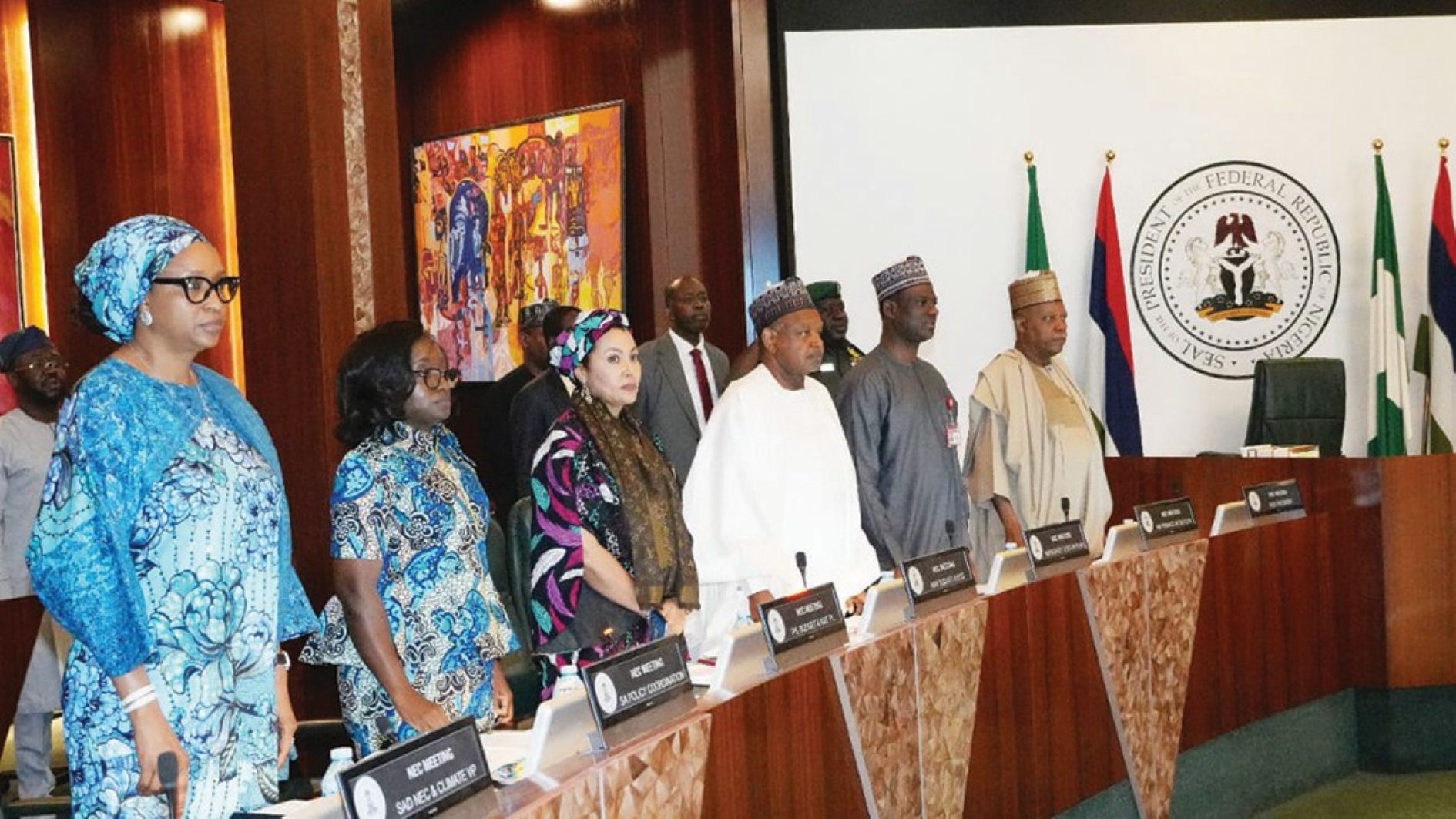
NEC sees stabilising economy, warns against policy reversal ahead of 2027
Vice President Kashim Shettima has charged the National Economic Council (NEC) to ensure that the gains recorded from the Federal Government’s economic reforms translate into jobs, stronger purchasing power, increased business confidence and improved living conditions for Nigerians.
Shettima gave the charge yesterday in Abuja while presiding over the 160th meeting of NEC, which also received an update on the rehabilitation of 13 police training institutions nationwide and endorsed the Revised National Social Protection Policy (NSPP) 2026–2030.
NEC, on its part, said the economy was stabilising, but warned the Federal Government and sub-national administrations against policy reversals as political activities ahead of the 2027 elections intensify.
The 13 police training institutions are expected to be completed within three weeks to enable the Nigeria Police Force (NPF) to resume training in them.
The development comes amid renewed efforts by the government to strengthen the capacity of security personnel through improved infrastructure, equipment and sustained training and retraining.
At the NEC meeting, Shettima said the government must remain focused on implementing policies beyond their announcement, stressing that continuity and measurable results were essential to restoring and sustaining public confidence.

“There is no doubt that a serious government is measured by the matters it refuses to abandon. While attention may reveal a problem, continuity determines whether the problem yields to policy,” he said.
VP Shettima said improvements in revenue, debt management, production and investment would have limited meaning unless they ultimately improved conditions at the household level.
“Macroeconomic progress must, therefore, continue its passage into jobs, purchasing power, business confidence and stronger subnational economies, because numbers become politically meaningful when citizens recognise themselves in their improvement,” he said.
He urged NEC to maintain follow-through on existing programmes and commitments, warning that new priorities must not be allowed to displace unfinished responsibilities.
“Continuity is a form of accountability: yesterday’s promise still deserves a place on today’s table, and no new priority absolves us of an old responsibility,” he said.
President Tinubu, he disclosed, entrusted NEC with the responsibility of making cooperation across the federation productive and ensuring that government policies translated into tangible outcomes for citizens.
“A government that remembers earns the confidence of its people because its promises do not expire when the microphones are switched off,” Shettima added.
The council also approved the Revised National Social Protection Policy (NSPP: 2026–2030), presented by the Minister of Budget and Economic Planning, Senator Abubakar Bagudu.
NEC consequently urged state governments to align their social protection policies, laws, budgets and implementation plans with the revised national framework, which is designed to strengthen the coordination, financing, implementation, monitoring and accountability of social protection programmes across the federation.
NEC said sustained reforms and fiscal discipline remained critical to translating the emerging economic gains into shared prosperity, jobs, stronger purchasing power, business confidence and improved living standards for Nigerians.
Briefing journalists after the meeting, Minister of Finance and Coordinating Minister of the Economy, Taiwo Oyedele, said the latest economic indicators pointed to significant improvement in inflation, foreign reserves, exchange-rate stability, government revenue, trade and Nigeria’s international credit standing.
Oyedele said real Gross Domestic Product (GDP) growth stood at 3.89 per cent in the first quarter of 2026, compared with 3.13 per cent in the corresponding period of 2025, while full-year growth was projected to exceed four per cent.
Headline inflation, he said, declined to 15.43 per cent at the end of July from 24.94 per cent a year earlier, while food inflation fell to 20.31 per cent from 36.2 per cent over the same period.
He said external reserves rose to $51.96 billion, representing a 38 per cent year-on-year increase and the highest level since January 2009, while the naira appreciated by 13.5 per cent year-on-year by mid-2026.
Oyedele also reported a substantial improvement in government revenue, with Federation Account net revenue increasing from N15.2 trillion in 2024 to N21.9 trillion in 2025 and projected to rise by at least 50 per cent in 2026.
Nigeria’s trade surplus, he added, almost doubled from N17.7 trillion in 2025 to N34.7 trillion in the first quarter of 2026.
While total public debt stood at N159.28 trillion, representing less than 37 per cent of GDP, debt servicing as a proportion of revenue had declined from almost 100 per cent in 2022 to below 60 per cent in 2025.
According to Oyedele, the improved economic outlook had also been reflected in international assessments, with Fitch, Moody’s and S&P upgrading Nigeria’s sovereign credit rating between April 2025 and May 2026.

