 Follow Us on Google News
 Follow Us on Google Discover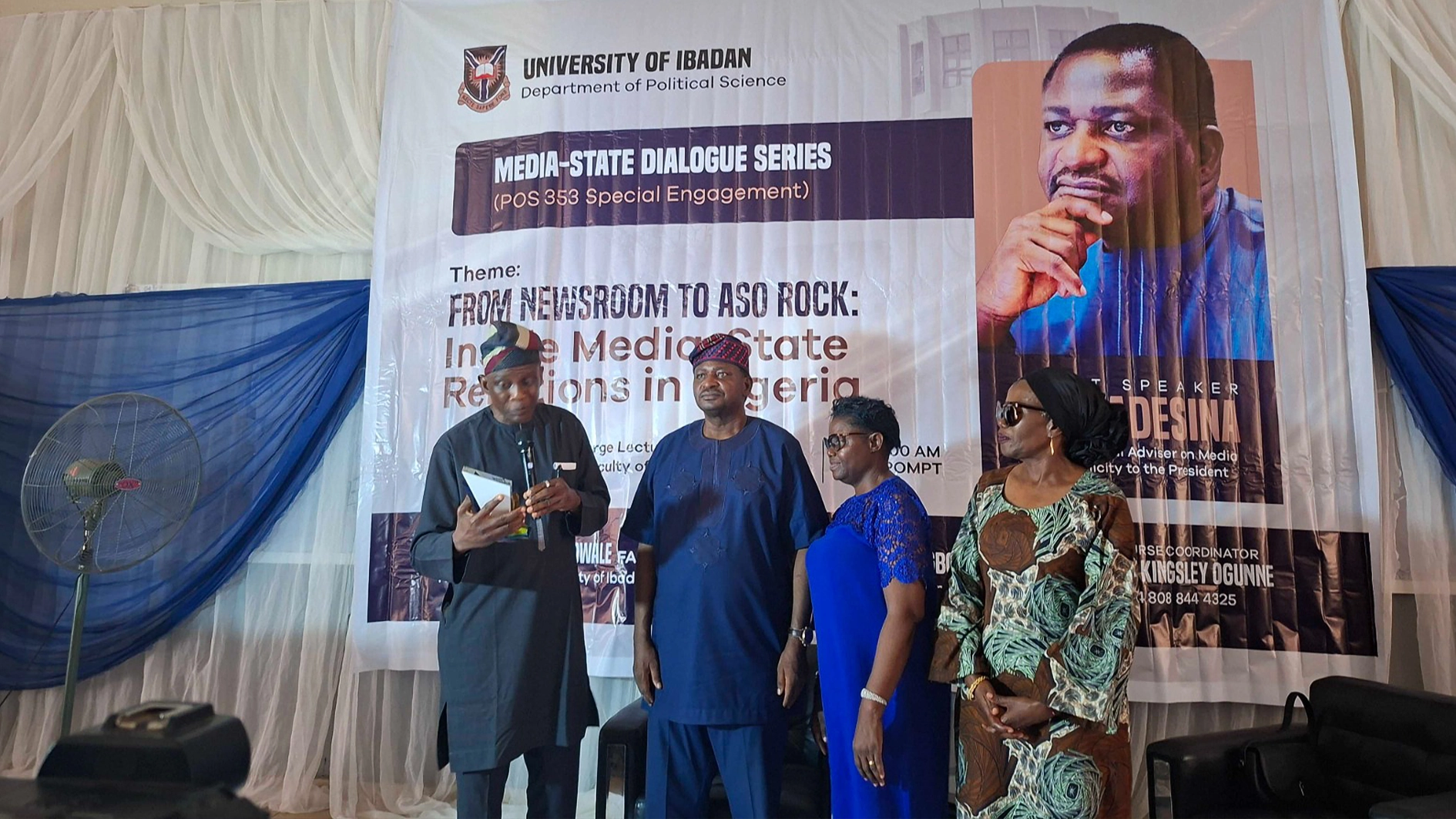
…also urged responsible communication at UI Dialogue Series
The Vice-Chancellor of the University of Ibadan, Prof. Kayode Oyebode Adebowale; Head of the Department of Political Science of the university , Prof. Dhikru Adewale Yagboyaju, and former Special Adviser to the President on Media and Publicity, Femi Adesina, on Wednesday called for ethical journalism, credibility, and responsible communication as critical pillars for sustaining democracy and strengthening governance in Nigeria.
Adebowale, Yagboyaju and Adesina made the call at the POS 353 Media-State Dialogue Series held at the Large Lecture Theatre, Faculty of the Social Sciences of the premier university.
The dialogue, themed: “From Newsroom to Aso Rock: Inside Media-State Relations in Nigeria,” brought together students, academics, media practitioners and policy communicators in an interactive academic engagement aimed at bridging theory and practice in media and governance studies.
Among them were Prof. Rashid Aderinoye, Prof. Remi Aiyede, Dr. Taiwo Adisa, Mr. Dapo Falade, Dr. Kingsley Ogunne who is the Course Coordinator, and a host of others.
The dialogue session featured robust engagement between students and speakers, with discussions focusing on statecraft, media ethics, political communication, and the evolving responsibilities of journalists in the digital age.

Declaring the dialogue open, the Vice-Chancellor, Prof. Adebowale, said the University of Ibadan remained committed to producing graduates who are not only academically sound but also capable of engaging critically with real-world governance challenges.
The VC, whose message was delivered by Prof. Yagboyaju, described the dialogue series as a “historic academic intervention” that reflects the university’s tradition of intellectual leadership and public engagement.
According to him, democracy cannot function effectively without a strong and independent media on one hand, and an accountable, responsive government on the other. He stressed that both institutions must operate within a framework of mutual respect, responsibility, and shared commitment to public good.
“A functional democracy depends on a strong media and an accountable government working within a framework of mutual respect and responsibility,” he said.
Adebowale explained that POS 353 is more than a classroom course, describing it as a “microcosm of Nigerian democracy” where students are exposed to the evolving roles of the media as watchdog, development partner, and instrument of public accountability. He noted that the media-state relationship in Nigeria has continued to evolve from the colonial period through the military era and into the current digital age, where communication has become decentralised and instantaneous.
The Vice-Chancellor said the objective of the dialogue was to expose students to the complexities of governance communication, particularly the difficult balance between transparency, national security, and public interest. He urged participants to approach media-state relations with analytical depth and intellectual maturity.
In his lecture, Femi Adesina, who was the guest speaker, urged young Nigerians to build their careers on integrity, excellence, and a strong professional reputation, noting that competence naturally attracts recognition and opportunities in any society.
The former presidential spokesperson stressed that individuals who distinguish themselves through consistent performance will not be ignored.
“Be the best in whatever you are doing. There is no way the state will ignore you. You will be recognised if you are the best,” he said.
Adesina also emphasised the importance of reputation in public life, describing it as a long-term asset that must be carefully built and protected. He urged students to ensure that their careers are anchored on honesty, discipline, and ethical conduct.
The former President of the Nigerian Guild of Editors [NGE] also urged intellectual flexibility, urging students and practitioners to remain open-minded when engaging with issues. He said informed individuals must be willing to adjust their positions when presented with better evidence or deeper understanding.
“After a better understanding of an issue, one can change his or her position to avoid being dogmatic,” he added.
Adesina stressed that intellectual humility is a critical quality for professionals in media and governance, where decisions and opinions often shape public perception and policy direction.
Earlier, the Head of the Political Science Department, Prof. Yagboyaju cautioned against the growing threat of falsehood, misinformation, and unverified content in political communication, warning that such practices pose a serious danger to public trust and democratic stability.
The HOD said credibility remains the most valuable currency in political communication and journalism, stressing that no amount of strategic communication or public relations effort can survive the damage caused by misinformation.
“A political communicator’s most valuable asset is credibility. You can package a candidate or institution brilliantly, but if your information cannot withstand scrutiny, you erode trust not only in the message but in the entire communication system,” he said.
Yagboyaju emphasised that in the digital era, where information spreads rapidly across multiple platforms, communicators must prioritise verification over speed. He warned that the pressure to break news quickly often leads to the circulation of false or misleading information, which ultimately undermines democratic accountability.
He further urged students and aspiring journalists to build careers rooted in integrity, professionalism, and respect for facts. According to him, ethical communication is not optional but essential for maintaining credibility in both media and political environments.
He also noted that the media-state relationship is inherently complex and often tense due to differing institutional mandates. However, he stressed that such tension must remain constructive rather than destructive, anchored on mutual respect for facts and the public’s right to accurate information.

