 Follow Us on Google News
 Follow Us on Google Discover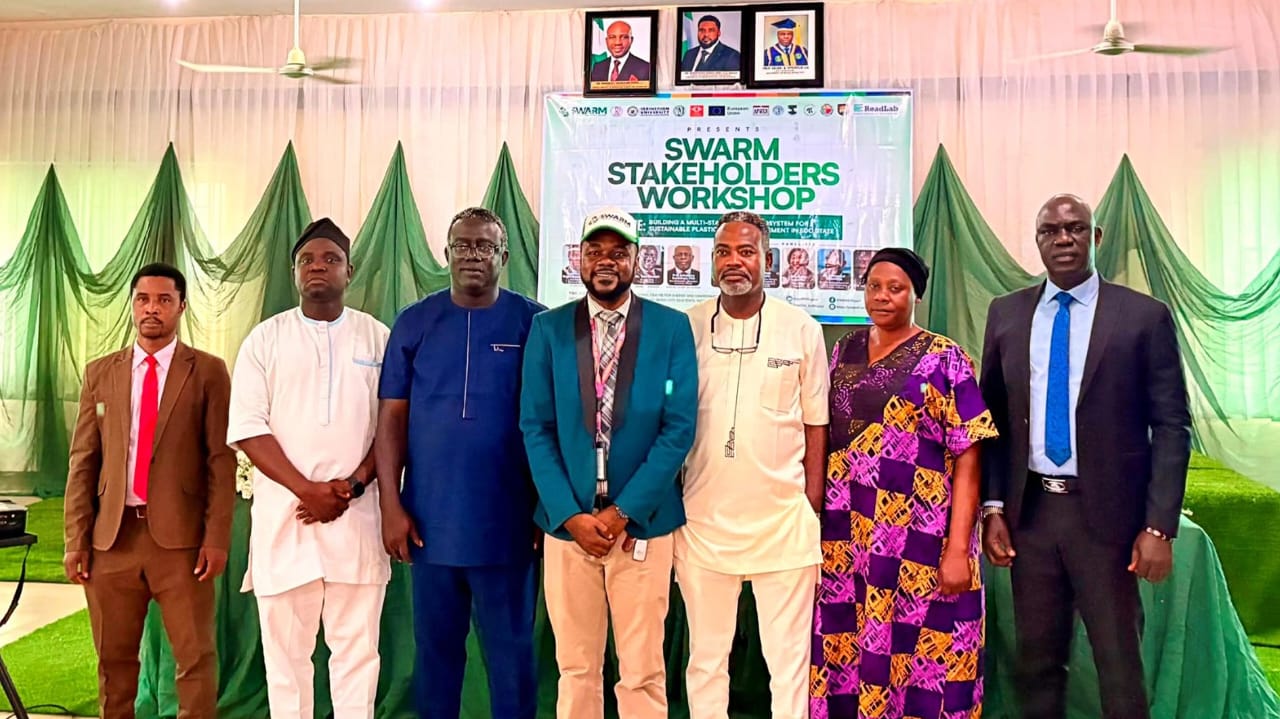
The Sustainable Plastic and Recycling Management Capacity Building Project (SWARM) on Friday disclosed that the University of Benin(UNIBEN), Igbinedion University Okada (IUO), and the University of Nigeria (UNN) are taking the lead in establishing a collaborative ecosystem for effective plastic waste management in Nigeria.
Speaking during a SWARM stakeholders workshop with the theme, ” Building a Multi-Stakeholder Ecosystem for Sustainable Plastic Waste management in Edo State “at the University of Benin Ugbowo Campus, the SWARM project lead University of Benin, Prof. Andrew Amenaghawon emphasized the urgency of addressing environmental challenges related to plastic waste, particularly in Edo State.
He pointed out that plastic waste is a critical global issue, ranking among the most significant environmental challenges faced worldwide.
Prof. Amenaghawon noted that over 400 million tons of plastic are produced globally each year, underscoring the need for sustainable management solutions.
According to him, Globally, more than 400 million tonnes of plastic are produced annually, yet only a fraction is recycled.
He added that in Africa, rapid urbanization, limited infrastructure, and inadequate public
awareness exacerbates the problem, leading to widespread mismanagement of waste and
significant environmental and health risks.
While noting that Nigeria and South Africa, two of the continent’s largest economies are among the highest generators of plastic waste, with recycling rates far below global averages, Prof. Amenaghawon said UNIBEN, UNN, and Igbinedion University Okada (IUO) are partners in the Higher Education Institutions (HEIs) and are uniquely positioned to drive change by generating knowledge, training skilled professionals, and fostering innovations that can transform waste into valuable resources.
He said that many HEIs face outdated curricula, limited research capacity, and insufficient exposure to modern waste management practices, adding that this gap hampers their ability to contribute effectively to the circular economy.
He stressed that the SWARM project directly addresses these challenges by equipping universities with modern tools, building academic and professional capacity, and fostering collaboration between Africa and Europe by creating a unified approach to sustainable plastic waste management.
Prof. Amenaghawon encouraged youths and students’ participation in sustainability, recycling innovation, and environmental leadership, noting that SWARM not only strengthens institutions but also empowers communities to protect the environment, boost green innovation, and enhance economic opportunities.
The don said the workshop organized under the sustainable Plastic and Recycling Management Capacity Building Project (SWARM), an Erasmus+ Capacity Building in Higher Education Project is focused on strengthening education, institutional capacity, stakeholder engagement and practical action in sustainable Plastic waste and recycling management.
Prof. Amenaghawon noted that the workshop aims to create a platform for dialogue among academia, government, industry, civil society, students, schools, and community actors.
He added that introducing the SWARM project is crucial to achieving its relevance for sustainable plastic waste management in Nigeria.
While noting that the SWARM project will identify key gaps and opportunities in plastic waste management, Prof. Amenaghawon highlighted that the SWARM project workshop, among others, would promote practical collaboration among stakeholders in Edo State.

