 Follow Us on Google News
 Follow Us on Google Discover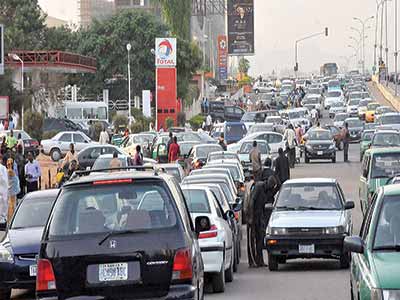
PPPRA explains import allocation to private sellers
Long queues at a filling station.[/caption]THE reason petrol is sold higher than the official price of N86.5 in most parts of the country is because of the uncertainty the adoption of price modulation mechanism has created.
The Guardian gathered in Abuja yesterday that marketers believe that the price of the product is likely to rise above the current price in April, hence they hoard the product to be sold at higher prices within the next few months.
The price modulation, as explained by the Minister of State for Petroleum Resources, Dr. Ibe Kachiwku, entails quarterly review of the price of the product which would be influenced by the prevailing price of gasoline in the international market. But the template of the Petroleum Products Pricing Regulatory Agency (PPPRA) is not expected to be tampered with within the next few months.
A source said: “There is so much anxiety within the system as there is nothing in place to ensure there is price stability. The adoption of the price modulation has created nothing but instability. Marketers do not know what the price would be in the international market at the end of March, and that is why there is so much stockpiling presently by marketers.
This is not a secret because most of the sharp practices in product supply are perpetrated by those in the supply chain. The hoarding will continue until there is stability. The sad aspect of the price modulation is that nobody can predict what will happen in the next few weeks, even though the price of crude oil keeps sliding down.
The real determinant of the price of petrol is the price of gasoline, and since that itself is volatile, the price of petrol will also be volatile.”
Indeed, apart from Lagos and Abuja, most filling stations in the country sell petrol between N90 and N140 per litre. The Department of Petroleum Resources (DPR) has also shown inadequacy in dealing with marketers selling above the official price of N86.5 per litre.
Meanwhile, the Executive Secretary of PPPRA, Farouk Ahmed, has thrown more light on why the agency allocated 78 percent of the total volume of 3.1 million metric tons of petrol import allocation for the first quarter of 2016 to the Nigerian National Petroleum Corporation (NNPC).
Speaking in Abuja at the weekend, Ahmed noted that the decision was chiefly influenced by the inability of some oil marketers to meet previous import allocation quota, due to difficulty in accessing foreign exchange.

