 Follow Us on Google News
 Follow Us on Google Discover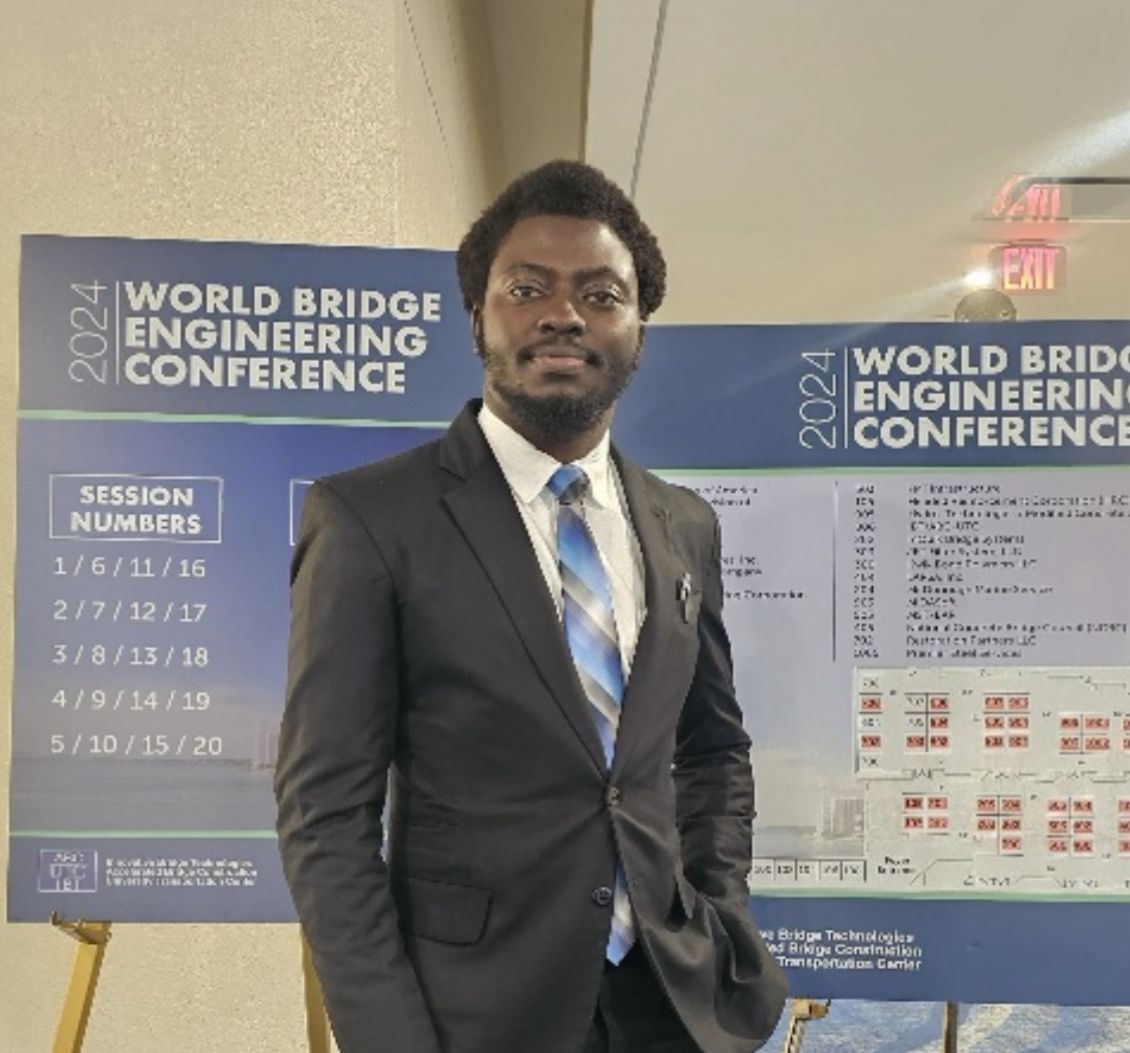
An expert in civil engineering and non-destructive testing, Charles Lawal has called for the urgent adoption of Infrared Thermography (IRT) in Nigeria’s construction sector, emphasising its potential to revolutionise structural inspection and prevent building collapses. Lawal made this statement while presenting his research, Infrared Thermography Assessment for Monitoring Ageing MSE Walls, at the World Bridge Engineering Conference in Miami, Florida.
Lawal, who holds multiple degrees in building engineering from Nigeria, a master’s in Geosciences from the United States, and is currently pursuing a master’s in Civil and Environmental Engineering at Georgia Southern University, led a funded research project by the Georgia Department of Transportation (GDOT). The study focused on IRT-based inspection of Mechanically Stabilised Earth (MSE) retaining walls. His work involved field investigations of ageing infrastructure across Southeast Georgia, including the Crossgate and Old River Road bridges, which support major highways in the region. Using advanced thermal imaging technology and standardised inspection protocols, Lawal demonstrated how IRT can detect hidden defects such as voids, cracks, and delamination without damaging the structure.
“The tragedy of building collapses in Nigeria is not just a failure of concrete and steel — it is a failure of foresight,” Lawal said. “Infrared Thermography gives us the ability to see what traditional methods miss. It is a non-invasive, cost-effective, and scalable solution that can save lives.”
Relating the findings of his research to Nigeria’s long-standing challenges with building collapses, Lawal highlighted alarming statistics: over 640 reported building collapses since 1974, with more than half occurring in Lagos. Globally, more than 30,000 structural failures are reported each year, and over 50 percent of urban buildings in developing countries lack formal inspection protocols. He argued that IRT offers a proactive diagnostic approach capable of identifying early warning signs before they escalate into disasters. “We can no longer afford reactive inspections. IRT allows us to visualise subsurface vulnerabilities and intervene before it is too late,” he explained.
Beyond its technical innovation, Lawal emphasised the socio-economic impact of IRT. In a country where inspection budgets are tight and public trust in construction safety is low, IRT, through the method he has developed, offers a way to restore confidence. “Thermal scans can be conducted quickly and affordably across multiple structures. This means more frequent inspections, better data, and fewer surprises,” he said.
Despite its promise, Lawal warned that Nigeria’s construction industry must overcome institutional inertia and regulatory gaps to fully embrace IRT. He called on engineers, architects, regulators, and academic institutions to integrate IRT into standard practice. “The tools exist. The knowledge is available. What we need now is the will to act,” he urged.
Addressing the broader implications, Lawal stressed that every building collapse in Nigeria is a human catastrophe. “We must stop treating these tragedies as isolated events. They are systemic failures that demand systemic solutions. Infrared Thermography is one such solution — scientifically sound, practically proven, and morally imperative,” he concluded.
As Nigeria’s construction industry continues to grow, Lawal’s message is clear: progress must be matched with safety. The future of infrastructure depends not just on what we build, but on how we inspect, maintain, and protect it.

