 Follow Us on Google News


 Follow Us on Google Discover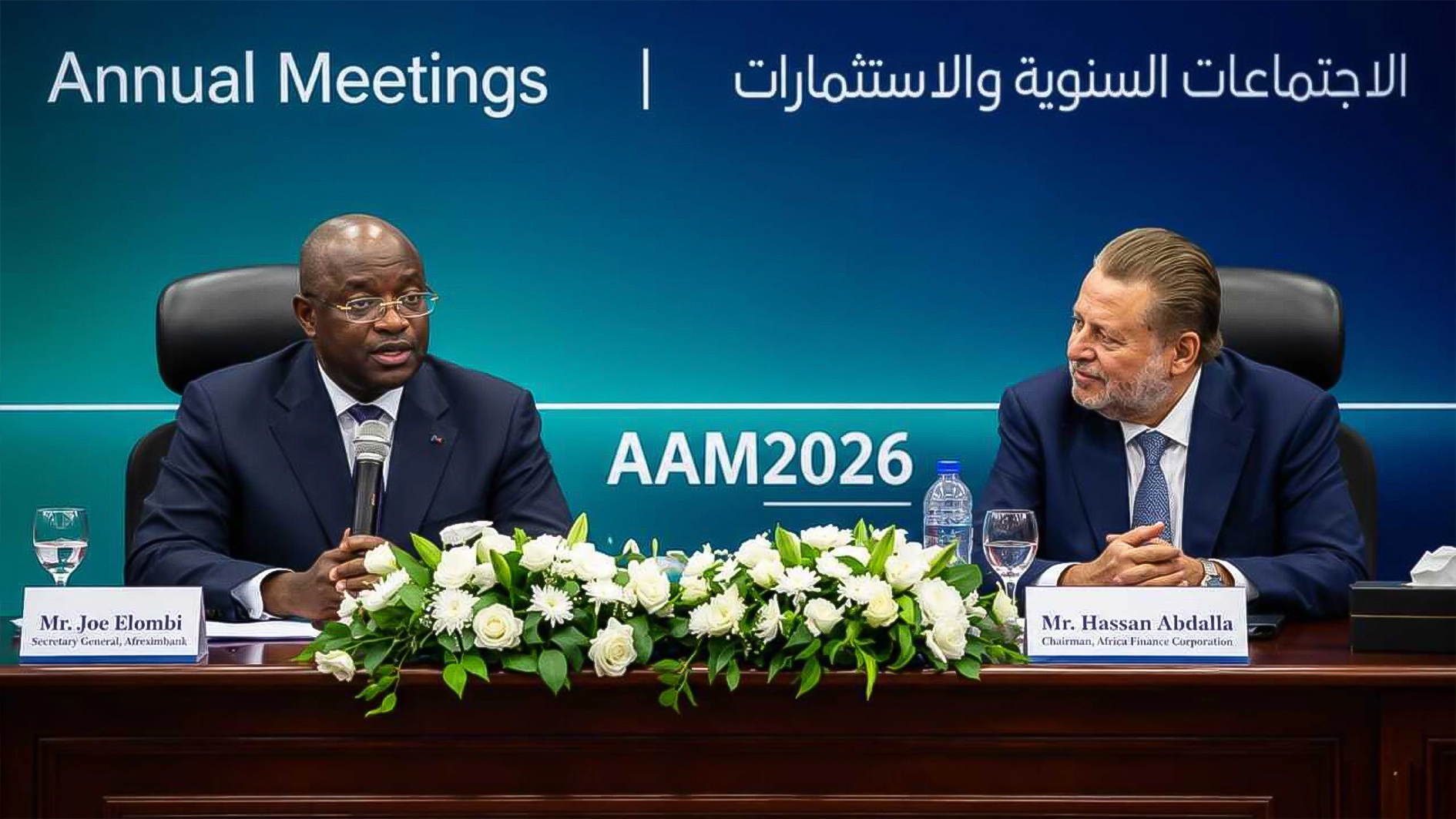
…expands Central Bank alliances to shield African economies from global shocks
As rising geopolitical tensions continue to pressure African economies, Egypt and African Export-Import Bank (Afreximbank) are positioning the 33rd Afreximbank Annual Meetings as a critical platform for reshaping Africa’s economic future through industrialisation and stronger regional trade alliances.
The four-day meetings, scheduled to hold in Egypt from June 21 to 24, are expected to draw more than 4,000 delegates, including presidents, policymakers, central bank governors, development financiers, investors and business leaders, amid growing calls for African countries to rely more on intra-continental trade and local value addition to shield their economies from external shocks.
Speaking at a media briefing ahead of the 2026 Annual Meetings of African Export-Import Bank, President and Chairman of the Board of Directors of Afreximbank, Dr George Elombi said the continent could no longer depend heavily on external markets and raw commodity exports if it hoped to achieve sustainable economic growth and sovereignty.
According to him, Africa’s next growth phase must be anchored on stronger trade relationships among African countries, expansion of industrial processing capacity and deeper economic integration.
“The message is simple: Africa’s next phase of growth must be driven by intra-African trade, by industrial processing and by greater economic integration amongst our countries,” Elombi said.
He noted that Africa had already laid important institutional foundations for integration through initiatives such as the African Continental Free Trade Area and the Pan-African Payment and Settlement System, adding that the challenge now was to translate those frameworks into tangible economic gains.
In addition, Elombi disclosed that Afreximbank is intensifying its collaboration with African central banks as part of a broader strategy to strengthen trade financing, industrialisation and financial system resilience across the continent amid growing global economic uncertainty.
He said partnerships with central banks have become a major pillar of the institution’s expansion drive and development agenda as African economies grapple with external shocks, tighter global financial conditions and weakening access to international capital.
According to him, many African governments joined the bank through their respective central banks, while governors of the monetary authorities have continued to play strategic roles within the institution’s governance structure to ensure that the bank remains aligned with Africa’s economic transformation objectives.
He said the lender is now broadening the partnership framework beyond national monetary authorities to include regional central banking institutions in order to deepen liquidity support and strengthen banking systems across multiple African economies.
As part of the regional push, Elombi disclosed that the bank already has a $5 billion programme with the Central Bank of West African States designed to support commercial banks within the sub-region and improve access to trade and development financing.
He added that the bank is also strengthening cooperation with the Bank of Central African States as it seeks to build stronger regional financial institutions capable of supporting intra-African trade and economic integration.
Elombi said Afreximbank was also driving initiatives aimed at easing cross-border trade barriers, including the Collaborative Transit Guarantee Scheme designed to reduce customs bottlenecks and improve movement of goods across African borders.
He explained that discussions at the annual meetings would centre on how African countries can redirect trade patterns towards the continent, strengthen industrial capacity and unlock investments in sectors capable of driving long-term growth.
“The key discussion would be around how Africa readjusts its own trade direction and its own trade patterns,” Elombi said. “When the world closes itself to us, we cannot close ourselves off from one another.”

He stressed that expanding intra-African trade would require major investments in logistics, transportation and energy infrastructure to support manufacturing and regional supply chains.
Elombi also pointed to opportunities in mineral processing, noting that despite Africa’s vast mineral wealth, much of the continent still lacks sufficient processing capacity outside countries such as South Africa and Morocco.
“The money is available, what we need is the expertise and the determination of governments to direct in what areas to put the investment.”
He disclosed that Afreximbank remained financially resilient despite global economic headwinds, with total assets rising to $49.4 billion and shareholders’ funds reaching about $8.6 billion.
According to him, the bank maintained a capital adequacy ratio of 23 per cent and a non-performing loans ratio of 2.4 per cent.
“So we have a strong bank,” Elombi said. “Investor confidence has remained very strong in Afreximbank and we believe that will be the case even in this difficult year of 2026.”
Governor of the Central Bank of Egypt, Hassan Abdalla, described Egypt’s partnership with Afreximbank as strategic and fundamental to advancing the continent’s economic transformation agenda.
He said Afreximbank had emerged as one of Africa’s most influential financial institutions, playing a major role in promoting trade, industrialisation and regional cooperation across the continent.
“Over the years, Afreximbank has established itself as one of the continent’s most impactful financial institutions and a key driver for Africa’s transformation,” Abdalla said.
According to him, African economies are increasingly shifting towards diversification and resilience as governments seek to unlock greater value from natural resources and strengthen productive sectors.
Abdalla added that the annual meetings would provide an important platform for dialogue on trade finance, regional integration and reforms to the global financial architecture to better reflect the interests of developing economies.
He said preparations for the meetings were progressing rapidly through coordination between the Central Bank of Egypt, Afreximbank and other national authorities, with extensive work ongoing on logistics, security, technical and protocol arrangements.
“We do not view the Afreximbank annual meetings as merely a conference,” Abdalla said. “We consider it a strategic milestone in our collective journey towards building a more integrated, industrialised, resilient and economically sovereign African continent.”

