Rising jihadist violence, fragile civilian governments, worsening economic pressures and shifting global alliances are emerging as the major drivers behind the renewed wave of coup attempts and military takeovers across West Africa, according to diplomacy and security officials.
The warning comes as the United States described the region’s security situation as a “very high concern”, following fresh reports of an attempted coup in Benin, long regarded as one of the more politically stable countries in the sub-region.
Speaking in Abidjan on Sunday ahead of the inauguration of President Alassane Ouattara of Ivory Coast, US Under Secretary of State for Economic Growth, Energy and the Environment, Jacob Helberg, said Washington was deeply worried about the deteriorating security environment but was increasingly focused on economic stability through trade and private investment.
“The security needs of the region are obviously a very high concern for the administration,” Helberg said. “If Americans are expected to take risks to deploy investment, that investment has to be reliably secure.”
He declined to comment directly on developments in Benin, citing the fluid nature of the situation.
Spreading jihadist violence fuels instability
At the core of West Africa’s political turbulence is the relentless spread of jihadist insurgencies, particularly in the Sahel. Armed groups linked to al-Qaeda and the Islamic State continue to expand their reach, overwhelming national armies and exposing the weakness of state institutions.
Data from conflict-monitoring organisation ACLED analysed by journalists show that jihadist attacks surged from about 1,900 incidents in 2019 to over 5,500 in 2024.
By October 10, 2025, more than 3,800 attacks had already been recorded this year alone. The violence now spans an area far larger than before and has claimed nearly 77,000 lives in six years.
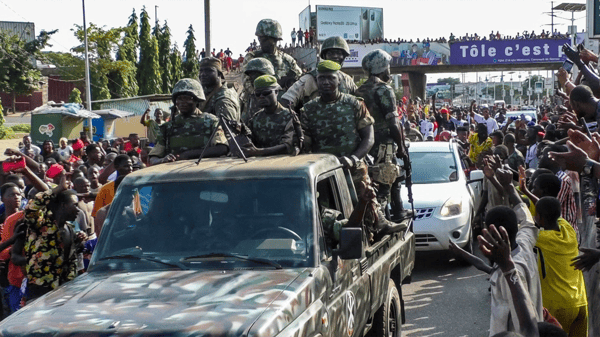
In Mali, Burkina Faso and Niger, soldiers seized power between 2020 and 2023, blaming civilian leaders for failing to protect citizens.
Many communities initially welcomed the coups in the hope that the military would restore security. However, attacks have continued, and in some areas intensified, eroding public trust in both civilian and military authorities.
Economic hardship and public frustration
Beyond insecurity, deepening economic hardship has become a powerful trigger for unrest. Rising food prices, unemployment, poverty and failing public services continue to strain households across the region. Young people, who form the majority of the population, face limited opportunities and growing frustration with political leadership.
These pressures have weakened the legitimacy of elected governments, making them vulnerable to military intervention. In several countries, protests against corruption, poor governance and economic mismanagement have preceded coup attempts.
Shifting alliances and weakened external support
The geopolitical landscape has also changed significantly. The juntas in Mali, Burkina Faso and Niger have broken security ties with France and other Western partners, while strengthening cooperation with Russia. This shift has altered the balance of foreign influence in the region.
Under former US president Joe Biden, Washington suspended large portions of development aid after the coups, adding to fiscal pressure in already fragile economies. Helberg said diplomatic talks with the three junta-led countries were ongoing but stressed that outcomes remained uncertain.
Despite political instability, the US is now placing renewed emphasis on trade and private-sector investment as tools for long-term stability. In recent weeks, senior US officials have visited Mali, Burkina Faso and Niger to promote American business engagement.
Regional response under strain
West Africa’s main political bloc, the Economic Community of West African States (ECOWAS), has struggled to contain the coup wave. Sanctions imposed on junta-led states have delivered limited results and, in some cases, hardened military rulers’ defiance.
As instability begins to creep southward from the Sahel towards coastal states such as Benin, Togo and Ivory Coast, security experts warn the region is entering a dangerous phase.
Without meaningful reforms in governance, stronger institutions, economic inclusion and improved counter-insurgency capacity, the conditions that encourage military takeovers are likely to persist.