 Follow Us on Google News


 Follow Us on Google Discover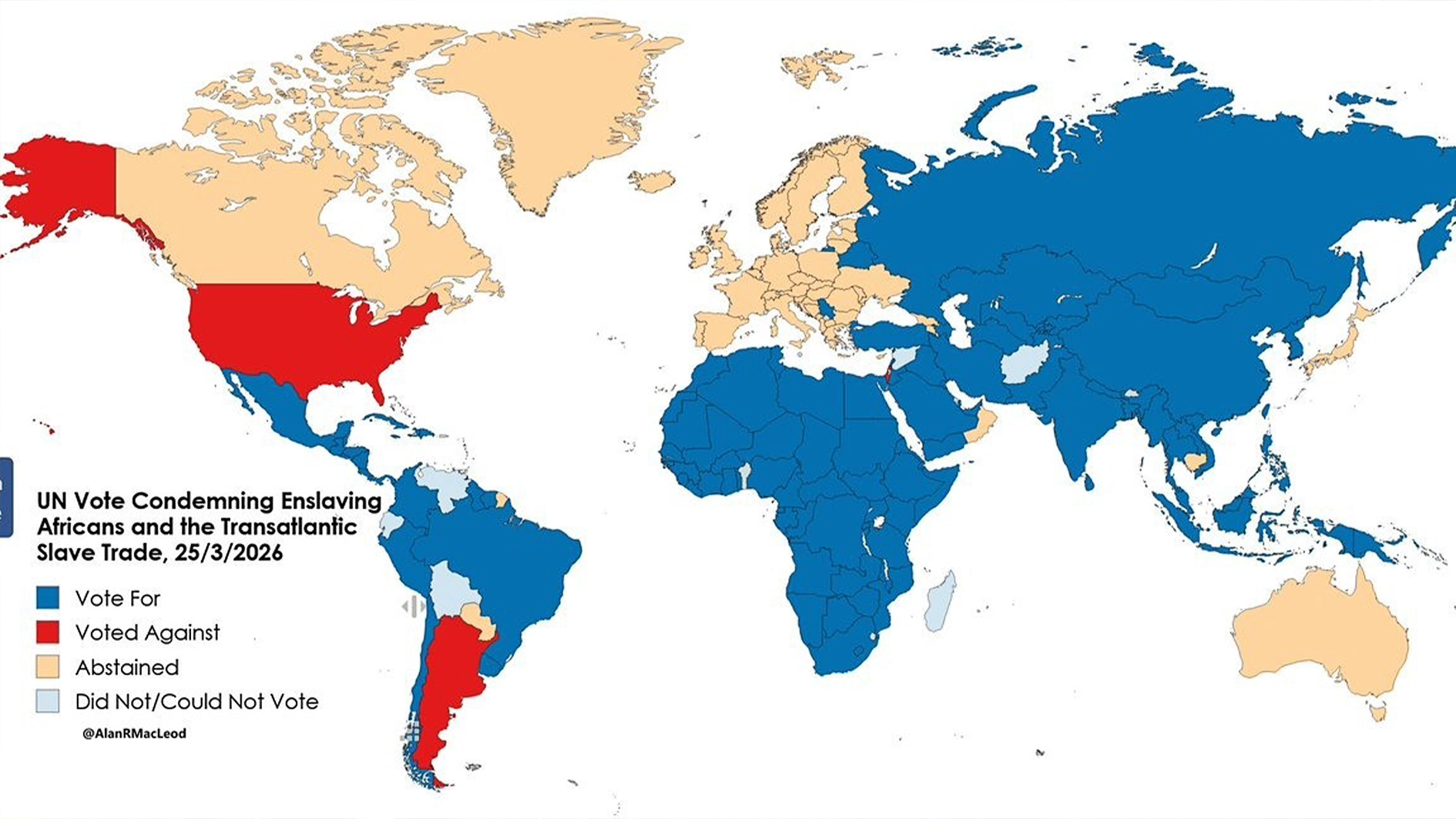
The United Nations General Assembly has formally recognised the transatlantic trafficking of enslaved Africans as “the gravest crime against humanity,” while calling for reparations and the return of cultural artefacts to affected nations.
The resolution, adopted on Wednesday, also urges the “prompt and unhindered restitution” of cultural property—including artworks, monuments, and national archives—to their countries of origin without charge.
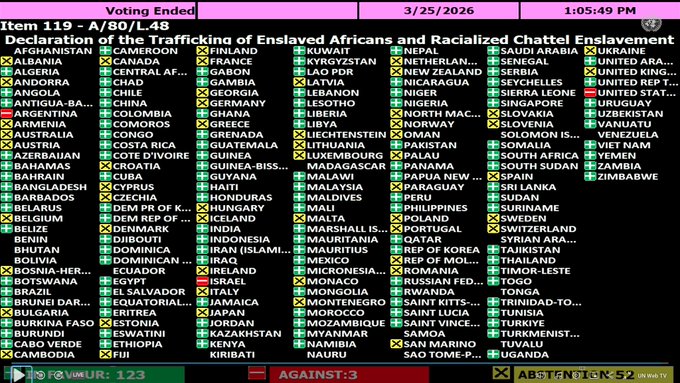
The measure passed with 123 votes in favour, three against, and 52 abstentions among the 193 member states. Argentina, Israel, and the United States voted against the resolution, while the United Kingdom and several European Union countries abstained.
Although General Assembly resolutions are not legally binding, they carry significant moral and political weight as reflections of global opinion.
The resolution calls on member states to engage in dialogue on reparatory justice, including formal apologies, restitution, compensation, rehabilitation, and guarantees of non-repetition. It also urges reforms in laws, policies, and institutions to address racism and systemic discrimination.
 In addition, it encourages voluntary contributions to support education on the transatlantic slave trade and calls for collaboration among the African Union, the Caribbean Community (CARICOM), the Organization of American States, and UN bodies on reconciliation efforts.

Ghana’s President, John Dramani Mahama, a key advocate of the resolution, described its adoption as a historic step toward justice and remembrance.
“Today, we come together in solemn solidarity to affirm truth and pursue a path to healing and reparative justice,” he said ahead of the vote.
“The adoption of this resolution serves as a safeguard against forgetting. Let it be recorded that when history beckoned, we did what was right for the memory of the millions who suffered the indignity of slavery,” he added.
Speaking on behalf of several Western countries, the United Kingdom’s acting UN Ambassador, James Kariuki, acknowledged the enduring impact of slavery and its legacy.
He said the history of slavery and its consequences must never be forgotten, noting that Western nations remain committed to addressing present-day issues such as racism, xenophobia, and intolerance.
Kariuki also stressed the need to tackle modern forms of slavery, including human trafficking, forced labour, sexual exploitation, and forced criminality.
Ongoing Debate Over Reparations
In the United States, calls for reparations gained renewed momentum following the 2020 killing of George Floyd. However, the issue remains politically contentious, amid broader debates over race, history, and inequality.
The resolution unequivocally condemns slavery, the transatlantic slave trade, and racialised chattel enslavement as among the most inhumane and enduring injustices in human history. It underscores the need to address these historical wrongs in ways that promote justice, dignity, human rights, and healing.

