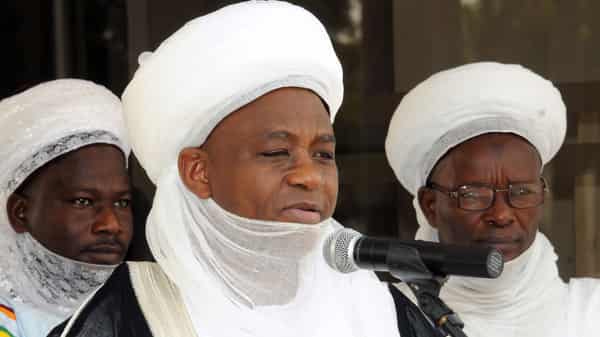
The Sultan of Sokoto, Alh. Muhammadu Sa’ad Abubakar has said that it is totally wrong for Christians to be dragged or subjected to sharia law or court.
Abubakar issued this statement on Wednesday at the opening of the 2025 triennial meeting of the Nigeria Inter-Religious Council (NIREC) in Abuja, with the theme, “Collaboration of Inter-Religious Council with Government to Promote Peace in Nigeria”.
The Sultan said that the sharia law will never be implemented for any non-Muslim, advising that Christians should not be made to dress or pray like Muslims.
While emphasizing that the Sharia is purely 100 per cent for Muslims, Abubakar explained that Nigeria is more of a multi-religious country than a secular state.
He added that the government has not adopted any of Islam or Christianity as state religion but supports the development of the two major religions in the country.
The Sultan who spoke against recent calls for abolition of Sharia law, said that Nigeria allowed the practice of all religions without undue external interference.
Also speaking at the event, the Speaker of the House of Representatives, Rep. Abbas Tajudeen called for deeper collaboration between NIREC and the Federal Government.
He said this will strengthen peace-building efforts and counter rising insecurity across the country.
Tajudeen noted that the gathering was significant, coming at a time when violent extremists were threatening national unity and exploiting religious sentiments to sow discord.
The speaker commended NIREC for its longstanding interventions in promoting harmony, noting that the meeting demonstrates the national resolve to live together in religious harmony.
“It signifies the need for more synergy between the council and the government, and for concerted efforts in promoting peaceful coexistence between people of diverse ethnic and religious backgrounds.
“I look forward to the actionable plans that the council will propose at this meeting, and promise legislative support for their implementation.
“We must challenge stereotypes and show that the negative narrative on inter-religious relations in our country, especially the story of genocide against members of a particular religion, is false and misleading,” he said.
The Secretary to the Government of the Federation, Sen. George Akume said that the country was facing numerous challenges, including internal security issues, heightened political rhetoric and degraded mutual trust.
He said that Nigeria also came under international pressure for the wrong reasons, orchestrated by mis-characterisation of the security situation.
The SGF assured all Nigerians that the Federal Government would not hrelent in ensuring the welfare and security of citizens as enshrined in the constitution .
He called on leaders of faith, traditional rulers, and voices of reason to come together to promote peace through collaboration.
“We have survived past crises, including a grueling civil war and emerged with a renewed commitment to unity in diversity.
“Our independence and sovereignty are non-negotiable, and we can not allow terror or division to sink the ship of state.
“It is precisely at times like this that NIREC, and indeed, all well-meaning Nigerians must come together to promote peace through collaboration,” he said.
The President, Christian Association of Nigeria (CAN), Archbishop Daniel Okoh, called for increased collaboration between faith-based organisations and the government to address the growing insecurity in the country.
Okoh said that Nigeria was facing a critical moment in its national history, with insecurity threatening collective survival and national cohesion.
He said that faith institutions remained among the most trusted and far-reaching structures in Nigeria, with immense potential for strengthening security and sustaining peace.
The CAN President called for closer collaboration between government and faith-based organisations, including NIREC, to promote dialogue, mobilise communities, and nurture social harmony.
Earlier, the Executive Secretary of NIREC, Rev. Fr. Cornelius Omonokhua, emphasised the importance of collaboration between religious leaders and government to defeat terrorism and banditry.
According to him, every human life is precious to God, and it is imperative for all stakeholders to work together to protect and secure citizens.
Omonokhua prayed for God’s guidance and wisdom for leaders to be able to protect citizens, and for repentant hearts for criminals to be transformed into law-abiding citizens.
He also prayed for a change of attitude among Nigerians and the entire human race, from negative to positive values and mental re-engineering.