 Follow Us on Google News


 Follow Us on Google Discover
Welcome, and thank you for being here. This is one of those questions I have genuinely looked forward to writing about, because it sits at the very heart of how Nigerians think about money, success, and security. After months of research into Nigeria’s income distribution data and years of covering economic stories for this publication, I can tell you that the answer is far more interesting, and far more nuanced, than a single naira figure.
So, how much to be considered rich in Nigeria? It depends heavily on where you live, who you are comparing yourself to, and what “rich” actually means in the Nigerian context. But let us get into the details, because this topic deserves proper treatment.
Wealth is one of those concepts that economists and ordinary people define quite differently, and nowhere is that gap wider than in Nigeria.
How Many Naira Is Considered Rich in Nigeria?
Let us start where most conversations about this topic start: with raw numbers.
In urban centres like Lagos and Abuja, the general consensus among economists, financial planners, and the Nigerians I have spoken with over the years is that earning above ₦1 million per month begins to place you in genuinely wealthy territory. That figure is roughly equivalent to about $650 to $700 at today’s exchange rates, which sounds modest by global standards. In Nigeria, however, that monthly income sits so far above the statistical average that it represents a different way of life entirely.
To put it bluntly: Nigeria’s current national minimum wage is ₦70,000 per month, signed into law in July 2024. According to the National Bureau of Statistics, the average monthly income for workers in the formal sector hovers between ₦80,000 and ₦120,000 when you account for the full labour force. So ₦1 million monthly is already more than eight times that average.

Here is how I would broadly categorise the naira income bands that define economic class in Nigeria today:
Lower income: Below ₦70,000 monthly. This is survival-mode territory in most cities, and even in rural areas it leaves very little room for anything beyond basic necessities.
Lower middle class: ₦70,000 to ₦150,000 monthly. This covers the national minimum wage through to a modest formal salary. Life is manageable, but fragile.
Middle class: ₦150,000 to ₦700,000 monthly. This is a wide band, and experience within it varies enormously. The lower end means careful budgeting and constant trade-offs; the upper end offers real comfort and the ability to save meaningfully.
Upper middle class: ₦700,000 to ₦2 million monthly. Here is where genuine financial security begins. You can afford private healthcare, school fees at a decent institution, reliable transport, and you are building actual savings rather than just surviving month to month.
Rich: ₦2 million to ₦5 million monthly. This bracket represents wealth by almost any Nigerian standard. You are in the top 2% to 3% of earners nationally, and your lifestyle reflects it.
Very wealthy: Above ₦5 million monthly, and especially above ₦10 million monthly. At these levels, we are talking about executives, senior civil servants, successful business owners, and a handful of others. Generational wealth-building becomes genuinely possible here.
I have had this conversation with market traders in Onitsha, civil servants in Abuja, and tech entrepreneurs in Lagos. They all have slightly different answers. A man running a spare parts business in Aba once told me, “If I can pay school fees without borrowing and still have something left over at the end of the month, I consider myself rich.” That definition is more useful than any income bracket, honestly.
That said, numbers matter. The Nigeria Revenue Service (formerly FIRS) collects income tax from formal sector employees, and their data consistently shows that the overwhelming majority of registered taxpayers earn below ₦500,000 monthly. The ₦1 million threshold, therefore, is not an arbitrary line.
What Percentage of Nigerians Earn Above ₦200,000 Monthly?
This secondary question is worth taking seriously, because ₦200,000 per month feels like a significant milestone to many Nigerians. And statistically, it absolutely is.
Based on labour force survey data and income distribution figures, somewhere between 25% and 30% of formal sector employees earn above ₦200,000 monthly. That sounds relatively high until you factor in something crucial: formal sector employment accounts for only about 20% of Nigeria’s total workforce. The National Population Commission estimates Nigeria’s working-age population at over 80 million. If formal employment covers roughly 20 million of those, then 25% to 30% earning above ₦200,000 translates to approximately 5 to 6 million people out of the entire working population.
That is a small fraction of 220 million Nigerians.
The Guardian Nigeria has written compellingly about this issue. In a piece examining the widening poverty gap, the data is stark: four out of ten Nigerians live on less than $1.90 per day. ₦200,000 monthly, by comparison, is roughly $130 at current rates. The distance between these two realities is vast.
What does ₦200,000 per month actually feel like in practice? In Lagos, it covers a modest flat in a decent neighbourhood (perhaps ₦80,000 to ₦100,000 annually prorated monthly), transport costs, food for a single person, and not much else. In Kaduna or Enugu, it provides a noticeably more comfortable existence. Context, as always, is everything in Nigeria.
Income Distribution Across Nigerian Employment Groups
The table below summarises approximate monthly income ranges across key employment categories in Nigeria, based on 2024 and 2025 data from sector-level salary surveys, the NBS Labour Force reports, and industry compensation studies. The data highlights an uncomfortable truth: the vast majority of Nigerian workers earn in income bands that would not be considered “comfortable” by urban standards, let alone wealthy.
| Employment Category | Estimated Monthly Income Range | Approximate Share of Workforce |
|---|---|---|
| Subsistence farmers and rural informal workers | ₦15,000 to ₦45,000 | 30% to 35% |
| Urban informal workers (traders, artisans, hawkers) | ₦40,000 to ₦120,000 | 35% to 40% |
| Entry-level formal sector workers | ₦70,000 to ₦200,000 | 8% to 12% |
| Mid-level formal sector professionals | ₦200,000 to ₦700,000 | 5% to 8% |
| Senior professionals and executives | ₦700,000 to ₦3,000,000 | 1% to 3% |
| High-net-worth individuals and business owners | ₦3,000,000 and above | Under 1% |
The table tells a sobering story. Over 70% of Nigeria’s working population earns below ₦120,000 monthly, an income that would not sustain a basic urban lifestyle without the extraordinary juggling act that most Nigerians perform daily: multiple income streams, extended family networks, and relentless resourcefulness.
The Observer Nigeria’s analysis of wealth redistribution framed this clearly: Nigeria’s inequality is not just wide, it is structurally entrenched, and without deliberate policy intervention it tends to reproduce itself across generations.
Are 70% of Nigerians Under 30 Years Old?
This is a question that circulates widely, and I want to address it carefully because the numbers are sometimes misquoted.
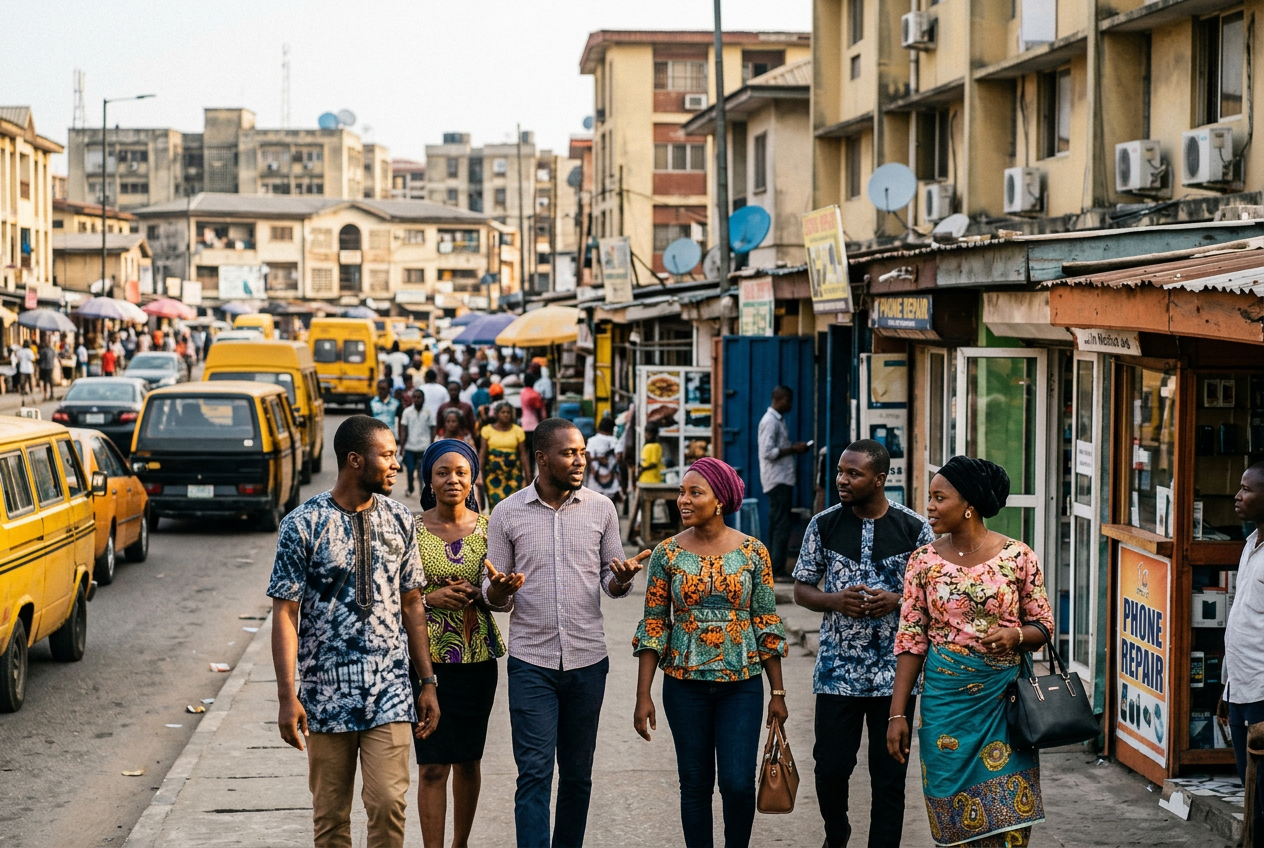
The figure of 70% under 30 is an approximation rather than a precise statistic. What the demographic data actually shows is that Nigeria has a remarkably young population. The National Population Commission and United Nations Population Fund consistently report that the median age in Nigeria is approximately 18 to 19 years, meaning half the population is younger than that. More specifically, estimates suggest that roughly 60% to 63% of Nigerians are under the age of 25, while approximately 70% to 75% are under the age of 30.
So the figure is in the right ballpark, even if it varies slightly depending on the source and the year.
Why does this matter for a conversation about wealth? Because it profoundly shapes what being rich in Nigeria means right now, and what it will mean over the next generation. A country where the majority of people are young and economically active (or soon to be) creates particular dynamics around income aspiration, financial expectations, and wealth perception.
I have watched this play out in real time. A 24-year-old Lagos tech worker earning ₦800,000 monthly from a remote role for a foreign company considers themselves moderately comfortable but not particularly wealthy. Meanwhile, their 55-year-old uncle who earns ₦400,000 from a senior civil service position considers himself solidly well-off. Same country, completely different financial realities and expectations. The youngest generation of Nigerian earners are the first to genuinely benchmark Nigerian salaries against global digital income standards, and that changes everything.
How Much to Be Considered Rich in Nigeria? The Direct Answer
Right. Let us address the primary question head-on, plainly and clearly.
Based on income distribution data, comparative analysis, and the lived experience of Nigerians across different regions and sectors, here is what the evidence suggests:
To be considered rich in Nigeria in 2025 and 2026, you generally need to be earning or possessing the following:
- Monthly income of ₦2 million or more from employment, business, or investments
- Net worth exceeding ₦500 million (approximately $325,000 at current exchange rates), encompassing property, financial assets, and business equity
- Passive income streams producing at least ₦500,000 per month independently of your main employment
- Comfortable homeownership in a decent neighbourhood without a crippling mortgage or perpetual rent anxiety
- Access to private healthcare without financial strain
- Ability to fund children’s education through to university level without borrowing
- Meaningful savings and investment portfolio, including foreign currency holdings or overseas assets
The closely related concept of being “upper middle class” rather than outright wealthy sits at ₦700,000 to ₦1.5 million monthly. At that level, life is genuinely comfortable, many of the above markers apply in modified form, but true financial independence remains aspirational rather than achieved.
One thing I have observed consistently: Nigerians tend to underestimate their own economic position when comparing themselves to social media displays of wealth, and overestimate the situation when comparing themselves to rural relatives. Social comparison is a deeply unreliable guide to where you actually stand. The Guardian Nigeria’s examination of Nigeria’s economic contradictions captured this well, noting that average living standards in real terms have fallen across broad swaths of the population even as a minority of Nigerians appear increasingly prosperous.
Is ₦4 Million Naira a Lot in Nigeria?
Here we need to distinguish between ₦4 million as a monthly income and ₦4 million as a one-time sum or total savings, because these are very different conversations.
₦4 million monthly income is unambiguously wealthy in Nigeria. Full stop. This income places you in roughly the top 0.5% to 1% of earners in the country. At this level, you can comfortably afford a quality life in Lagos or Abuja, service a mortgage on a decent property, fund private school fees, travel internationally at least once or twice a year, build proper savings, and invest meaningfully. This is genuinely rich by Nigerian standards, not just comfortable.
₦4 million as a lump sum, on the other hand, tells a different story. It is a meaningful amount of money, do not get me wrong. ₦4 million could serve as a solid emergency fund, a partial property deposit, startup capital for a small business, or the beginnings of an investment portfolio. But it is not “set for life” money in 2025’s Nigeria, where inflation has been running at 20% to 33% annually and the naira’s purchasing power erodes steadily.
To put ₦4 million in lump-sum context: it is roughly equivalent to $2,600 at current exchange rates. You would not consider $2,600 in savings to be wealthy in most countries, and the same logic applies in Nigeria once you account for the real cost of living. A decent 3-bedroom flat in Lekki or Maitama costs ₦150 million to ₦300 million to purchase outright. ₦4 million in savings is meaningful but nowhere near retirement-level security.
What ₦4 million per month does is place you in a category where building genuine wealth becomes possible. You can save and invest ₦1.5 million to ₦2 million monthly while living very comfortably, and that compounding over five to ten years creates the kind of net worth that genuinely qualifies as wealthy.
How to Build Wealth in Nigeria: A Step-by-Step Guide
I have covered Nigerian economics long enough to know that the question of how much makes you rich is almost always followed by the more important question: how do I actually get there? Here is a practical guide based on what I have observed works in the Nigerian context.
- Secure a high-income skill or business model first. Wealth in Nigeria rarely comes from a single salary. Identify skills with genuine market value (technology, finance, law, medicine, engineering) or a business model that can scale. Your income ceiling is the most important variable.
- Separate your naira from the inflation trap. Once you are earning meaningfully, do not leave all savings in a naira current account earning below-inflation returns. Explore Treasury Bills, money market funds, and dollar-denominated savings accounts to preserve purchasing power.
- Diversify income streams deliberately. The Nigerians I have seen build genuine wealth almost all have at least three income sources: a primary job or business, a secondary income stream (consulting, rental income, or a side business), and passive investment returns.
- Invest in real property strategically, not emotionally. Buying land in your village for sentimental reasons is fine but buying strategic commercial or residential property in growing urban corridors is wealth building. The two are very different decisions.
- Build a foreign currency buffer. Given the naira’s documented volatility, holding at least 20% to 30% of your savings in dollars, pounds, or euros provides critical protection against devaluation events. Domiciliary accounts at Nigerian commercial banks are a starting point.
- Reduce your lifestyle inflation consciously. One of the most consistent patterns I have observed among Nigerians who actually accumulate wealth is that they resist the social pressure to spend at the level of their income. Living on 50% to 60% of your earnings and investing the rest is unglamorous but transformative over time.
- Think generationally. The wealthy Nigerian families I have profiled tend to share one characteristic: they think about wealth as something to build across generations, not spend within a single lifetime. That means investing in children’s education, building transferable assets, and creating structures that outlast individual earners.
Related Articles
If this conversation about wealth and income in Nigeria has you thinking more broadly about where you sit economically, these two pieces from my archive offer useful perspective:
In What Is the 1% Income in Nigeria?, I examine exactly where the income elite begins in Nigerian terms, with data on what separates the top 1% from the comfortable upper-middle class.
And in What Is the Average Income in Nigeria?, I walk through the real statistical picture of Nigerian earnings, including the enormous regional and sectoral variations that make national averages somewhat misleading.
How Much to Be Considered Rich in Nigeria: Final Thoughts
So where does all of this leave us?
If you are earning ₦1 million per month or more, you are objectively doing well by Nigerian standards. You are in the top 5% to 10% of earners, and with the right financial decisions, genuine wealth accumulation is within reach. If you are earning ₦2 million monthly or above, you are rich in Nigeria by almost any measure, not billionaire rich, but financially secure in a way the vast majority of your compatriots will never experience.
But here is what I genuinely believe after years of covering these topics: the question “how much to be considered rich in Nigeria” is ultimately less useful than the question “how financially free am I?” Freedom is the real target. It means your savings and investments can cover your expenses without requiring you to work, even for a few months. It means an unexpected medical bill does not destroy your plans. It means your children’s futures do not depend entirely on you keeping your job.
Nigeria’s economic environment makes this harder than it should be. Inflation erodes savings. Currency volatility undermines planning. Infrastructure costs add a private tax to every middle-class household. But I have met enough Nigerians who have built real wealth in this environment to know it is absolutely possible.
Be deliberate. Be consistent. Think long-term.
Three actionable takeaways:
- Treat ₦2 million monthly as your income target for genuine wealth in Nigeria, and build backward from there: what skills, business, or career trajectory gets you to that number?
- Protect every naira of savings from inflation by diversifying into Treasury Bills, dollar accounts, or real assets rather than leaving money idle in current accounts.
- Wealth in Nigeria is built across multiple income streams and multiple years. No single salary, no matter how impressive, is as powerful as three consistent income sources compounding over time.
Frequently Asked Questions About How Much to Be Considered Rich in Nigeria
How much monthly income is considered rich in Nigeria?
Earning ₦2 million or more per month is widely considered the threshold for being genuinely rich in Nigeria by national income distribution standards. At this level you are in the top 1% to 2% of earners and can build meaningful savings while living very comfortably.
Is ₦500,000 per month a good salary in Nigeria?
₦500,000 monthly is an excellent salary by Nigerian standards, placing you in approximately the top 5% to 10% of formal sector earners. It provides genuine financial comfort in most Nigerian cities, though in Lagos it still requires careful budgeting given rent and transport costs.
What naira amount makes you upper class in Nigeria?
Consistent monthly earnings between ₦700,000 and ₦2 million places you firmly in Nigeria’s upper-middle to upper class. At these income levels you can afford private healthcare, quality private schooling, comfortable housing, and meaningful savings simultaneously.
How many Nigerians earn above ₦1 million monthly?
Estimates suggest fewer than 2% to 3% of Nigeria’s working population earns above ₦1 million monthly from a single formal income source. Including business owners and those with multiple income streams pushes this figure slightly higher, but it remains a very small fraction of the population.
Is ₦4 million per month considered rich in Nigeria?
Absolutely yes. ₦4 million monthly places you in the top 0.5% to 1% of Nigerian earners and affords a genuinely wealthy lifestyle in any Nigerian city. At this income level, building substantial net worth through property and investments is realistically achievable.
What net worth is considered wealthy in Nigeria?
A net worth of ₦500 million (roughly $325,000 at current exchange rates) encompassing property, investments, and liquid assets is broadly considered the entry point for genuine wealth in Nigeria. Net worth above ₦1 billion places you in high-net-worth territory by local standards.
Does being rich in Nigeria differ between Lagos and smaller cities?
Significantly so. An income of ₦400,000 monthly provides a comfortable, even prosperous life in Enugu, Kano, or Calabar, whilst the same amount in Lagos barely covers rent, transport, and food without meaningful savings. The cost of living gap between Lagos and secondary cities is enormous.
What percentage of Nigerians are truly wealthy?
Using the ₦2 million monthly threshold as a guide, fewer than 1% to 2% of Nigeria’s working population qualifies as truly wealthy by income. This represents perhaps 2 to 4 million people out of over 220 million Nigerians, a sobering reflection of the nation’s inequality.
Is ₦4 million in savings considered a lot in Nigeria?
As a lump sum, ₦4 million is meaningful but not life-changing. At roughly $2,600 in current dollar terms, it provides a solid emergency fund or business startup capital but does not represent financial security in a country where property costs hundreds of millions of naira.
What percentage of Nigerians earn above ₦200,000 monthly?
Approximately 25% to 30% of formal sector employees earn above ₦200,000 monthly, but since formal employment covers only about 20% of the total workforce, this translates to roughly 5% to 8% of all working Nigerians reaching this income level.
How does Nigeria’s youth population affect perceptions of wealth?
With approximately 70% to 75% of Nigerians under the age of 30, wealth aspirations are shaped by a generation that benchmarks income against global digital standards, not just local norms. This creates a higher psychological bar for what “feels” rich compared to what the statistics define as wealthy.
Can you build wealth in Nigeria on a middle-class salary?
Yes, but it requires extraordinary discipline and deliberate strategy. Diversifying income streams, protecting savings from inflation through foreign currency or Treasury Bills, and resisting lifestyle inflation are the three habits most commonly shared by Nigerians who successfully build wealth from middle-class starting points.

