 Follow Us on Google News


 Follow Us on Google Discover
Hello there, friend. I need to share something with you that represents months of careful research and years of fascination with Nigeria’s extraordinary cultural landscape. When people ask me what are the three ethnic groups in Nigeria, they’re usually referring to the Hausa-Fulani, Yoruba, and Igbo, who collectively account for about 60 to 68% of our nation’s population. But here’s what most people miss: these three groups exist within a vastly more complex demographic reality comprising 371 officially recognised ethnic groups speaking over 500 languages, making Nigeria one of the most culturally diverse nations on Earth.
I remember my first research trip through Cross River State, where I encountered representatives from twelve different ethnic groups at a single cultural festival. Each performance was utterly distinct. That experience taught me something crucial: reducing Nigerian identity to just three groups erases the lived experiences of over 90 million people belonging to the other 368 ethnic communities. Yes, the big three dominate conversations about Nigerian ethnicity, and for good reason. But let me walk you through the fuller picture.
What are the Three Main Ethnic Groups in Nigeria?
The three main ethnic groups in Nigeria are the Hausa-Fulani, Yoruba, and Igbo, who together form what many call Nigeria’s demographic triumvirate. These groups have shaped our political landscape, influenced economic policy, and dominated cultural discourse since independence in 1960. According to the Federal Ministry of Foreign Affairs, the largest groups are the Hausa in the north, the Yoruba in the southwest, and the Igbo in the southeast, each accounting for roughly a fifth of the population.
The Hausa-Fulani people represent approximately 29% of Nigeria’s population, making them our numerically largest ethnic group. They predominantly occupy the northern states from Sokoto to Kano, Katsina to Kaduna, Katsina to Zamfara. Their language, Hausa, is spoken by over 63 million people when you include second-language speakers, making it Nigeria’s most widely spoken indigenous tongue. The Hausa language belongs to the Afroasiatic family and serves as a lingua franca across much of West Africa, not just Nigeria.
I spent three weeks in Kano researching traditional governance systems, and the way Hausa facilitates trade, Islamic scholarship, and daily commerce across ethnic boundaries was remarkable. You’d hear a Yoruba trader negotiating in fluent Hausa with a Kanuri merchant, both code-switching to Nigerian Pidgin when joking around. The emirate system, established centuries ago, continues to influence northern political structures today. The emir’s palace in Kano, with its intricate Islamic architecture and elaborate ceremonial protocols, represents continuity stretching back to when the Kano Emirate was a major trans-Saharan trading hub.
The Yoruba people, constituting roughly 21% of Nigeria’s population, dominate the southwestern states of Lagos, Ogun, Oyo, Osun, Ondo, and Ekiti. What makes the Yoruba fascinating is their historical urban sophistication. Long before colonialism, Yoruba civilization centred on densely populated city-states, each controlled by an oba, or king. Ile-Ife, considered the spiritual homeland of the Yoruba, boasts terracotta and bronze artworks dating back to the 12th century.

The Yoruba language belongs to the Niger-Congo family and has given Nigeria (and the world) some of its most renowned writers, musicians, and intellectuals. In Lagos alone, you’ll find Yoruba influence in everything from the street names to the rhythm of daily life. What struck me most during my research in Ibadan was the Yoruba approach to religion. They’ve embraced both Islam and Christianity alongside traditional Orisha worship, creating a unique religious pluralism that has generally mitigated sectarian conflict in Yoruba-majority areas. This tolerance represents something rather beautiful in a world increasingly divided along religious lines.
The Igbo people comprise approximately 18% of Nigeria’s population and primarily occupy the southeastern states of Abia, Anambra, Ebonyi, Enugu, and Imo. The Igbo are known for their entrepreneurial spirit, their decentralised governance structure (traditionally lacking paramount chiefs), and their significant role in Nigeria’s commercial sector. Unlike the hierarchical emirates of the north or the monarchical city-states of Yorubaland, traditional Igbo society operated on a relatively egalitarian basis with elders and age grades governing through consensus.
The Igbo language, also from the Niger-Congo family, has numerous dialects that sometimes differ substantially. An Igbo speaker from Abia might struggle to understand an Igbo speaker from Owerri using deep vernacular. I’ve witnessed this linguistic diversity firsthand at academic conferences where Igbo scholars would occasionally need to switch to English to ensure mutual comprehension. Following the Nigerian Civil War (1967 to 1970), the Igbo rebuilt their commercial networks with extraordinary resilience, establishing trading communities throughout Nigeria and across West Africa.
Understanding Nigeria’s Complex Ethnic Landscape
Now here’s where it gets genuinely fascinating. Beyond these three major groups, Nigeria hosts ten to fifteen medium-sized ethnic groups, each exceeding one million people. The National Bureau of Statistics’ demographic bulletins document this extraordinary diversity through population projections that capture the geographical distribution of Nigeria’s 371 ethnic communities.
The Ijaw people, approximately 10 to 14 million strong, inhabit the Niger Delta across Bayelsa, Delta, and Rivers states. Their distinct fishing and riverine culture has been shaped by centuries of life amongst mangrove swamps and waterways. Their languages belong to the Niger-Congo family but differ markedly from Yoruba or Igbo. The discovery of oil in Ijaw territories transformed their communities, often tragically, as environmental degradation and revenue disputes have created ongoing tensions with the federal government.
The Kanuri, around 4 million people, dominate Borno State in Nigeria’s northeast, speaking a Nilo-Saharan language that connects them culturally to communities across the Lake Chad Basin. Their historical Kanem-Bornu Empire was one of Africa’s longest-lasting states, existing from the 9th to the 19th century. I’ve always found it rather poignant that the Kanuri, despite their remarkable historical legacy, are often overlooked in mainstream discussions of Nigerian ethnicity.
The Ibibio, approximately 5 million people, occupy Akwa Ibom State in the south-south region. The Tiv, about 2.5 million strong, dominate Benue State in the Middle Belt. The Edo people, descendants of the ancient Benin Kingdom (not to be confused with the Republic of Benin), maintain rich artistic traditions in Edo State. The Nupe inhabit Niger State. The Urhobo and Itsekiri occupy Delta State. The Fulani, semi-nomadic pastoralists, are spread across Nigeria’s northern and middle regions. The Igala dominate Kogi State. The Idoma also call Benue State home.
That’s just scratching the surface! The remaining 300-plus ethnic groups each contribute unique languages, traditions, and perspectives to Nigeria’s national identity. Taraba State holds the distinction of being Nigeria’s most ethnically diverse state, hosting approximately 80 different ethnic groups within its borders, as documented by Radio Nigeria. This extraordinary concentration stems from Taraba’s geographical position in Nigeria’s Middle Belt, where the northern savanna meets the southern forest zone.
Population Distribution Across Major Ethnic Groups
| Ethnic Group | Approximate Population | Primary States | Language Family | Religious Majority |
|---|---|---|---|---|
| Hausa-Fulani | 67 million (29%) | Kano, Katsina, Kaduna, Sokoto, Zamfara, Jigawa | Afroasiatic (Hausa), Niger-Congo (Fulfulde) | Islam |
| Yoruba | 48 million (21%) | Lagos, Ogun, Oyo, Osun, Ondo, Ekiti | Niger-Congo | Islam/Christianity mixed |
| Igbo | 41 million (18%) | Abia, Anambra, Ebonyi, Enugu, Imo | Niger-Congo | Christianity |
| Ijaw | 10-14 million | Bayelsa, Delta, Rivers | Niger-Congo | Christianity |
| Kanuri | 4 million | Borno, Yobe | Nilo-Saharan | Islam |
| Ibibio | 5 million | Akwa Ibom | Niger-Congo | Christianity |
The table reveals something crucial about Nigeria’s demographic reality. Whilst the big three dominate numerically, dozens of other groups have populations comparable to entire nations elsewhere in Africa. The Ijaw alone outnumber the entire population of Benin Republic. This depth of diversity makes Nigeria unique even by African standards.
Which City Never Sleeps in Nigeria?
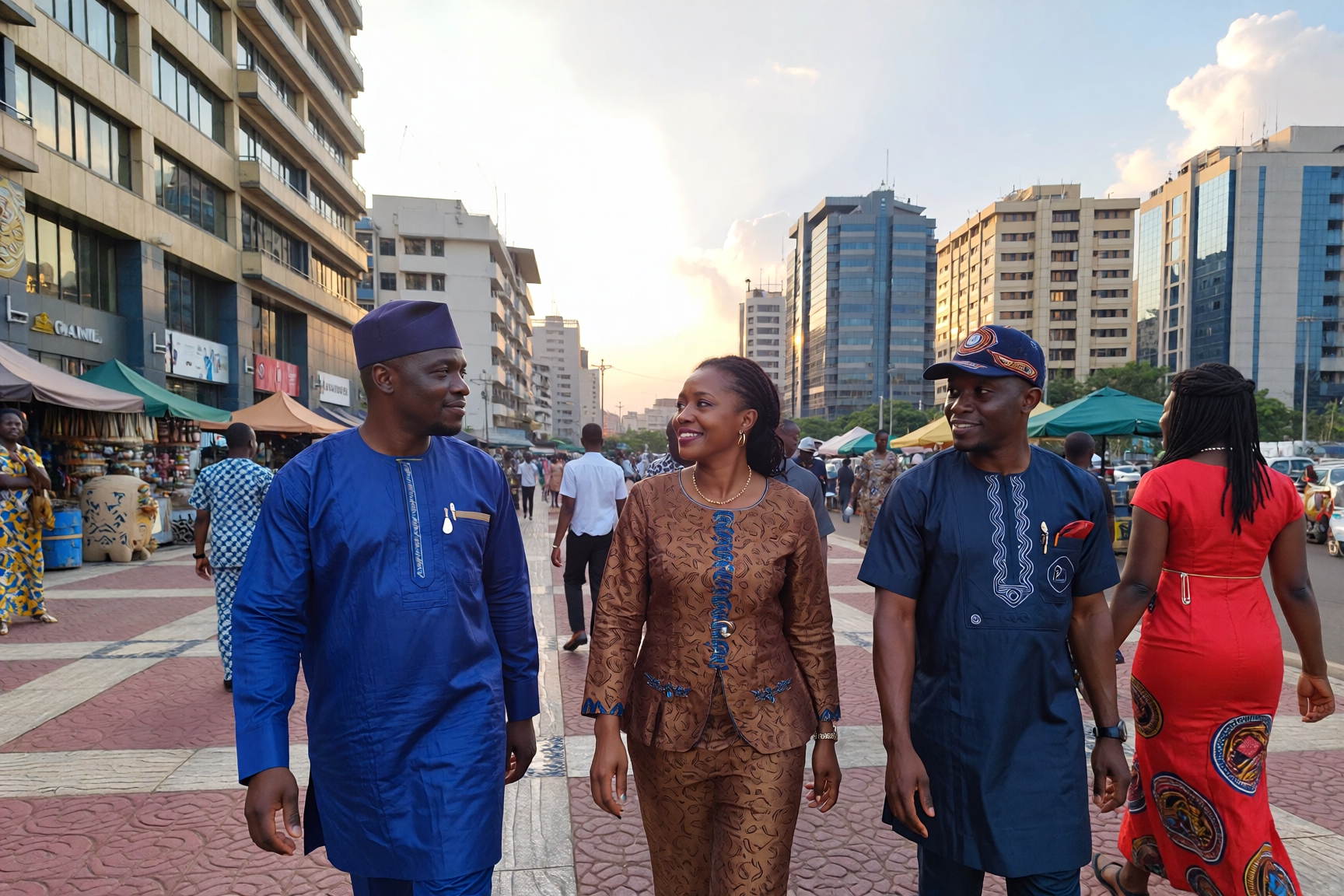
Lagos is widely regarded as Nigeria’s city that never sleeps, and having lived there for six months during my research fellowship, I can personally attest to this designation. The former capital and current economic hub operates on a 24-hour rhythm that rivals New York or London. At 3 AM, you’ll find bustling markets in Oshodi, all-night restaurants in Victoria Island, and traffic (yes, traffic!) on the Third Mainland Bridge.
But here’s what connects this to our ethnic discussion: Lagos represents Nigeria’s ethnic diversity in microcosm. According to census projections, Lagos hosts representatives from all 371 of Nigeria’s ethnic groups. Walk through any neighbourhood, and you’ll hear Hausa, Yoruba, Igbo, Edo, Ijaw, Ibibio, Fulfulde, and English all within the space of five minutes.
The city’s vibrant nightlife, from the upscale clubs of Lekki to the beer parlours of Surulere, brings together Nigerians from every corner of the country. Lagos never sleeps because it’s constantly mediating, negotiating, and celebrating the ethnic complexity that defines modern Nigeria. The markets operate around the clock because traders from different ethnic backgrounds cater to customers who keep different cultural schedules. The Hausa cattle traders arrive at dawn. The Igbo spare parts dealers open mid-morning. The Yoruba street food vendors set up their stalls in the evening.
This round-the-clock rhythm reflects something deeper about Nigerian urban spaces. They function as laboratories of national integration, where ethnic boundaries blur through commerce, intermarriage, and shared struggle against poor infrastructure, traffic, and the general chaos that characterises Lagos life. When you’re all stuck in the same go-slow on Eko Bridge, ethnic identity matters rather less than your shared frustration! As one Guardian Nigeria columnist noted in an essay on harnessing the gains in our diversity, intermarriages and economic mobility help integrate Nigerians beyond tribal lines, creating shared experiences that transcend ethnic boundaries.
What are the Three Largest Ethnic Groups?
The three largest ethnic groups in Nigeria are the Hausa-Fulani (approximately 67 million people, representing 29% of the population), the Yoruba (approximately 48 million people, representing 21% of the population), and the Igbo (approximately 41 million people, representing 18% of the population). Together, these groups account for roughly 156 million of Nigeria’s estimated 230 million people, or about 68% of the national population. The remaining 32% comprises 368 other distinct ethnic groups including the Ijaw, Tiv, Kanuri, Ibibio, Edo, Efik, Annang, Urhobo, Igala, Idoma, and Nupe. These demographics are based on projections from the 2006 census conducted by the National Population Commission, as Nigeria has not conducted a comprehensive census since then due to the political sensitivity of demographic data in a federation where resource allocation and political representation depend heavily on population figures.
What are the Six Ethnic Groups?
When people ask about six ethnic groups in Nigeria, they’re typically expanding beyond the big three to acknowledge significant medium-sized communities. The six most commonly referenced are the Hausa-Fulani, Yoruba, Igbo, Ijaw, Kanuri, and Tiv. However, this framework still represents an oversimplification.
The Ijaw people, inhabiting the oil-rich Niger Delta, have increasingly demanded greater political representation and resource control. Their activism, sometimes manifested through militant groups like the Movement for the Emancipation of the Niger Delta, reflects frustrations about environmental degradation and revenue allocation. The Kanuri, with their historical connection to the Kanem-Bornu Empire, maintain distinct cultural practices and governance traditions. The Tiv, primarily agriculturalists in Benue State’s fertile Middle Belt, have faced recurring conflicts with Fulani herders over land use.
But here’s my point: whether we’re discussing three groups, six groups, or ten groups, we’re still leaving out the vast majority of Nigeria’s ethnic diversity. The Ibibio in Akwa Ibom. The Edo in Benin City. The Efik in Calabar. The Nupe in Niger State. The Igala in Kogi. The Urhobo in Delta. The Annang in Akwa Ibom. Each of these communities numbers in the millions and maintains distinct cultural identities.
I once attended a symposium where a professor from Plateau State made a rather pointed observation. He said, “When southerners talk about northern domination, they mean Hausa-Fulani domination. When northerners talk about southern economic power, they mean Yoruba and Igbo power. Meanwhile, my Berom people, numbering over 300,000, are rendered invisible in both narratives.” His comment has stuck with me ever since. It captures the challenge of discussing Nigerian ethnicity in categories of three or six when the reality encompasses hundreds.
Seven Steps to Understanding Nigerian Ethnic Diversity
If you genuinely want to understand Nigerian ethnic complexity beyond surface-level categorisations, follow these seven steps based on years of ethnographic research:
1. Reject the Majority-Minority Binary
Stop thinking in terms of “major” and “minority” groups. This terminology is problematic and misleading. Collectively, the so-called minority groups constitute about 40% of Nigeria’s population. That’s over 90 million people! The Ijaw alone outnumber many sovereign African nations. Instead, think in terms of demographic scale: large groups (Hausa-Fulani, Yoruba, Igbo), medium-sized groups (Ijaw, Tiv, Kanuri, Ibibio, Edo), and smaller communities, each with equal claims to cultural recognition and political representation.
2. Learn About Language Families, Not Just Individual Languages
Nigeria’s 500-plus languages belong to three main families: Niger-Congo (which includes Yoruba, Igbo, Ijaw, Edo, Ibibio, and most southern languages), Afroasiatic (primarily Hausa and related Chadic languages), and Nilo-Saharan (mainly Kanuri). Understanding these families helps you appreciate both diversity and connection. Many supposedly distinct ethnic groups share linguistic roots, suggesting historical migrations and cultural exchanges that predate colonial borders.
3. Visit States Beyond Lagos, Abuja, and Port Harcourt
You cannot understand Nigerian ethnicity from the major cities alone. Spend time in Taraba, Cross River, Plateau, Benue, or Adamawa states. These Middle Belt and border regions host extraordinary ethnic mixing. You’ll encounter groups you’ve never heard of, languages that sound nothing like the three dominant tongues, and cultural practices that challenge everything you thought you knew about Nigerian identity.
4. Study Pre-Colonial Political Systems
The Hausa emirates, Yoruba monarchies, Igbo village democracies, Kanuri sultanate, and Edo kingdom all represented sophisticated governance systems before British colonialism. These systems still influence contemporary politics, succession disputes, and resource allocation. Understanding traditional authority structures explains much about how ethnic groups navigate Nigeria’s federal system today.
5. Attend Local Festivals and Cultural Events
Nothing beats experiential learning. The Osun-Osogbo festival in Yorubaland, the Argungu fishing festival in Hausa country, the New Yam festival in Igboland, the Leboku festival amongst the Yakurr people, and countless others offer windows into living cultural traditions. I’ve learned more about ethnic identity from watching masked dancers and listening to oral historians than from any academic text.
6. Engage with Ethnic Organisations and Community Leaders
Groups like Afenifere (Yoruba), Ohanaeze Ndigbo (Igbo), Arewa Consultative Forum (northern groups), Ijaw National Congress, and Pan Niger Delta Forum represent organised ethnic interests. Understanding their demands, grievances, and visions reveals how ethnicity functions as political mobilisation in contemporary Nigeria. But also engage with traditional rulers: the Ooni of Ife, the Sultan of Sokoto, the Oba of Benin, the Aku Uka of Wukari. Their perspectives bridge past and present.
7. Read Beyond the Mainstream Narrative
Most Nigerian history as taught in schools centres on the big three. Actively seek out scholarship on smaller groups. Read about the Ogoni struggle in the Niger Delta. Learn about the Tiv-Jukun conflicts. Understand the Berom-Fulani tensions on the Plateau. Discover the Ukwuani people’s fight for linguistic recognition. These stories complicate easy narratives about Nigerian unity or division. They reveal a nation constantly negotiating its identity across hundreds of competing claims.
How Ethnic Groups Shape Modern Nigeria
Ethnicity isn’t just cultural heritage or demographic statistics. It’s political currency in Nigeria’s federal system. The Constitution’s federal character principle requires ethnic and geographical balance in government appointments, creating both opportunities for inclusion and mechanisms for quota manipulation. Resource allocation through the Federation Account follows formulas that consider population (favouring the big three), derivation (favouring oil-producing minority communities), and land mass (favouring northern states).
Political power rotates informally between North and South, but rarely ventures outside the Hausa-Fulani, Yoruba, and Igbo triangulation. The presidency has been held by a Hausa-Fulani (Shehu Shagari), a Kanuri (Sheu Shagari had Kanuri ancestry through his mother), an Ijaw (Goodluck Jonathan), a Yoruba (Olusegun Obasanjo, Olu Falae contested), an Igbo (never at federal level, which remains a source of southeastern grievance), and currently a Yoruba (Bola Tinubu). This pattern reveals how ethnic calculations dominate elite politics.
State creation since 1967 has aimed to manage ethnic tensions by giving groups territorial control. Nigeria evolved from 3 regions to 4, then 12, 19, 21, 30, 36 states plus the Federal Capital Territory. Almost every state creation exercise spawned ethnic agitations for separate states. The Itsekiri want separation from Delta State’s Urhobo majority. Some Igala communities seek autonomy from Kogi State. The ongoing clamour reflects a fundamental truth: territorial control offers ethnic groups access to federal resources and political influence. These tensions occasionally escalate into threats and violence, as explored in a Guardian Nigeria analysis of addressing ethnic profiling and tribal tensions, which documents how constitutional rights to free movement are sometimes violated through ethnic ultimatums.
Language policy, supposedly neutral, reinforces ethnic hierarchies. English serves as the official language and lingua franca, advantaging groups with higher Western education rates. Hausa, Yoruba, and Igbo receive special constitutional recognition as “national languages” despite representing only three of 371 groups. The other 368 languages exist in a grey zone, maintained through cultural practice but lacking institutional support. Many smaller languages face extinction as younger generations shift to dominant tongues.
Intermarriage between ethnic groups remains common in urban areas but controversial in some communities. Yoruba-Igbo unions are relatively accepted. Hausa-Fulani marriages with southern Christians face more resistance. I know couples who’ve faced family rejection, community ostracism, and children struggling with identity formation when parents come from different ethnic groups. Yet these unions represent Nigeria’s future: a generation less invested in tribal boundaries, more focused on shared economic struggles and national development. The challenge, as one Guardian Nigeria opinion piece on Nigeria’s disunity and the albatross of national integration argues, is creating a national orientation that pursues unity in diversity through systematic education and constitutional reforms that encourage belonging rather than division.
Related Articles
If you found this exploration of Nigerian ethnic diversity fascinating, you might also enjoy my other demographic research. I’ve written extensively about how many ethnic groups are in Nigeria, documenting all 371 officially recognised groups whose languages and cultures create the complex tapestry of our national identity. Additionally, my article on what is the dominant culture in Nigeria explores how the Hausa-Fulani, Yoruba, and Igbo cultural influences intersect with 368 other ethnic groups to shape contemporary Nigerian society.
Conclusion: Celebrating Complexity, Not Simplification
So what are the three ethnic groups in Nigeria? The Hausa-Fulani, Yoruba, and Igbo. That’s the simple answer. But it’s incomplete, rather like describing a rainbow as having three colours. The fuller answer acknowledges 371 ethnic groups, each with distinct languages, cultures, traditions, and historical identities. The beautiful, complicated, occasionally frustrating truth is that Nigerian identity cannot be reduced to neat categories. We are simultaneously one nation and hundreds of peoples. We share citizenship whilst maintaining distinct cultural allegiances. We compete for resources whilst collaborating in markets, schools, and neighbourhoods.
This diversity represents both challenge and opportunity. The challenge: how do we build national cohesion when ethnic loyalty often trumps national identity? The opportunity: Nigeria’s cultural wealth, linguistic diversity, and varied traditions position us as one of the world’s most fascinating social experiments. If we can make unity work despite (or perhaps because of) our differences, we offer a model for multi-ethnic democracy that much of the world desperately needs.
Rather than asking which ethnic group is superior, which deserves more power, or which represents “true” Nigerian identity, we should celebrate the extraordinary fact that 371 distinct peoples have chosen (sometimes reluctantly, often pragmatically) to remain united under one flag. That’s worth defending.
Key Takeaways:
- Nigeria’s three largest ethnic groups (Hausa-Fulani, Yoruba, and Igbo) represent 68% of the population, but the remaining 32% comprises 368 distinct ethnic communities numbering over 90 million people who deserve equal recognition in discussions of Nigerian identity.
- Ethnic diversity in Nigeria extends beyond population numbers to include 500-plus languages across three major language families, distinct political traditions from monarchies to village democracies, and varied cultural practices spanning Islam, Christianity, and indigenous religions.
- Understanding Nigerian ethnicity requires moving beyond superficial categorisations to engage with local festivals, traditional governance systems, ethnic organisations, and communities in the Middle Belt and border regions where extraordinary cultural mixing challenges simplistic narratives about national identity.
FAQs About the Three Ethnic Groups in Nigeria
What are the three ethnic groups in Nigeria?
The three largest ethnic groups in Nigeria are the Hausa-Fulani (approximately 67 million people, 29% of the population), the Yoruba (approximately 48 million people, 21%), and the Igbo (approximately 41 million people, 18%). Together, these groups account for about 68% of Nigeria’s population, whilst the remaining 32% comprises 368 other distinct ethnic communities.
Which ethnic group is the largest in Nigeria?
The Hausa-Fulani people are Nigeria’s largest ethnic group, representing approximately 29% of the population or about 67 million people. They predominantly occupy the northern states including Kano, Katsina, Kaduna, Sokoto, Zamfara, and Jigawa, and their language serves as a lingua franca across much of West Africa beyond Nigeria’s borders.
How many ethnic groups are actually in Nigeria?
Nigeria is home to 371 officially recognised ethnic groups speaking over 500 languages, making it one of the most ethnically diverse nations on Earth. This extraordinary diversity ranks Nigeria third globally for cultural variety after only Chad and Cameroon, with ethnic communities ranging from the 67-million-strong Hausa-Fulani to groups numbering just a few thousand people.
What languages do the three main ethnic groups speak?
The Hausa-Fulani speak Hausa (an Afroasiatic language) and Fulfulde (a Niger-Congo language), the Yoruba speak Yoruba (Niger-Congo family), and the Igbo speak Igbo (Niger-Congo family). Each of these languages has numerous dialects and variations across different states, with Hausa being the most widely spoken indigenous language in Nigeria when second-language speakers are included.
Where do the three ethnic groups live in Nigeria?
The Hausa-Fulani predominantly occupy northern states from Sokoto to Kano, the Yoruba dominate southwestern states including Lagos, Ogun, Oyo, Osun, Ondo, and Ekiti, whilst the Igbo primarily inhabit southeastern states of Abia, Anambra, Ebonyi, Enugu, and Imo. However, urban migration and economic opportunities have created significant populations of all three groups in major cities nationwide.
What religions do the three main ethnic groups follow?
The Hausa-Fulani are predominantly Muslim, having converted to Islam around the 10th century through contact with Arab traders. The Yoruba practice both Islam and Christianity alongside traditional Orisha worship, creating unique religious pluralism, whilst the Igbo are predominantly Christian following extensive missionary activity during the colonial period.
Why are they called the “big three” ethnic groups?
They’re called the big three because of their large populations, political influence, and cultural dominance since Nigeria’s independence in 1960. Together accounting for 68% of the population, these groups have historically controlled most presidential positions, dominated federal appointments, and shaped national policy through their demographic weight and organised political mobilisation.
How does Lagos represent Nigeria’s ethnic diversity?
Lagos hosts representatives from all 371 of Nigeria’s ethnic groups, functioning as a microcosm of national diversity where Hausa, Yoruba, Igbo, Edo, Ijaw, Ibibio, and hundreds of other languages are spoken daily. The city’s 24-hour economy brings together traders, workers, and entrepreneurs from every corner of Nigeria, creating spaces where ethnic boundaries blur through commerce and shared urban struggle.
What makes Nigerian ethnic diversity unique in Africa?
Nigeria’s 371 ethnic groups speaking 500-plus languages create diversity comparable to entire continents elsewhere, with genetic variation among Nigerian ethnic groups rivalling that found across all of Europe. The concentration of 80 ethnic groups in Taraba State alone, for instance, exceeds the total ethnic diversity of many African countries.
What are the major challenges of ethnic diversity in Nigeria?
Ethnic diversity creates competition for political power, resource allocation disputes between oil-producing minorities and the federal government, language policy debates favouring the big three at the expense of 368 other groups, and occasional violence when ethnic grievances intersect with economic scarcity. Federal character principles attempt to balance ethnic interests but sometimes reinforce divisions rather than fostering unity.
How do Nigerians navigate multiple ethnic identities?
Many Nigerians maintain layered identities, identifying simultaneously as members of specific ethnic groups, residents of particular states, adherents of religions, and Nigerian citizens. Urban intermarriage creates children with multiple ethnic heritages who often code-switch between languages depending on context, whilst rural communities typically maintain stronger single-ethnic identities and cultural practices.
Can Nigeria’s ethnic diversity be a strength?
Nigeria’s ethnic diversity offers extraordinary cultural wealth, linguistic richness, varied governance traditions, and creative innovation when communities collaborate rather than compete. Countries worldwide struggle with far less diversity than Nigeria manages daily, and if our federal system can balance ethnic interests with national cohesion, we offer a model for multi-ethnic democracy that much of the world desperately needs.

