 Follow Us on Google News


 Follow Us on Google Discover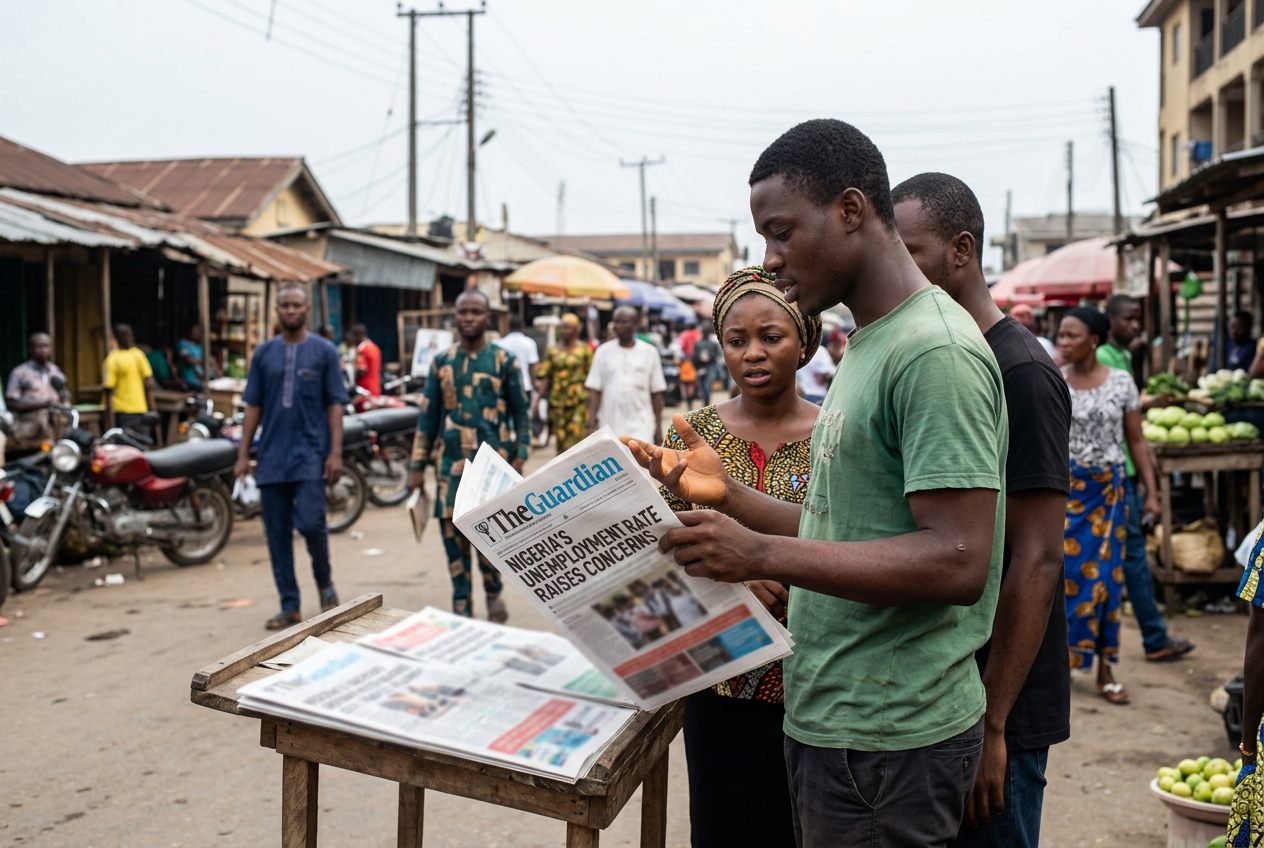
Welcome, and thank you for arriving at this one with your scepticism intact. You will need it.
This piece is the end of several months of research and the better part of a working life spent reading Nigerian economic data for a living, and I want to be honest with you from the opening paragraph: what is the unemployment rate in Nigeria is one of the hardest simple questions I have ever tried to answer. Not because the number is hidden. Because the way economists decide who counts as jobless changed in 2023, and the change was so consequential that the official figure now describes something almost nobody means when they use the word.
You have probably seen the number. Four point three per cent. It circulates in policy documents and international summaries and it looks, at a glance, like the labour market of a small prosperous country somewhere in northern Europe.
Now think about your own street. Your cousin with the second-class upper who has been “doing something small” for three years. The graduate at your gate who applied to eleven banks. The 2018 set from your polytechnic, half of whom are still waiting.
Both things are true at once. That is the strange, uncomfortable heart of this subject, and unpicking it properly takes a bit of patience.
So let us be patient together.

What is the unemployment rate in Nigeria currently, and who counts as employed?
The most recent official figure published by the National Bureau of Statistics puts unemployment at 4.3 per cent, recorded in the second quarter of 2024. You can read the survey document itself rather than take my word for it, and I would encourage you to, because the methodology notes tell you more than the headline ever will.
That 4.3 per cent was a fall from 5.3 per cent in the first quarter of 2024. Before that, the annual figure for 2023 sat at 5.4 per cent.
Here is where it gets interesting.
In 2023 the bureau adopted the International Labour Organisation’s framework for measuring work, replacing a home-grown definition Nigeria had used for years. Under the old system, you were counted as unemployed if you worked fewer than twenty hours a week. Under the new one, you are counted as employed if you worked at least one hour in the reference week for pay or profit.
One hour.
The okada rider who did three trips on Tuesday and nothing else all week? Employed. The graduate who helped her aunt sell recharge cards for an afternoon? Employed. The man who fixed one generator in seven days and earned ₦8,000 for it? Employed, and statistically indistinguishable from a bank manager on ₦900,000 a month.
I want to be fair to the bureau here, because the criticism it receives is often unfair. The one-hour threshold is not a Nigerian invention or a political trick. It is the global standard, used by the United Kingdom, Ghana, Brazil and roughly every statistical agency that reports to the ILO. The logic is that in economies where most people are self-employed, a binary employed-or-not question captures very little, so you measure the hours and the quality separately.
The trouble is that Nigeria is an extreme case of exactly the economy that definition struggles with. When the 2023 annual labour force report tells you that 92.2 per cent of employed Nigerians work informally, and that only 14.4 per cent of employed people are actually somebody’s employee, you are looking at a country where the word “employed” has been stretched until it covers almost everyone who is awake and trying.
So the rate is low because the bar is low. Not because jobs are plentiful.
There is a second problem, and it is arguably worse. That 4.3 per cent figure was published in November 2024. As of this writing, no newer quarterly labour force release has followed it. The World Economic Forum’s 2026 risk assessment named lack of economic opportunity and unemployment as Nigeria’s single leading economic threat for the year, which is a striking thing to be told about a country that has not measured the problem in about two years.
Government has not been idle on the policy side, to be clear. The National Directorate of Employment, which sits under the Federal Ministry of Labour and Employment and was created in 1989 precisely to attack mass joblessness, continues to run skills and job-placement schemes, and a national employment registration portal was launched in 2026. But programmes without measurement are archery in the dark. You can loose as many arrows as you like.
As one Guardian columnist argued in a sharp assessment of Nigeria’s data credibility problem, the gap between what the figures said and what citizens could see with their own eyes did lasting damage to public trust in official statistics. That damage is real, and it is not repaired by insisting the methodology is internationally compliant. It is compliant. It is also, on its own, misleading.
So, what is the unemployment rate in Nigeria, in plain English?
Here is my direct answer, and I will stand behind it.
The unemployment rate in Nigeria is officially 4.3 per cent, based on the National Bureau of Statistics survey for the second quarter of 2024, which remains the most recent published figure. That number is accurate to its own definition and close to useless as a description of Nigerian working life, because it counts one hour of paid work per week as employment and because it is now roughly two years out of date. A more honest reading of the same survey data puts meaningful labour underutilisation somewhere between 13 and 16 per cent, while separate international modelling of Nigeria produces an even lower headline of around 3 per cent, and the pre-2023 methodology produced 33.3 per cent for the same country.
Four numbers. One labour market. All defensible.
If you want the figures that actually tell you something, these are the ones I would put in front of a policymaker:
- Labour underutilisation (LU2), 15.9 per cent in 2023 and 13.0 per cent in Q2 2024, combining the unemployed with those working under forty hours who want more.
- Informal employment, 92.2 per cent, meaning roughly 77.6 million people working without contracts, pensions or protection.
- Youth NEET rate, 15.6 per cent, capturing young people in neither work, education nor training, which is the closest single statistic to what most Nigerians mean by “unemployed youth”.
- Wage employment, 14.4 per cent, the share of employed people drawing a salary from an employer.
- Pension or health insurance entitlement, 26.3 per cent of wage earners, which tells you how thin formality goes even inside the formal sector.
Read those five together and the picture resolves. Nigeria does not have a shortage of activity. Nigeria has a shortage of jobs that pay enough, last long enough and protect anybody. The 4.3 per cent measures the first thing. Everyone arguing about it is talking about the second.
There is one more figure I find genuinely clarifying, and it inverts what most parents believe. In 2023, unemployment among Nigerians with post-secondary education stood at 9.4 per cent. Among those with no formal qualification at all, it was 3.2 per cent.
Read that twice.
The more educated you are in Nigeria, the more likely you are to be counted as unemployed. Not because education is worthless, but because a degree raises your reservation wage. The graduate will hold out for something befitting the certificate her mother sold land to pay for. The man with no schooling cannot afford to hold out for anything, so he takes whatever Tuesday offers and is duly counted as employed.
Unemployment, measured this way, is partly a luxury. You have to be able to afford to wait.
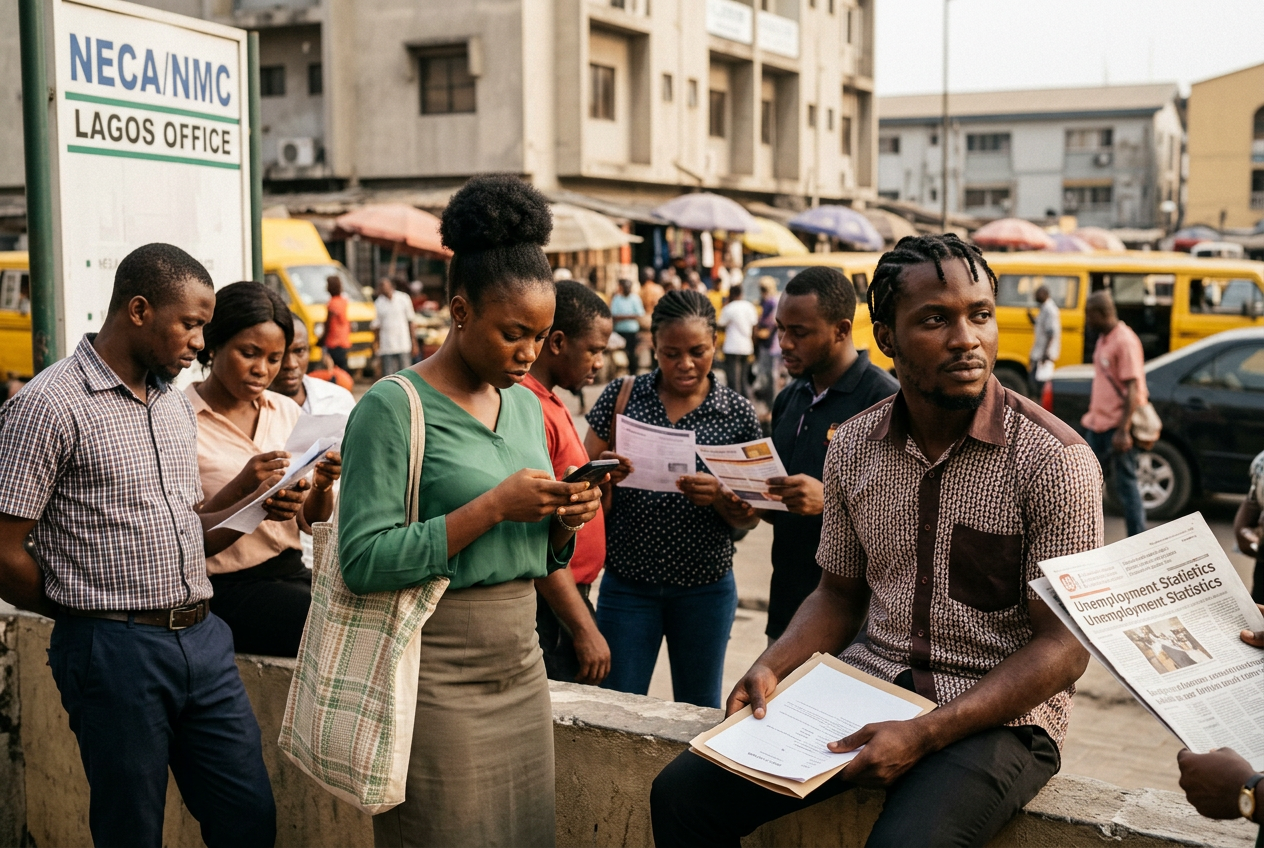
Which state in Nigeria has the highest unemployment rate?
Abia. By a distance nobody expected.
The 2023 annual survey, which remains the only state-level breakdown produced under the new methodology, put Abia at 18.7 per cent against a national rate of 5.4 per cent. That is more than triple the national figure and comfortably ahead of the Federal Capital Territory at 14.1 per cent and Rivers at 13.4 per cent.
I found this genuinely surprising when I first read it, and I suspect you might too. Abia is Aba. Aba is Ariaria, one of the most furiously entrepreneurial marketplaces on the continent, a place where shoes and leather goods are made at a scale that supplies half of West Africa. How does the home of Nigeria’s most famous hustle post the country’s worst joblessness?
The answer, I think, is that Abia is not short of enterprise. It is short of the kind of formal, salaried absorption that keeps a state’s educated young people from waiting. The same survey found Abia had the highest youth NEET rate in the country at 38.1 per cent, and the lowest share of wage employees entitled to pension or health cover, at 3.9 per cent. Rivers followed on NEET at 36 per cent, which fits the pattern of oil-state economies that generate enormous revenue and remarkably few jobs.
Now look at the other end.
Nasarawa recorded the lowest unemployment rate in Nigeria at 0.5 per cent. Sokoto came next at 1.2 per cent. If you have spent any time in either state you will know that this does not mean prosperity has quietly broken out in Lafia and nobody mentioned it.
It means agriculture. In farming states, near enough everybody is doing something for pay or profit in any given week, and the one-hour rule sweeps them all into the employed column. Northern states cluster at the bottom of the unemployment table for the same reason they cluster near the top of the poverty tables. Subsistence work is work, statistically. It is just not a living.
Unemployment rates across six Nigerian states, highest to lowest
| State | Unemployment rate (2023) | Distance from the 5.4 per cent national rate | Geopolitical zone |
|---|---|---|---|
| Abia | 18.7 per cent | 13.3 points above | South East |
| Federal Capital Territory | 14.1 per cent | 8.7 points above | North Central |
| Rivers | 13.4 per cent | 8.0 points above | South South |
| Ogun | 8.8 per cent | 3.4 points above | South West |
| Sokoto | 1.2 per cent | 4.2 points below | North West |
| Nasarawa | 0.5 per cent | 4.9 points below | North Central |
The spread across these six states runs from 0.5 to 18.7 per cent, a gap far wider than anything separating Nigeria from other countries, which tells you the national average conceals more than it reveals. The southern states with the strongest education systems post the highest unemployment, and the agricultural north posts the lowest, which is the opposite of what most people assume before they look.
A related figure worth carrying with you: Plateau recorded the highest time-related underemployment at 33.9 per cent, meaning a third of employed people there were working under forty hours and wanted more. Bauchi had the highest labour force participation at 92.3 per cent, Ekiti the lowest at 63.4 per cent. Kano and Lagos held the largest informal workforces, at roughly 5.2 million and 4.6 million people respectively, excluding agriculture.
The Guardian’s editorial board made a point some years ago, in a piece calling for action beyond another policy statement, that Nigeria has never lacked plans for job creation. What it has lacked is a business environment in which jobs create themselves. Reading the state data, that argument holds up rather well. The states with the highest joblessness are not the ones with the fewest schemes.
Which country has the highest unemployment rate in the world?
This depends entirely on whose ledger you open, which by now will not surprise you.
On World Bank and ILO modelled estimates, the answer is Eswatini, at roughly 34.2 per cent, with South Africa close behind at about 32.4 per cent and Djibouti third at around 26 per cent. Southern Africa dominates the top of this table, and has for two decades.
On IMF World Economic Outlook projections for 2026, the answer is Sudan, at a scarcely believable 61.3 per cent, followed by South Africa at 32.5 per cent and Jordan at 21.3 per cent. Sudan’s figure is a war statistic rather than an economic one, describing a labour market that has substantially ceased to exist.
For practical comparison, South Africa is the one to hold in mind, because it is the only large, industrialised, statistically well-measured economy that consistently reports unemployment above thirty per cent. That is what a genuinely severe unemployment crisis looks like in a country with the administrative capacity to count it properly.
The global median sits at roughly 5.1 per cent.
And here is the uncomfortable comparison. Nigeria, on its official figure, currently reports lower unemployment than the world median, lower than the United Kingdom, lower than the United States. In 2020, under the previous methodology, Nigeria reported 33.3 per cent and was ranked among the worst in the world.
The country did not change that much between 2020 and 2023. The ruler did.
This is precisely why cross-country unemployment league tables should be read with real caution. Comparing Nigeria’s 4.3 per cent to South Africa’s 32.4 per cent and concluding that Nigerians are seven times more likely to have work is statistical nonsense of the highest order. South Africa has a large formal economy, meaningful unemployment insurance and a population that reports itself as actively seeking salaried work. Nigeria has a vast informal economy where seeking is a luxury and everybody is doing something.
Different countries. Different questions. Same word.
What is the unemployment rate in Nigeria in 2026 likely to be?
Nobody officially knows, and I want to be straightforward about that rather than manufacture a figure to fill the gap.
What we can say is this. The macroeconomic weather has improved measurably. Headline inflation fell to 15.43 per cent in July 2026, down from 24.94 per cent a year earlier, and real GDP grew 3.9 per cent year-on-year in the first quarter of 2026 after 4.07 per cent in the final quarter of 2025. The naira has been comparatively steady. Those are genuinely better numbers than Nigeria has posted in some years.
But food inflation climbed back to 20.31 per cent in July, and the arithmetic underneath the labour market has not changed at all. Roughly 3.5 million Nigerians enter the job market every year. About 1.7 million graduates leave universities and polytechnics annually. The formal economy adds nowhere near that many salaried positions, and it has not done so in my lifetime.
So my working expectation, offered as a professional judgement rather than a forecast, is that whenever the next survey lands it will show a headline rate somewhere between 4 and 7 per cent, and that this will again tell you almost nothing. The figures to watch instead are the NEET rate and labour underutilisation. If those move, something real has happened. If only the headline moves, it is arithmetic.
An older Guardian opinion piece described the daily humiliation of the Nigerian jobseeker with a bluntness that has stayed with me, noting that the unemployed are judged and blamed for a situation they did not create. Nothing in the 2026 data changes that. A person counted as employed because they earned ₦5,000 last Thursday is carrying the same shame at the same family gathering as one counted as unemployed.
Which brings me to the part of this article you can actually use.
Seven practical steps if you are looking for work in Nigeria right now
- Stop measuring yourself against the national statistic and start measuring against your state. If you are in Abia, Rivers or the FCT, you are competing in a market roughly three times tighter than the national figure suggests, and you should plan for a search of nine to twelve months rather than three.
- Register with the National Directorate of Employment and the national electronic labour exchange. It costs nothing, the schemes are underused precisely because people assume they are useless, and the placement and vocational programmes are real even where they are thin.
- Price your reservation wage honestly and in writing. Work out your genuine monthly floor, rent divided by twelve, transport, food, data, and compare it to the ₦70,000 national minimum wage. If your floor is ₦180,000, you now know exactly which roles are a waste of your application fee and which are not.
- Take the bridging work, but timebox it. Six months of anything that pays while you build toward the role you want is sensible. Three years of it is a trap, because the longer you sit outside your field the harder the re-entry conversation becomes. Put an end date in your diary and honour it.
- Build one skill with a foreign-currency ceiling. Software, design, technical writing, data work, video editing, bookkeeping to international standards. A remote contract paying $600 a month is worth more than most Lagos mid-level salaries, and the entry cost is typically ₦100,000 to ₦300,000 in training plus six to nine months of serious effort.
- Treat your network as infrastructure, not as begging. Around 85 per cent of Nigerian employment is self-generated rather than advertised, which means the vacancy you want has probably never been posted anywhere. Twenty genuine conversations a month will outperform two hundred online applications, and I have watched this play out too many times to think it coincidence.
- Keep your own records. Note every application, every interview, every rate quoted. When the national statistics fail you, your own data does not, and after twelve months you will know more about your actual market than any published survey can tell you.
None of that fixes a structural problem. All of it improves your individual odds, which is the only thing within your control while the country argues about definitions.
Final Thoughts
If you take one idea from all of this, let it be that the unemployment rate in Nigeria is not a lie, but it is an answer to a question almost nobody is asking. It answers “how many Nigerians did no paid work at all last week and were actively looking?” It does not answer “how many Nigerians cannot find work that sustains them?” The first number is 4.3 per cent. The second is somewhere north of half the working population, and no official statistic currently captures it.
That gap is not a scandal of manipulation. It is a scandal of measurement, and the fix is unglamorous: publish the survey on schedule, report underutilisation and NEET alongside the headline with equal prominence, and stop letting a single decontextualised percentage travel the world unaccompanied.
Until then, read every unemployment figure you encounter with three questions attached. What definition? What year? What state? Ask those three and you will understand Nigeria’s labour market better than most people quoting numbers at you.
And if you are the one waiting, applying, hoping: the statistic is not a verdict on you. It was never designed to be.
- Treat 4.3 per cent as a definitional artefact, not a description of the job market, and use labour underutilisation at around 15.9 per cent as your working figure instead.
- Check your own state’s rate before judging your search, because the gap between Abia at 18.7 per cent and Nasarawa at 0.5 per cent dwarfs any national trend.
- Build at least one skill priced in foreign currency, since the formal Nigerian economy is not adding salaried roles anywhere near the 3.5 million people joining the labour force each year.
Related Articles
If the informal economy in this piece surprised you, the fuller picture of how the 92 per cent actually earn is worth your time, and I set it out in detail in a study of everyday Nigerian earning, which walks through trading, farming, artisan work and the stacked income streams that most households genuinely rely on. It pairs naturally with everything above, because you cannot understand the employment figure without understanding what employment looks like on the ground.
The wage floor question also deserves its own treatment, and I gave it one in an examination of Nigeria’s statutory pay floor, covering the ₦70,000 threshold, the patchy state-level compliance and what it means for a worker whose employer simply declines to pay it. If step three of the list above caught your attention, start there.
Key Takeaways
- Nigeria’s official unemployment rate is 4.3 per cent from the second quarter of 2024, unchanged since November 2024 because no newer survey has been published, and it counts one hour of paid work per week as employment.
- Abia records the highest state-level rate at 18.7 per cent while Nasarawa records the lowest at 0.5 per cent, and educated Nigerians are counted as unemployed roughly three times more often than those with no formal schooling.
- Eswatini and South Africa top the global tables at around 34 and 32 per cent, but cross-country comparisons with Nigeria are close to meaningless given how differently the underlying question is asked.
Frequently Asked Questions: What is the unemployment rate in Nigeria?
What is the unemployment rate in Nigeria?
The official rate is 4.3 per cent, recorded by the National Bureau of Statistics for the second quarter of 2024 and still the most recent published figure. It counts anyone who worked at least one hour for pay or profit in the survey week as employed, so it understates joblessness as most Nigerians understand the term.
Why does Nigeria’s official unemployment rate look so low?
Nigeria adopted the International Labour Organisation measurement framework in 2023, replacing a national definition that treated anyone working under twenty hours a week as unemployed. Under the current one-hour threshold, the vast informal workforce of traders, farmers and artisans is classified as employed, which pushes the headline rate into low single digits.
When did the National Bureau of Statistics last publish labour force data?
The last quarterly labour force survey was published in November 2024, covering the second quarter of that year. No newer release has followed, which means Nigeria has been navigating its most-cited economic risk without current measurement for roughly two years.
Which state in Nigeria has the highest unemployment rate?
Abia State recorded the highest rate at 18.7 per cent in the 2023 annual labour force survey, more than three times the national average of 5.4 per cent. The Federal Capital Territory followed at 14.1 per cent and Rivers State at 13.4 per cent.
Which Nigerian state has the lowest unemployment rate?
Nasarawa recorded the lowest at 0.5 per cent, with Sokoto next at 1.2 per cent. These are agricultural states where nearly everyone does some paid work in a given week, so the one-hour rule classifies almost the entire adult population as employed regardless of income.
Which country has the highest unemployment rate in the world?
On World Bank and ILO modelled estimates, Eswatini leads at roughly 34.2 per cent, with South Africa second at about 32.4 per cent. IMF projections for 2026 instead place Sudan first at 61.3 per cent, reflecting the collapse of its labour market under war rather than ordinary economic conditions.
What is the youth unemployment rate in Nigeria?
Youth unemployment for those aged 15 to 24 was 6.5 per cent in the second quarter of 2024, down from 8.4 per cent the previous quarter. The more revealing figure is the youth NEET rate of 15.6 per cent, which captures young people in neither employment, education nor training.
Does having a degree protect you from unemployment in Nigeria?
Statistically it does the opposite, since unemployment among Nigerians with post-secondary education stood at 9.4 per cent in 2023 against 3.2 per cent for those with no formal qualification. Graduates can afford to hold out for suitable roles while those without schooling take whatever work appears, and the survey counts the latter as employed.
What is the difference between unemployment and underemployment in Nigeria?
Unemployment counts people who did no paid work at all and were available and seeking, while time-related underemployment counts employed people working under forty hours weekly who want more. Nigerian underemployment ran at 11.1 per cent in 2023, and combining it with unemployment produces a labour underutilisation rate of 15.9 per cent.
How many Nigerians work in the informal economy?
Informal employment accounted for 92.2 per cent of all employed Nigerians in 2023, roughly 77.6 million people working without contracts, pension cover or health insurance. Kano and Lagos held the largest informal workforces at approximately 5.2 million and 4.6 million people respectively, excluding agriculture.
What is the unemployment rate in Nigeria in 2026?
No official 2026 figure exists, because the National Bureau of Statistics has not published a labour force survey since November 2024. International modelling estimates place Nigeria near 3 per cent for recent years, which is even lower than the national figure and equally poor at describing conditions on the ground.
What should jobseekers do while the official data stays unreliable?
Use your state-level rate rather than the national average to set realistic expectations, since the spread runs from 0.5 to 18.7 per cent across Nigeria. Register with the National Directorate of Employment, build one skill that can earn in foreign currency, and keep your own written record of applications and rates offered.

