 Follow Us on Google News
 Follow Us on Google Discover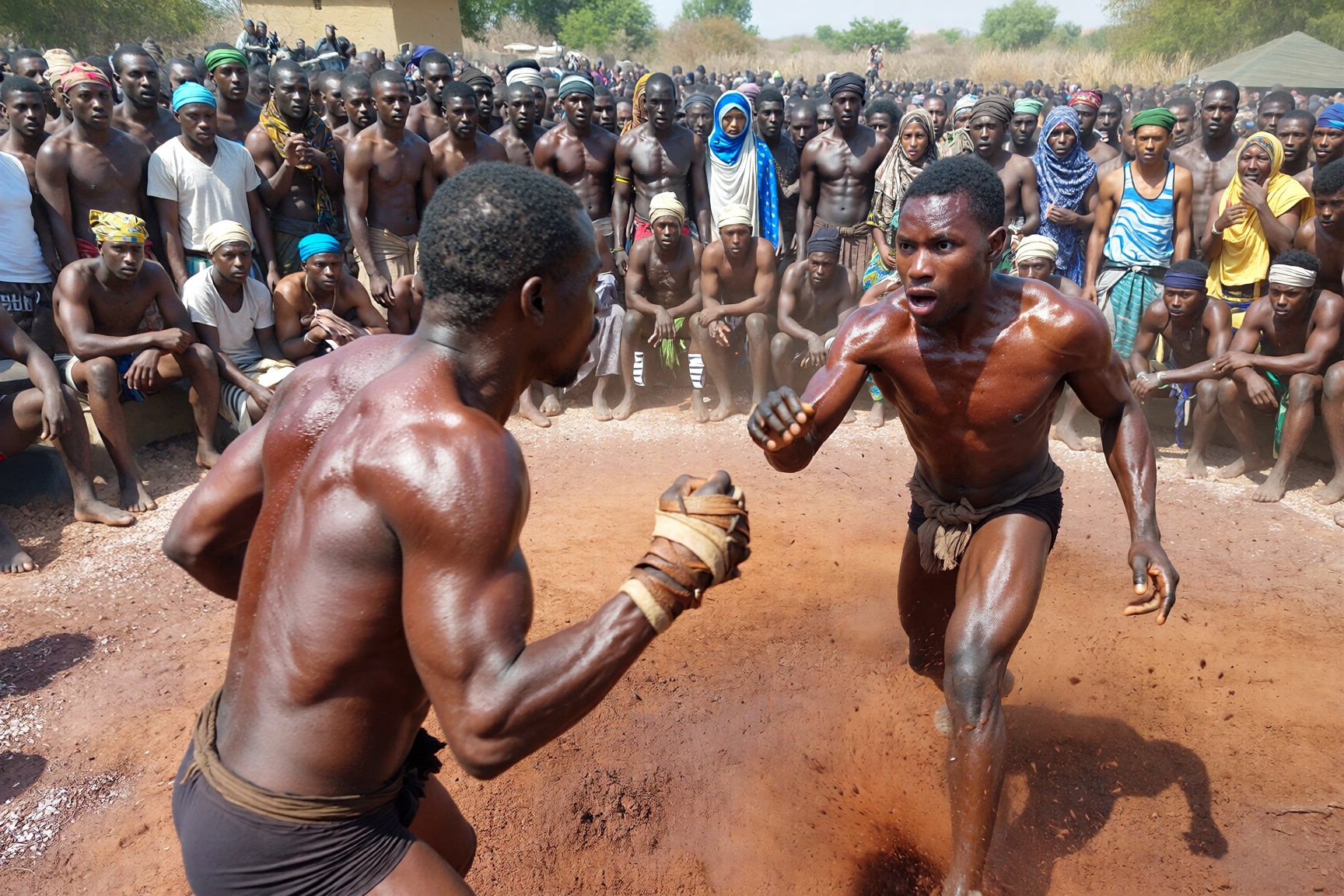
Welcome, dear readers! After spending months researching Nigeria’s traditional combat sports and years documenting the cultural practices that make our nation extraordinary, I’m absolutely thrilled to share this comprehensive exploration of Dambe, one of Africa’s most fascinating martial arts. Where did Dambe come from? This ancient boxing tradition emerged from the Hausa people of Northern Nigeria, probably around the 15th or 16th century, developing alongside the trans-Saharan caravan trade routes where butchers’ guilds needed both entertainment and a way to settle disputes. Watching my first proper Dambe match in Kano back in 2018 changed everything I thought I knew about traditional Nigerian sports. The raw intensity, the ritualistic preparation, the deafening crowd chanting in Hausa whilst two warriors circled each other with wrapped fists, one hand bound with cord like an ancient weapon. That moment taught me something crucial: Dambe isn’t just fighting. It’s living history.
I still remember the veteran fighter who explained to me afterwards, through a translator, how his grandfather had taught him the art, and his great-grandfather before that, passing down techniques refined over centuries. These weren’t random brawls. This was systematic martial discipline, cultural preservation, and community celebration all wrapped into one explosive package.
What Is the History of Dambe?
The history of Dambe stretches back centuries into Northern Nigeria’s pre-colonial past, intertwining with the social structures, economic activities, and spiritual beliefs of the Hausa people. Understanding this history requires looking beyond the fights themselves to comprehend the cultural ecosystem that birthed and sustained this remarkable tradition.
Dambe emerged from the butcher’s profession, specifically among the Hausa ethnic group. The butchers, known as “maharba” in Hausa, formed tight-knit guilds that travelled with merchant caravans across the Sahel region. These caravans moved goods between major trading centres like Kano, Katsina, and Sokoto, and the long journeys required entertainment. Dambe provided that entertainment whilst simultaneously serving practical purposes.
The Federal Ministry of Arts, Culture and the Creative Economy recognises traditional sports like wrestling and boxing as part of Nigeria’s intangible cultural heritage, though Dambe specifically receives less formal documentation than some other traditions. This oversight has meant that much of Dambe’s history survives through oral transmission rather than written records.
Historical accounts suggest Dambe may have originated as early as the 15th or 16th century, coinciding with the height of the trans-Saharan trade when Northern Nigerian emirates thrived as commercial and political centres. The sport developed distinctive characteristics that reflected Hausa warrior culture and Islamic influence. Fighters would compete during festivals, particularly after harvest seasons when communities gathered for celebrations.

One fascinating aspect involves the spiritual dimensions. Pre-Islamic and early Islamic Hausa societies believed in protective charms and spiritual preparation before combat. Fighters consulted marabouts (Islamic spiritual guides) for protective verses and wore amulets believed to shield them from injury. This spiritual layer added gravitas to what might otherwise seem like simple fistfights.
The colonial period brought changes to Dambe. British administrators viewed traditional combat sports with suspicion, sometimes attempting to regulate or ban them as “savage” practices. Despite this, Dambe persisted in rural areas and smaller towns where colonial oversight proved less effective. The sport adapted, incorporating new rules and safety measures whilst maintaining core traditions.
Post-independence Nigeria saw varying levels of official support for traditional sports. The National Institute for Sports includes traditional sports in its curriculum, recognising their cultural value alongside modern sporting disciplines like boxing, wrestling, and martial arts. However, Dambe struggled to gain the same institutional backing as other combat sports.
During the 1970s and 1980s, urbanisation and modernisation threatened Dambe’s survival. Young Hausa men increasingly moved to cities, disconnecting from village traditions where Dambe thrived. Television introduced international boxing and wrestling, creating new sporting preferences that displaced traditional forms.
Recent decades have witnessed a modest revival. Cultural preservationists, academics, and some traditional rulers have worked to document and promote Dambe as authentic Nigerian heritage. Festivals in Northern states occasionally feature Dambe exhibitions, and a few training centres have emerged to teach the art systematically rather than through informal mentorship alone.
The history of Dambe also reflects broader Nigerian narratives about ethnic identity and cultural preservation. As Nigeria navigates tensions between modernisation and tradition, sports like Dambe serve as tangible connections to pre-colonial African civilisations and their sophisticated cultural systems.
What Does Dambe Mean?
The word “Dambe” comes from the Hausa language, where it translates roughly to “to box” or “boxing with the fist.” The etymology reveals something important about how Hausa speakers conceptualise this combat form, distinguishing it from other fighting styles like wrestling (kokawa in Hausa) or stick-fighting.
In Hausa linguistic structure, Dambe specifically refers to striking combat using the fists, particularly the dominant hand which fighters traditionally wrap with cord or cloth. This wrapping creates what fighters call the “spear” hand, whilst the unwrapped hand becomes the “shield” used for defence and grabbing.
The term carries cultural weight beyond its literal meaning. When someone in Northern Nigeria mentions Dambe, they’re not just referring to physical combat. They’re invoking a whole cultural complex including pre-fight rituals, musical accompaniment, crowd participation, and community bonds forged through shared spectatorship.
Different regions have slight variations in terminology. Some communities use “Damben” or add qualifiers to distinguish professional fighters from casual practitioners. The great champions earn honorific titles that become inseparable from their names, rather like how Western boxers might be called “The Greatest” or “The Brown Bomber.”
Language scholars note that Dambe shares linguistic roots with other Hausa words related to striking and impact. This linguistic family reveals how deeply fighting traditions penetrated Hausa consciousness, with specialised vocabulary developing to describe different techniques, outcomes, and fighter attributes.
Understanding what Dambe means requires grasping that for practitioners and communities, it represents more than sport. It’s cultural identity, masculine initiation, entertainment, spiritual practice, and historical continuity all compressed into violent but carefully regulated combat.
The Seven Essential Steps to Understanding Dambe’s Origins and Cultural Significance
After years studying traditional Nigerian martial arts and months conducting field research across Northern Nigeria, I’ve developed this comprehensive guide to help anyone grasp where Dambe comes from and why it matters. These seven steps will take you from complete novice to genuinely informed enthusiast.
1. Study the Hausa Butchers’ Guild System
Start your Dambe education by understanding the professional class that created it. The butchers (maharba) formed distinct social and economic guilds within Hausa society, operating rather like medieval European craft guilds. These guilds regulated who could practice the trade, maintained quality standards, and provided mutual support for members.
Visit traditional markets in Northern cities like Kano, Kaduna, or Zaria to observe how butchers still maintain some guild traditions. Notice how they occupy specific market sections, how knowledge passes from master to apprentice, and how professional identity shapes social standing. This context explains why Dambe became associated specifically with butchers rather than other professional groups.
The connection between butchering and fighting skills makes practical sense. Butchers developed exceptional upper body strength from daily work breaking down livestock carcasses. They understood animal anatomy intimately, knowledge that translated to understanding human vulnerable points. Their profession also required sharp hand-eye coordination and precise movements under pressure.
Research the historical caravan trade routes where butchers travelled with merchants. These journeys, sometimes lasting months, created opportunities for inter-community competitions where Dambe fighters from different towns tested skills against each other. This competitive circuit helped standardise rules and techniques across wide geographic areas.
2. Examine Pre-Colonial Northern Nigerian Emirates
Understanding Dambe requires grasping the political structures of pre-colonial Hausa states. The major emirates like Kano, Katsina, Sokoto, and Zaria each maintained distinct cultural variations whilst sharing core Hausa traditions. Dambe flourished differently in each emirate, with local styles and champion fighters becoming sources of regional pride.
Study how traditional rulers (emirs and district heads) patronised fighting sports. Championships often occurred during royal celebrations, harvest festivals, or religious holidays. The emir’s endorsement legitimised Dambe, elevating it from mere street fighting to respected cultural practice worthy of formal organisation.
The Voice of Nigeria covers various Nigerian martial arts and combat sports traditions, providing context for how indigenous fighting systems like Dambe fit within broader Nigerian sporting culture that includes both traditional and modern combat disciplines.
Investigate how Islamic influence shaped Dambe’s development. The 19th century Sokoto Caliphate brought stricter Islamic practices to Northern Nigeria, which paradoxically both supported and constrained Dambe. Religious scholars debated whether such combat aligned with Islamic principles, whilst many practitioners saw no contradiction between their faith and their fighting tradition.
3. Learn the Technical Vocabulary and Fighting Techniques
Dambe possesses sophisticated technical vocabulary in Hausa that describes specific strikes, defensive moves, and tactical approaches. Learn terms like “kafa” (kick), though kicking techniques entered Dambe relatively late compared to hand strikes. Master the distinction between “mayanka” (the killing strike) and defensive manoeuvres.
Study the unique stance Dambe fighters adopt: one leg forward, torso twisted, the “spear” hand cocked back whilst the “shield” hand extends forward for grabbing and blocking. This stance differs dramatically from Western boxing or other Asian martial arts, reflecting Dambe’s independent evolution.
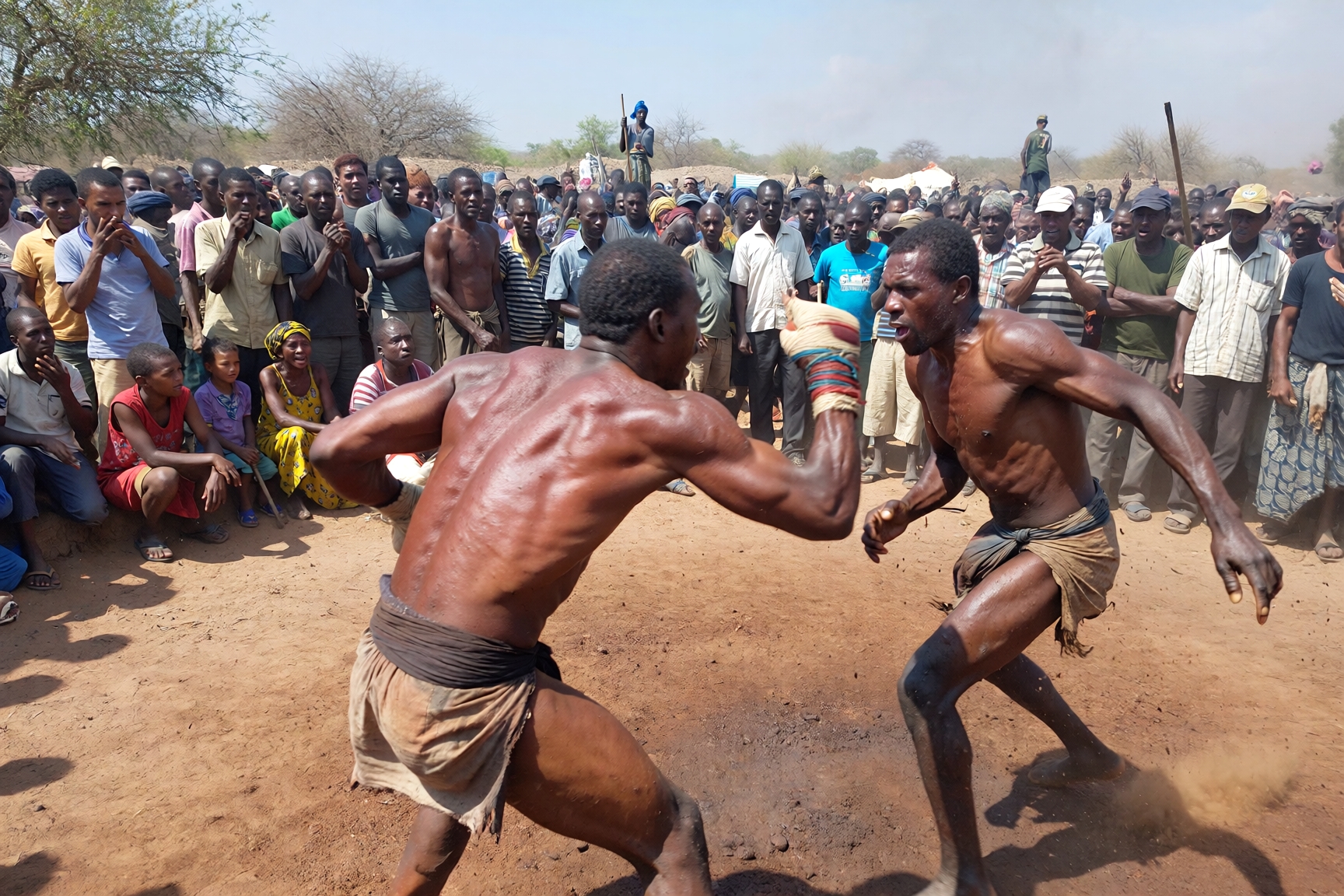
Watch available Dambe footage online or, even better, attend live matches if possible. Notice how fighters use their wrapped hand differently from their free hand. The wrapped fist delivers devastating power strikes meant to knock opponents down instantly. The free hand grabs opponent’s clothing, pulls them off-balance, and deflects incoming attacks.
Pay attention to the ritual elements. Fighters enter the ring performing what looks like dance movements, actually a combination of warm-up, spiritual preparation, and psychological warfare designed to intimidate opponents. Musicians play traditional drums and horns creating rhythms that fighters synchronise their movements with.
4. Research the Rules and Winning Conditions
Dambe operates under rules that evolved over centuries through community consensus rather than formal codification. Understanding these rules reveals the sport’s logic and ethical framework.
A Dambe match ends when a fighter’s hand, knee, or body touches the ground, signalling defeat. This rule encourages fighters to maintain balance and defensive positioning. Unlike Western boxing with multiple rounds and point scoring, Dambe focuses on definitive outcomes where one fighter clearly dominates the other.
Matches occur in three rounds maximum, with rest periods between rounds. If neither fighter achieves a knockdown, the match might be declared a draw, though crowds generally prefer decisive outcomes. Referees (often elder former fighters) monitor for illegal techniques including eye-gouging, biting, or strikes to the groin.
The wrapped “spear” hand raises interesting regulatory questions. Traditional wrapping uses rough cord or cloth that increases striking surface area and provides wrist support. Modern iterations sometimes incorporate padding requirements inspired by Western boxing, though purists argue this dilutes Dambe’s distinctive character.
Study the pre-fight negotiations where fighters agree on specific conditions. Some matches allow leg kicks whilst others restrict combat to hand strikes. High-stakes championship bouts might have additional rules agreed upon by both parties’ representatives.
5. Understand the Festival and Community Context
Dambe never existed as isolated sporting event. It formed integral parts of larger community celebrations, typically during harvest festivals, wedding celebrations, or religious holidays when villages gathered for multi-day festivities.
Attend or research major Northern Nigerian cultural festivals where Dambe sometimes features. The Argungu Fishing Festival, for instance, includes wrestling and traditional sports exhibitions. Durbar festivals during Eid celebrations occasionally showcase Dambe alongside horse-riding displays and other cultural performances.
Notice how entire communities participate. Women and children attend despite the violence, viewing it as family entertainment rather than adult-only spectacle. Vendors sell food and drinks. Musicians provide soundtracks. Elders sit in places of honour offering commentary and settling disputes.
The betting culture surrounding Dambe deserves attention. Spectators wager considerable sums on favoured fighters, creating economic incentives that sustained professional Dambe even during periods of official discouragement. This betting system, whilst problematic from certain moral perspectives, proved crucial for Dambe’s survival.
6. Analyse Dambe’s Decline and Modern Revival Efforts
Understanding where Dambe came from requires acknowledging where it nearly went: extinction. Multiple factors contributed to Dambe’s decline from the mid-20th century onwards.
Urbanisation pulled young men away from villages where Dambe traditions thrived. Cities offered employment opportunities that competing as a Dambe fighter couldn’t match economically. The sport’s association with rural, traditional lifestyles made it seem backward to modernising Nigerians seeking to embrace contemporary culture.
Television and globalised media introduced international boxing, wrestling, and mixed martial arts that appealed to younger generations. The spectacle of Muhammad Ali, Mike Tyson, or later UFC fighters made traditional Dambe seem unsophisticated by comparison. Western boxing particularly captured Nigerian imagination, with the nation producing international champions.
Security concerns in Northern Nigeria from the 1990s onwards disrupted community festivals where Dambe occurred. Periodic ethnic and religious tensions made large gatherings risky. The Boko Haram insurgency from 2009 onwards devastated cultural life across the Northeast, including traditional sporting practices.
Revival efforts have emerged from multiple directions. Some traditional rulers sponsor annual Dambe championships. Cultural preservationists document techniques and history. A few enthusiasts have created training centres teaching Dambe systematically. Social media has helped by sharing Dambe footage that attracts both Nigerian and international attention.
7. Connect Dambe to Broader Nigerian Cultural Identity
The final step involves understanding Dambe’s place within Nigeria’s complex cultural landscape. This ancient boxing tradition represents one thread in the rich tapestry of Nigeria’s 371 ethnic groups and their diverse cultural practices.
Compare Dambe to wrestling traditions found among Igbo, Yoruba, and other Southern Nigerian ethnic groups. Each developed distinct combat sports reflecting their particular cultural values, social structures, and historical circumstances. Together, these traditions demonstrate Nigerian cultural creativity and the universal human impulse towards regulated combat sports.
Recognise how Dambe embodies tensions between tradition and modernity that characterise contemporary Nigerian society. The sport’s struggle for relevance mirrors broader questions about cultural preservation in rapidly changing African nations. Should traditional practices adapt to survive, or does adaptation destroy their essential character?
Consider Dambe’s potential future. Could it achieve international recognition similar to what Muay Thai accomplished for Thailand or Taekwondo for Korea? Some enthusiasts dream of standardised Dambe competitions, international tournaments, and eventual Olympic inclusion. Others argue this would sterilise Dambe’s authentic character, turning cultural practice into mere sport.
Regional Variations in Dambe Practice Across Northern Nigeria
This table compares how Dambe manifests differently across major Northern Nigerian regions, reflecting local cultural variations within the broader Hausa tradition.
| Region | Primary Style Characteristics | Festival Integration | Current Practice Status | Notable Features |
|---|---|---|---|---|
| Kano State | Orthodox Dambe with strict traditional rules; emphasises hand strikes over kicks | Integrated into Durbar and harvest festivals | Active with regular competitions | Strong institutional support from traditional rulers |
| Kaduna State | Hybrid style incorporating some wrestling techniques | Sporadic festival appearances | Declining but present in rural areas | Influenced by ethnic diversity of region |
| Katsina State | Conservative approach maintaining pre-colonial practices | Regular inclusion in cultural celebrations | Moderately active | Known for spiritual preparation rituals |
| Sokoto State | Emphasis on the wrapped “spear” hand technique | Associated with religious festivals | Limited urban practice, stronger rural presence | Historical centre of Dambe development |
| Bauchi/Gombe States | More aggressive fighting style with permitted kicks | Less festival integration, more informal matches | Struggling to maintain traditions | Younger demographic participation |
| Borno/Yobe States | Traditional style severely disrupted by insecurity | Previously integrated, now rarely practised | Nearly extinct due to security challenges | Historical significance overshadowed by current challenges |
The data reveals that Dambe’s vitality varies dramatically across Northern Nigeria, with security, urbanisation, and traditional authority support proving decisive factors in its survival. Kano State emerges as Dambe’s strongest remaining bastion, where royal patronage and regular competitions maintain the tradition. Meanwhile, security challenges in the Northeast have nearly eliminated Dambe practice in states where it once flourished. This geographic variation demonstrates how traditional sports depend on stable communities and cultural continuity to survive. The table also highlights how modernisation hasn’t uniformly affected Dambe, with some regions like Kano adapting the sport whilst preserving its essential character, whilst others have seen precipitous decline.
Which Country Did Boxing Originate From?
Boxing as a combat sport has no single origin country. Archaeological and historical evidence reveals that numerous ancient civilisations developed formalised fist-fighting traditions independently across Africa, Europe, Asia, and the Americas.
The earliest evidence of boxing appears in ancient Mesopotamian, Egyptian, and Sumerian artefacts dating to 3000 BCE or earlier. These civilisations left reliefs and sculptures depicting fighters with wrapped hands engaging in what appears to be regulated combat. Ancient Egyptian tombs contain paintings showing boxing matches with spectators and referees, suggesting sophisticated sporting culture.
Ancient Greece formalised boxing as an Olympic sport from at least 688 BCE. Greek boxing differed significantly from modern forms, featuring no ring, no rounds, and fights continuing until one combatant surrendered or could not continue. Greek fighters wrapped their hands with leather strips rather than padded gloves, making the sport remarkably brutal.
Roman boxing evolved from Greek traditions but became even more violent. Roman fighters sometimes wore the “cestus,” a leather hand wrapping studded with metal that could inflict fatal injuries. Roman gladiatorial culture absorbed boxing into larger spectacles of combat.
Meanwhile, completely independent boxing traditions developed elsewhere. Chinese martial arts included striking systems using fists. Indigenous peoples across the Americas developed combat sports incorporating punching. And crucially for our discussion, African societies across the continent created their own fist-fighting traditions.
Modern boxing, as we know it today with gloved hands, weight classes, and the Queensberry Rules, emerged in 18th and 19th century Britain. English aristocrats codified rules that transformed boxing from bare-knuckle brawling into “the sweet science.” This British boxing spread globally through colonial expansion and cultural influence.
So which country did boxing originate from? The question assumes a single origin point that never existed. Instead, boxing represents a universal human activity that emerged independently across multiple cultures whenever societies developed sufficiently to regulate violence into sporting competition.
This context makes Dambe’s independent development in Nigeria particularly fascinating. The Hausa people created a sophisticated boxing tradition without any apparent influence from European, Asian, or other African boxing systems. Dambe evolved its own techniques, rules, and cultural meanings through purely indigenous development. This demonstrates that boxing isn’t something Africans learned from colonialism but rather something humans create naturally when social conditions support regulated combat sports.
The question “which country did boxing originate from?” also reveals assumptions about cultural diffusion. Western narratives often suggest modern sports spread from Europe or America to “less developed” regions. Studying Dambe challenges this narrative by showing how traditional African societies possessed their own rich sporting cultures that European colonialism disrupted rather than created.
Who Is the King of Dambe in Nigeria?
The concept of a “King of Dambe” reflects modern attempts to brand and market the sport rather than traditional practice. Historically, Dambe never had a single universally recognised champion. Instead, different regions, towns, and communities had their local champions who might occasionally compete against fighters from other areas.
That said, certain fighters have achieved extraordinary prominence in recent decades as Dambe experienced modest revival and media attention. One fighter’s name appears repeatedly in discussions about contemporary Dambe excellence, though I’ll caution that his status as “king” depends on who you ask and which community you’re in.
The challenge in identifying a King of Dambe stems from the sport’s fragmented nature. Unlike Western boxing with its sanctioning bodies, world titles, and clear rankings, Dambe operates through informal networks and community-level organisation. A fighter might dominate in Kano whilst another rules in Kaduna, with no formal mechanism to determine superiority.
Some promoters have attempted to create formal Dambe championships with titles like “National Champion” or “Grand Champion.” These efforts aim to modernise Dambe by importing structures from international boxing. The success of these initiatives remains mixed. Traditional communities sometimes view such titles with scepticism, preferring the older system where a fighter’s reputation spoke for itself through repeated victories in local competitions.
Champion fighters typically earn their status through multiple factors beyond just winning fights. They must demonstrate technical mastery, courage under pressure, spiritual preparation, and respect for Dambe’s cultural traditions. A fighter who wins through luck or dirty tactics might not gain the community respect that defines true championship status.
The economics of Dambe championship further complicate matters. The most successful fighters can earn substantial sums from appearance fees and winnings, particularly when wealthy patrons sponsor high-stakes matches. This creates incentives for fighters to claim championship status even when their actual record might not fully support such claims.
Regional variations matter enormously. A fighter considered the King of Dambe in Kano might be relatively unknown in Sokoto or Bauchi. The lack of regular inter-regional competitions means local champions rarely test themselves against the full spectrum of Nigerian Dambe talent.
Some traditional rulers have attempted to establish their patronage as legitimising championship claims. An emir’s endorsement carries weight in his emirate but may not translate to universal recognition across Northern Nigeria. This creates situations where multiple fighters simultaneously claim to be champion, each backed by their local supporters and traditional authorities.
For anyone seriously interested in identifying top Dambe fighters, I’d recommend following social media channels and YouTube content showcasing recent matches. Visual evidence of a fighter’s technique, power, and record provides better assessment than secondhand reputation. Watch how crowds respond, how commentators describe fighters, and most importantly, how opponents react when facing particular fighters. These indicators reveal genuine respect within Dambe community more reliably than self-proclaimed titles.
The Cultural Significance of Dambe in Modern Nigeria
Dambe’s importance transcends sports, functioning as cultural preservation, masculine identity formation, community entertainment, and connection to pre-colonial African civilisations that possessed sophisticated social structures contrary to colonial narratives of African “primitiveness.”
Contemporary Nigeria faces questions about cultural authenticity versus modernisation. Young Nigerians increasingly embrace global culture through social media, Western education, and international entertainment. This creates anxiety about losing traditional practices that defined Nigerian ethnic groups for centuries before colonialism.
Dambe represents one answer to these concerns. By maintaining this ancient fighting tradition, communities assert that Nigerian culture possesses value independent of Western validation. When a Dambe fighter steps into the ring using techniques unchanged for generations, he performs cultural resistance against the homogenising forces of globalisation.
The gender dimensions deserve examination. Dambe remains almost exclusively male, both as participants and in its cultural meanings. Fighting prowess demonstrates masculinity within Hausa society, with successful fighters gaining enhanced marriage prospects, community respect, and masculine identity. This connects to broader patterns across Nigerian cultures where physical courage and combat skills help define manhood.
Critics sometimes question whether violent sports like Dambe deserve preservation. The fighting causes genuine injuries, occasionally serious ones. The betting culture can enable gambling problems. The masculine emphasis might reinforce problematic gender expectations. These valid concerns balance against cultural preservation arguments.
Economic aspects also matter. Dambe creates income opportunities for fighters, trainers, promoters, and associated businesses. In regions with limited employment options, these opportunities carry real significance. The revival of Dambe could potentially support cultural tourism, though this remains underdeveloped compared to Dambe’s actual potential.
Educational institutions increasingly recognise Dambe’s value. Some universities in Northern Nigeria have begun documenting Dambe techniques and history, treating it as serious subject for academic research rather than mere folkloric curiosity. This academic attention helps legitimise Dambe whilst also creating systematic knowledge that supports teaching and preservation.
Understanding Dambe’s Origins and Cultural Legacy
After exploring Dambe’s history, techniques, and cultural significance, we can definitively answer where this remarkable martial art came from. Dambe originated among the Hausa people of Northern Nigeria, emerging from the butchers’ guild system probably during the 15th or 16th centuries when trans-Saharan trade routes connected Nigerian emirates to broader West African and North African commercial networks.
The sport developed as entertainment and dispute resolution mechanism among travelling butchers who accompanied merchant caravans across the Sahel. These butchers possessed the physical strength, anatomical knowledge, and professional camaraderie that facilitated Dambe’s evolution from informal fighting to culturally significant martial tradition.
Dambe reflects broader patterns in how traditional African societies developed sophisticated cultural practices independent of external influence. The fighting system’s technical complexity, rule structures, spiritual dimensions, and community integration demonstrate that pre-colonial Nigerian civilisations possessed organised sporting cultures comparable to those in ancient Greece, Rome, or China.
The survival of Dambe through colonial suppression, post-independence urbanisation, and contemporary security challenges testifies to its deep cultural rootedness. Communities that practice Dambe maintain it not as museum piece but as living tradition that continues serving social functions around masculine identity, community entertainment, and cultural continuity.
Modern Nigeria faces choices about traditional practices like Dambe. Complete preservation seems impossible given social changes. Abandonment means losing irreplaceable cultural heritage. The likely future involves creative adaptation where Dambe maintains core elements whilst accepting modifications that allow survival in contemporary Nigeria.
International interest in Dambe has grown through social media exposure and combat sports enthusiasts discovering this authentic African martial art. This creates opportunities for Dambe to gain recognition similar to Muay Thai, Capoeira, or other traditional fighting styles that achieved global audiences whilst maintaining cultural authenticity.
For anyone seeking to understand Nigerian culture, Dambe offers a fascinating entry point. This ancient boxing tradition encapsulates themes of cultural preservation, ethnic identity, masculine performance, community bonds, and the complex negotiations between tradition and modernity that define contemporary African societies.
Key Takeaways:
- Dambe originated from Hausa butchers in Northern Nigeria during the 15th-16th centuries, developing as entertainment and dispute resolution along trans-Saharan trade routes where its unique wrapped-fist technique and knockout-focused rules evolved independently of other boxing traditions.
- The sport embodies broader tensions between cultural preservation and modernisation in Nigeria, surviving colonial suppression and contemporary challenges through community dedication whilst now facing choices about adaptation versus authentic preservation as younger generations embrace global combat sports.
- Understanding Dambe requires grasping its multiple functions beyond mere fighting: it serves as masculine identity formation, cultural continuity with pre-colonial Nigeria, community entertainment during festivals, and living evidence that African civilisations developed sophisticated sporting traditions independently of Western influence.
Related Articles on Nigerian Cultural Traditions
Understanding Dambe’s place in Nigerian society connects naturally to broader explorations of our rich cultural heritage. My article on What is Nigerian Culture Known For? examines how Nigeria’s 371 ethnic groups maintain distinct traditions whilst contributing to national identity. Dambe represents just one thread in this magnificent cultural tapestry, demonstrating how combat sports reflect deeper social values about courage, community, and cultural continuity.
Additionally, my piece exploring What are the Marriage Customs in Nigeria? reveals how traditional practices survive and adapt in contemporary Nigeria. The same cultural preservation challenges facing Dambe apply to marriage ceremonies, naming rituals, and other traditional customs. Both articles show how Nigerians navigate tensions between honouring ancestral traditions and embracing modern lifestyles. By understanding these broader cultural patterns, you’ll better appreciate why sports like Dambe matter beyond athletic competition, serving as tangible connections to Nigeria’s pre-colonial heritage and ongoing cultural vitality.
Frequently Asked Questions About Where Dambe Came From
Where exactly in Nigeria did Dambe originate?
Dambe originated among the Hausa people in Northern Nigeria, specifically developing within the butchers’ guild system across the major emirates of Kano, Katsina, Sokoto, and Zaria during the height of trans-Saharan trade. The sport’s precise birthplace remains disputed, with several Northern cities claiming to be Dambe’s ancestral home, though most historians point to the Kano-Katsina region as most likely given these cities’ historical prominence as commercial and cultural centres.
How old is Dambe as a martial art?
Dambe is estimated to be between 400 to 600 years old, with most scholars suggesting its emergence during the 15th or 16th centuries coinciding with the flourishing of Northern Nigerian emirate systems and trans-Saharan trade routes. The lack of written records from that era makes precise dating impossible, though oral traditions consistently describe Dambe as ancient practice predating European colonial contact.
Why did butchers specifically develop Dambe?
Butchers developed Dambe because their profession provided ideal physical conditioning through daily work breaking down livestock carcasses, whilst their guild system created social structures supporting organised competition, and their role accompanying merchant caravans offered opportunities for inter-community matches during travel. Additionally, butchers’ intimate knowledge of anatomy translated directly to understanding human vulnerable points and effective striking techniques.
What does the wrapped hand in Dambe represent?
The wrapped hand in Dambe, called the “spear,” represents the fighter’s primary offensive weapon, with rough cord or cloth wrapping providing wrist support, increasing striking surface area, and historically allowing fighters to deliver more powerful blows without hand injury. This distinctive feature evolved from practical necessity rather than symbolic meaning, though it has become Dambe’s most recognisable characteristic distinguishing it from other boxing traditions.
Is Dambe related to Western boxing?
Dambe developed completely independently from Western boxing, with no historical evidence suggesting contact between Hausa fighting traditions and European boxing systems until the colonial era. The similarities between Dambe and Western boxing reflect universal principles of effective fist-fighting rather than cultural exchange, demonstrating how different civilisations developed comparable combat sports through parallel evolution.
Can women participate in Dambe?
Traditional Dambe remains exclusively male, both as participants and cultural practice, reflecting Hausa social structures where combat sports serve masculine identity formation and physical courage demonstrates manhood. Modern revival efforts have occasionally included discussion about women’s Dambe, though this remains extremely controversial within traditional communities, and I’ve never personally witnessed female Dambe fighters in authentic traditional contexts.
How does Islam view Dambe?
Islamic perspectives on Dambe vary considerably, with some scholars and religious leaders accepting it as legitimate cultural practice consistent with Islamic principles of physical fitness and permissible entertainment, whilst others view it as promoting violence, gambling, and non-Islamic traditions. Many practising Muslims participate in or support Dambe without perceiving religious contradiction, though the debate continues within Northern Nigerian religious discourse.
What injuries commonly occur in Dambe?
Common Dambe injuries include facial lacerations, broken noses, concussions, hand and wrist injuries, and occasionally more serious trauma like orbital bone fractures or knockouts with extended unconsciousness. The wrapped “spear” hand delivers devastating power that can cause significant damage, though traditional communities generally accepted these risks as inherent to martial practice rather than problems requiring elimination.
How does someone become a Dambe champion?
Someone becomes a Dambe champion through years of training under experienced fighters, repeated victories in local and regional competitions, demonstration of technical mastery and courage, spiritual preparation through Islamic prayers and sometimes traditional charms, and community recognition as legitimate title-holder. Unlike modern boxing with formal ranking systems, Dambe championship status emerges through reputation and consensus rather than official designation.
What is the future of Dambe in Nigeria?
The future of Dambe remains uncertain, with the sport facing challenges from urbanisation, security concerns in Northern Nigeria, competition from international combat sports, and generational shifts in cultural preferences. However, modest revival efforts including social media documentation, formal training centres, traditional ruler patronage, and growing international interest suggest Dambe might survive through creative adaptation whilst maintaining core traditional elements.
How much do Dambe fighters earn?
Dambe fighter earnings vary dramatically depending on skill level, regional location, and match stakes, with local village competitions offering perhaps ₦5,000 to ₦20,000 (approximately £5 to £20) whilst championship fights with wealthy patron sponsorship might award ₦200,000 to ₦500,000 or more to winners. The betting culture surrounding Dambe means substantial additional money changes hands among spectators, though fighters themselves don’t directly benefit from these wagers.
Can foreigners learn Dambe?
Foreigners can theoretically learn Dambe, though practical access remains extremely limited given the lack of formal training institutions, the sport’s geographic concentration in Northern Nigeria, the importance of Hausa language for instruction, and cultural barriers to outsider participation in what communities view as authentic Hausa tradition. Some mixed martial arts enthusiasts internationally have attempted to incorporate Dambe techniques into their training, though this represents superficial borrowing rather than genuine Dambe practice with its full cultural context.

