 Follow Us on Google News
 Follow Us on Google Discover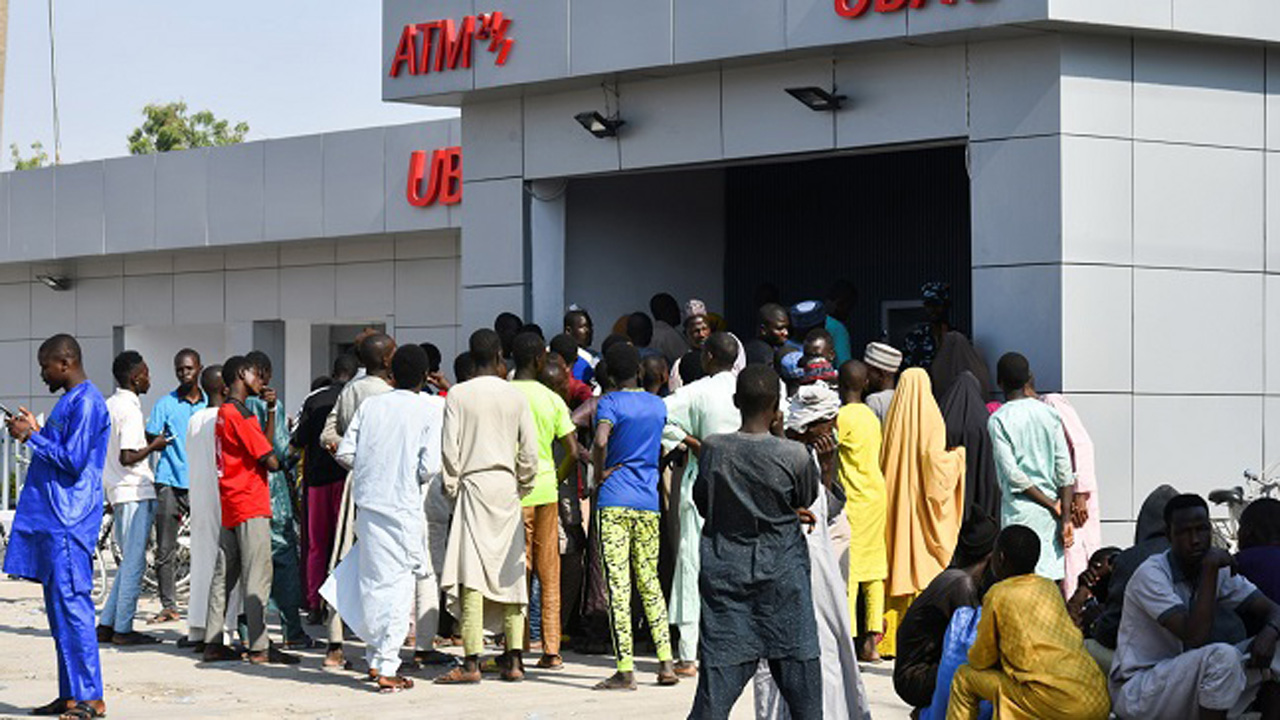

A few days before the fateful date, very few banks were distributing the new banknotes, leaving Nigerians, the majority of whom live in poverty and depend on the informal economy, without cash, and therefore without money. (Photo by Audu MARTE / AFP)
Nigeria is now trapped in probably the worst disaster since the post-civil war. The soul of the country has since gone missing. In the seven and a half years of the Buhari government, more Nigerians have fallen into poverty and human suffering than ever before. Is this the much-vaunted end? How can a country function without its soul? There is no fuel, food, cash, or job.
The most frustrating hardship is that bank customers are no longer allowed access to their money in the banks. Most bank customers cannot even transfer money from one account holder to another. I gather that one bank customer collapsed and died on being told that he could not access the money in his bank account. You may have seen the video of a middle-aged man who stripped himself naked in a banking hall because the bank told him he could not withdraw his money. After stripping, he started sobbing uncontrollably and shouting.” “Make una give me my money let me go. Give me my money let me go…How many years? .More than 20 something years now. N520,000, and, you are telling me story. I can’t pay my house rent. My wife is about to die. You’ve frustrated me…My children, 7 years and 4 year, there at home. I can’t pay their school fees.
[ad]
If una wan shoot me, shoot me make I die. Make them shoot me, make I die. Make I forget my wife. Make I forget my children. Make una shoot me, make I die…”
That was the frustration of a young man who was denied access to his money in his bank account. He stripped naked and wept profusely inside the bank. Many like him, who could not approach the banks, have silently died at home, attesting to the monumental suffering in the land. Currently, Nigeria is dotted with uncertainty and confusion. We are standing in the long, dark night of a national nightmare. For the past eight years, we have been led by individuals who view the commonwealth and public life as means to increase their private wealth. Our directionless vessel is adrift on the broken pieces of the pre-existing legal order, ruled by those who sacrifice the common good for their private interests. But don’t give in to melancholy. Be hopeful. Let me wipe away your tears. Weep no more.
Let me tell you something important: the people can still win, but only when we are united. Divisions prevent us from winning. We need to find common ground for survival, development, change, and growth. On February 25th, we should not just change the President, but also the direction of our country. This is the moral challenge of our time.
We must repeatedly emphasize ad nauseam that the real crisis affecting Nigeria is not just a political leadership crisis, but a human development crisis. It is a constant challenge for our government to eliminate avoidable human suffering. Our greatest challenge in Nigeria is the challenge of being human. The government often boasts about big projects and dedicates itself to unnecessary tasks, neglecting the most important task of satisfying basic human needs. To assess the performance of any government, we must ask: can the people access food, water, shelter, electricity, fuel, basic human rights, and healthcare? If these basic needs are not met, the government reduces people to mere clever and extremely mischievous animals, lacking the humanity that makes us who we are. Lack of basic necessities, such as electricity, is crucial for a simple life, and the government must provide it to truly meet the challenge of being human.
[ad]
Our debt burden is crushing. When this generation passes, the succeeding generations—our children, grandchildren, and great-grandchildren—will not have finished repaying Nigeria’s debt before the end of the world. The most painful aspect is that we are not borrowing for investment in capital projects or production. We are borrowing for consumption and to pay salaries. The astronomical cost of running the federal government is scandalous, as is the high cost of running the state governments. State governors have been known to boast about the large amounts of money they receive compared to senators. Salaries and emoluments of federal and state government staff should be drastically reduced, regardless of who is affected.
We cannot afford to run extravagant and wasteful federal or state governments anymore. The cost of running the presidency, including maintaining a presidential fleet and constant travel, should be trimmed down.

For example, in the 2020 budget, about N3 billion was officially budgeted for travel allowances for the President and Vice-President alone. Why should a sitting President or Vice-President constantly travel at the expense of taxpayers? Why should a large number of government officials accompany the President on every trip abroad?
The presidency does not need to oversee 10 to 20 government agencies. Most federal agencies and commissions located in Abuja should be eliminated, merged, or consolidated into one or two agencies to reduce government bureaucracy and streamline operations. By virtue of Section 147 of the 1999 Nigerian Constitution, 36 ministers are required, not 43 or more.
[ad]
A minister does not need five official cars, five drivers, ten special assistants, and five personal assistants. A special assistant to a minister should not have their own special assistant. A deputy director of a government agency or ministry should not have five official cars and five drivers. A special advisor should not have their own special advisor, executive assistant, or a retinue of officials and cars.
Legislators should not have idle staff members who sleep in the office every day. Given that the Nigeria Police Force, Independent Corrupt Practices and other Related Offenses Commission (ICPC), and Economic and Financial Crime Commission (EFCC) perform similar functions, is it necessary to retain all three institutions? Retaining only one of them could save costs.
Slashing wasteful expenditures or extravagance of the federal government and federal legislature could make more money available for government operations and improve the welfare of the people. Therefore, my friends, I challenge you today to be hopeful and dream big.
[ad]

