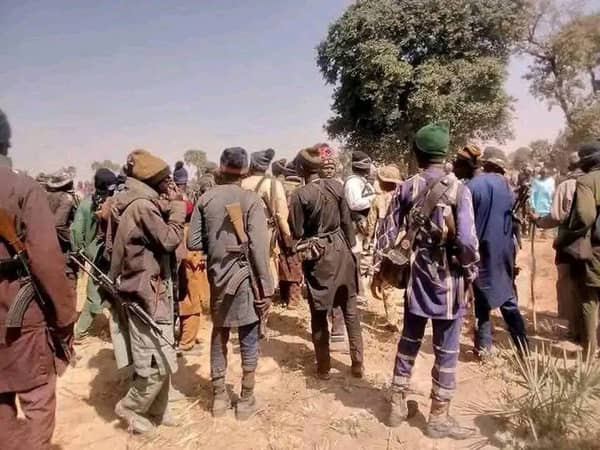
RECENT events in Brazil, including the 2001 kidnapping of Patricia Abravanel and the 2008 Eloá Pimentel tragedy, underscore the dangers of mismanaging hostage situations. Nigeria must draw lessons from these cases as terrorists are increasingly taunting security forces on social media, attempting to lure them into reckless confrontations that could endanger abducted schoolchildren.
Since the surge in mass kidnappings in 2014, President Tinubu stands out as the only Commander-in-Chief to personally lead a security “war room,” as shown in images and footage circulating in the media. His hands-on approach has produced early results: the rescue of 38 abducted worshippers in Kwara State and 50 schoolchildren in Niger State within 48–60 hours.
Although some victims in Kebbi and Niger are still in captivity, these outcomes suggest that when the presidency prioritises security, progress follows. It may be recalled that U.S. President Barack Obama was physically present in the war room to direct the targeting and neutralisation of the alleged mastermind of the 9/11 bombing by Al-Qaeda terrorists of the World Trade Centre in New York and the Pentagon in Virginia.
Tinubu’s decision to suspend his attendance at the G-20 summit in South Africa and the African Union meeting in Angola to focus on the kidnapping crisis has boosted his leadership optics. This contrasts sharply with previous administrations, which typically responded by merely directing service chiefs to “relocate to ground zero.”
After ordering Defence Minister Bello Matawalle to relocate to Kebbi, Tinubu personally took charge when another mass abduction occurred in Niger State. While some critics claim the war room lacked enough military presence, the mix of communication and intelligence specialists may explain the improved outcomes.
My experience as a Delta State commissioner during the era of militancy driven by resource agitators between 2003-2007 taught me that security cannot be left to armed forces alone. Community-level intelligence—“see something, say something”—is indispensable. Hence l set up an information office in all the local government headquarters in the state to obtain first-hand information from the grassroots.
President Tinubu’s approval of 30,000 new police recruits is therefore a welcome step. I have long argued that Nigeria needs at least 100,000 additional officers to meet UN standards of 222 to 100,000 people which is roughly one officer per 450 people. These were contained in my piece published on June 17 titled: “Democracy, GDP Growth, Poverty, and Insecurity in Nigeria.”
In that June 17 intervention, l made the case this way:
“Apparently, while President Tinubu has recorded significant progress in other segments of society as earlier catalogued, he appears to be confounded and overwhelmed by the alarming scourge of insecurity as evidenced by the escalation of killings in the past couple of years, especially in Benue and Plateau states.”
Continuing, l made the case that “The Benue State governor Hycinth Alia’s allegations that the killing of villagers in his state by heavily armed bandits who also burn the houses resulting in the villagers fleeing into the bushes while abandoning their homes and which is often followed by the arrival of herdsmen and their cattle should be investigated.”
I argued further thus: “That would help determine if indeed the attacks have international dimensions/elements and the invasion and seizure of our lands to be occupied by foreigners which is the unfolding scenario, is not a very high security threat to the sovereignty of Nigeria since the Wagner group (Russian private military contractors for hire) and other foreign mercenaries are currently operating in neighboring countries like Niger Republic, Mali and Burkina Faso which have withdrawn their membership of ECOWAS -a regional organisation serving the common interests of the nation that are located in the region” Additionally l stated in that piece that:
“In light of the above, it would appear as if instead of insecurity going down, it has been rising under President Tinubu’s watch.
That is not good optics for the incumbent administration.” Then l counsel that “As such, tackling insecurity needs to be prioritised by President Tinubu. It is a promise that he has made for the umpteenth time but the talk has not been transformed into action.
So, l would like to suggest that in the same manner that President Tinubu has significantly tamed inflation, stabilised the naira and ended petrol pump price subsidy, insecurity that is making the Benue and Nassarawa states look like killing fields, metaphorically, should compel the president to dorn his thinking cap and figure out, an out-of- the -box way, how to guarantee the security of the lives and properties of Nigerians who have been under siege…” In retrospect that was a fair assessment. If the advice had been acted upon at that point, perhaps our country might not have been labelled a CPC on November 30 by President Trump.
With vast ungoverned spaces, such as those in Niger and Kwara State, criminals will continue to find safe havens unless policing capacity is strengthened.
If President Tinubu’s administration scales this hurdle by warming up its relationship with the U.S. which has been tending towards being cold and recovering all the hostages compared to the Chibok girls who have remained missing since 2014, he would be credited for turning adversity into opportunity which would further reinforce his reputation as a political maverick.
Concluded.
Onyibe, an entrepreneur, public policy analyst, author, democracy advocate and development strategist wrote from Lagos.