 Follow Us on Google News
 Follow Us on Google Discover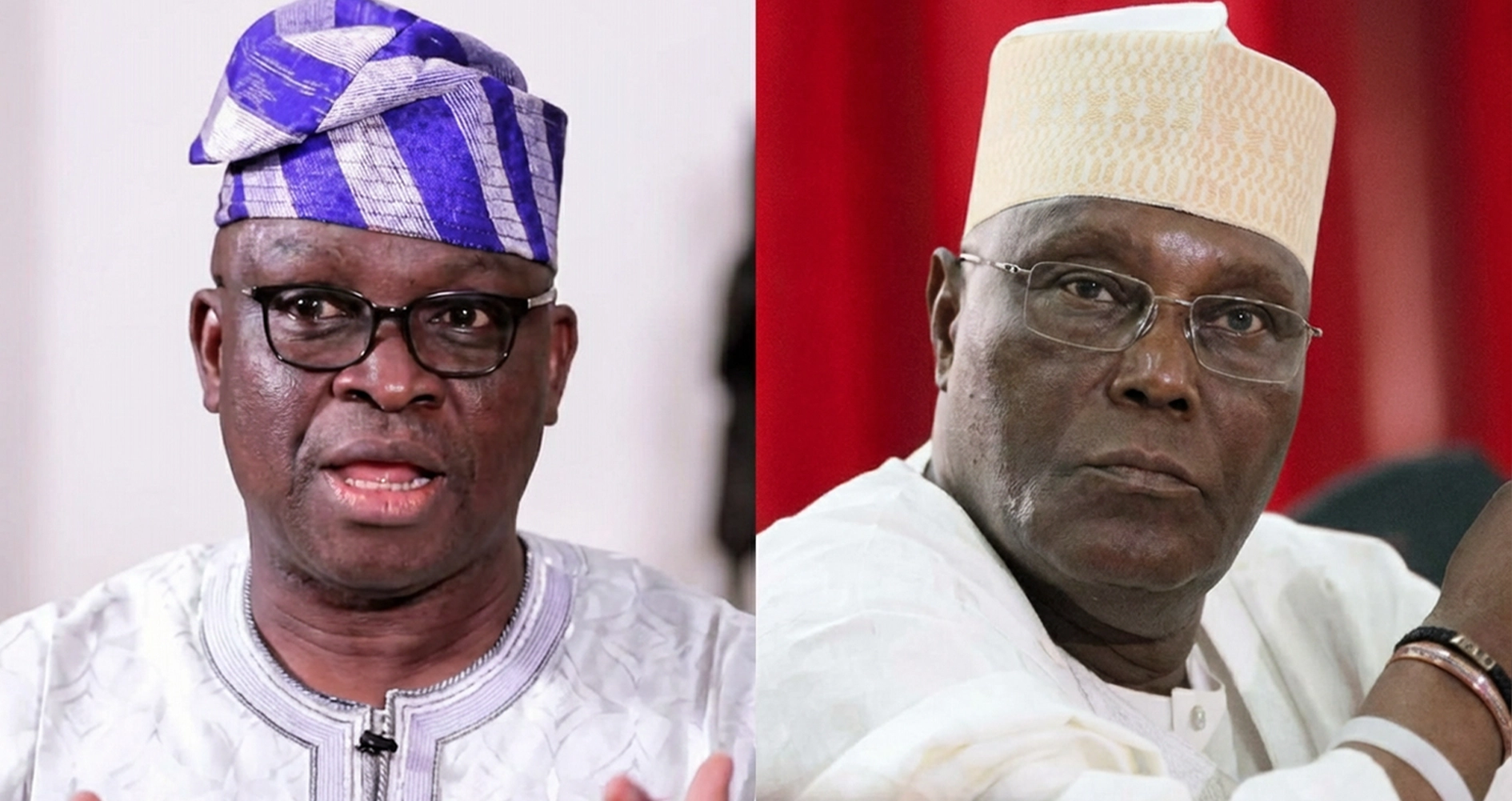
IT is a known fact that the man Ayodele Fayose is synonymous with theatrics in the nation’s political space and many observers are wont to see his actions and comments within the prism of comedy rather than anything of substance notwithstanding the fact that he is a two term governor of Ekiti State.
Fayose once again lived up to the billing when he recently circulated a dramatic narrative titled “Between Atiku and Makinde, Untold Story of What Happened in Minna Yesterday.”
Narrating his concocted story of what transpired between Governor Seyi Makinde, former Vice President Atiku Abubakar and a former military leader, General Ibrahim Babangida in his numerous verified social media accounts he claimed that Governor Makinde travelled to Minna for a strategic negotiation with former Vice President Abubakar.
According to him, Mr Peter Obi who is also a presidential contender in the African Democratic Congress (ADC) alongside Alhaji Abubakar would neither accept a vice presidential slot nor be acceptable to the North; adding that Atiku is 70 per cent certain” of securing the ADC ticket due to non-zoning; that Makinde demanded the vice presidential position as a condition for alignment and that N10 billion would be released in two tranches for party mobilisation for the former number two man.
As part of the deal according to the former Ekiti Governor, Southwest delegates would be delivered wholesale to Alhaji Abubakar while delegates from the South South would be secured through marital connections; that the Southwest would be tactically divided; and that a follow up meeting has been scheduled in Dubai within two weeks.
The warped narration is expansive. It is assertive. It is arranged with theatrical confidence but in terms of contents and fact, it is also entirely unverified, stripped of ornamentation. At best, it is fallacious.

What is presented as insider intelligence reads instead as constructed assertion, architecture without foundation, arithmetic without audit, performance without proof. In democratic discourse, imagination is not evidence. Assertion is not documentation. Repetition is not validation.
Public reasoning weakens when spectacle replaces substantiation. Political commentary becomes dangerous when confidence outruns corroboration.
Let us begin where institutional seriousness must begin: those allegedly present have categorically denied that such discussions occurred. When principal actors reject a narrative in its entirety, intellectual integrity demands restraint before amplification. What remains, therefore, is not disclosure but declaration; not access but assumption.
The first visible fracture appears in the performance of precision: “Seventy per cent certain.” Precision, when detached from methodology, is rhetorical theatre. Where is the institutional instrument? Where is the delegate census? Where is the procedural framework that generates this arithmetic? Percentages without process do not clarify reality; they simulate inevitability.
Yet within this theatrical arithmetic lies an unintended acknowledgement. The very suggestion that Atiku stands at “70 per cent certainty” to secure the ADC ticket reflects something observable. Political seriousness leaves evidence of its own.
History is filled with political prophets who trade in per centages as though they possess celestial polling machines. The problem is not confidence in preparation; the problem is the presumption of private arithmetic without public process. Political strength is built through structure and engagement, not announced through speculative percentages. Numbers without institutional basis are not analysis. They are performance.
Then comes the dramatic N10 billion assertion. It appears abruptly, fully formed, unsupported and unverified. It is pronounced with certainty yet anchored in nothing demonstrable. No documentation accompanies it. No corroboration sustains it. It is announced and left suspended in the air. Such declarations do not elevate discourse; they inflate spectacle.
Speculation does not gain authority through repetition. Noise multiplied is still noise. But beyond the absence of evidence lies a more revealing pattern.
This is not the first time Fayose has ventured publicly into narratives that subtly attempt to frame tension between Atiku Abubakar and Peter Obi. The recurring invocation of incompatibility, succession anxiety, regional acceptability, and hypothetical resistance mirrors a consistent effort to suggest rivalry before democratic processes have even commenced.
It is equally striking how persistently Governor Seyi Makinde is positioned at the centre of these speculative constructions. The storyline revolves less around verified political development and more around a sustained attempt to portray Makinde as architect of conditions, broker of leverage, financier of intrigue, and pivot of division. When commentary repeatedly inserts the same individual into elaborate frameworks of unverified negotiation, it raises a legitimate question: is this analysis, or is it disproportionate fixation reframed as strategy?
Political disagreements are normal. Strategic calculations are inevitable. But when one actor is consistently cast as the axis of intrigue without verifiable foundation, the pattern becomes instructive. It suggests projection more than perception.
To project incompatibility before formal engagement, to speculate on succession acceptability before party primaries have convened, and to assign internal arithmetic before delegates have assembled is not neutral commentary. It is narrative positioning.
Political observers are entitled to ask whether this pattern reflects detached analysis or strategic agenda.
It is equally on record that Fayose has, on several occasions, publicly expressed support for President Bola Ahmed Tinubu. That political choice is constitutionally his. However, when an actor who has openly aligned himself with the incumbent establishment becomes intensely invested in forecasting fragmentation within an emerging opposition platform, scrutiny becomes inevitable.
If the repeated emphasis is division, and the projected outcome is suspicion within ADC ranks, then the practical effect, intentional or otherwise, is to weaken opposition consolidation before it matures. That is not incidental commentary. That is strategic narrative intervention.
It is therefore unsurprising that narratives of incompatibility, succession anxiety, and internal tension surface with urgency. When consolidation is visible, projection becomes a defensive reflex. The fear is not of numbers on paper; it is of structural convergence in practice.
The repeated attempt to forecast discord before constitutional processes unfold reflects not analytical detachment but political apprehension. When commentary becomes incessant, when hypothetical fracture is rehearsed before any formal contest has begun, when unity is framed as rivalry in advance of procedure, it signals restlessness rather than confidence.
Democratic institutions cannot be reduced to corridor scripts. Political parties are not chessboards awaiting speculative rearrangement. They are governed by constitutions, internal procedures, consultations, and votes.
The African Democratic Congress is not a prop in anyone’s dramatic reconstruction. It is a constitutional political platform with mechanisms of internal accountability. Its presidential candidate will emerge through its primary process, not through invented percentages, not through speculative arithmetic, and not through theatrical narration.
Former Vice President Atiku Abubakar has demonstrated readiness to subject himself to the democratic discipline of the African Democratic Congress primary process. That posture reflects confidence grounded in preparation. Politics rewards structure, not speculation.
Within the ADC, engagement amongst gladiators continues to widen. Institutional discipline continues to strengthen. Serious political movements are not assembled in headlines; they are constructed through groundwork, consultation, coalition building, and constitutional adherence.
Momentum does not declare itself through theatrical flourish. It consolidates methodically. It expands strategically. It stabilises incrementally. History has consistently favoured disciplined preparation over dramatic invention and when the moment of decision arrives, only what has been patiently organised, constitutionally grounded, strategically consolidated, and publicly validated will stand.

