 Follow Us on Google News


 Follow Us on Google Discover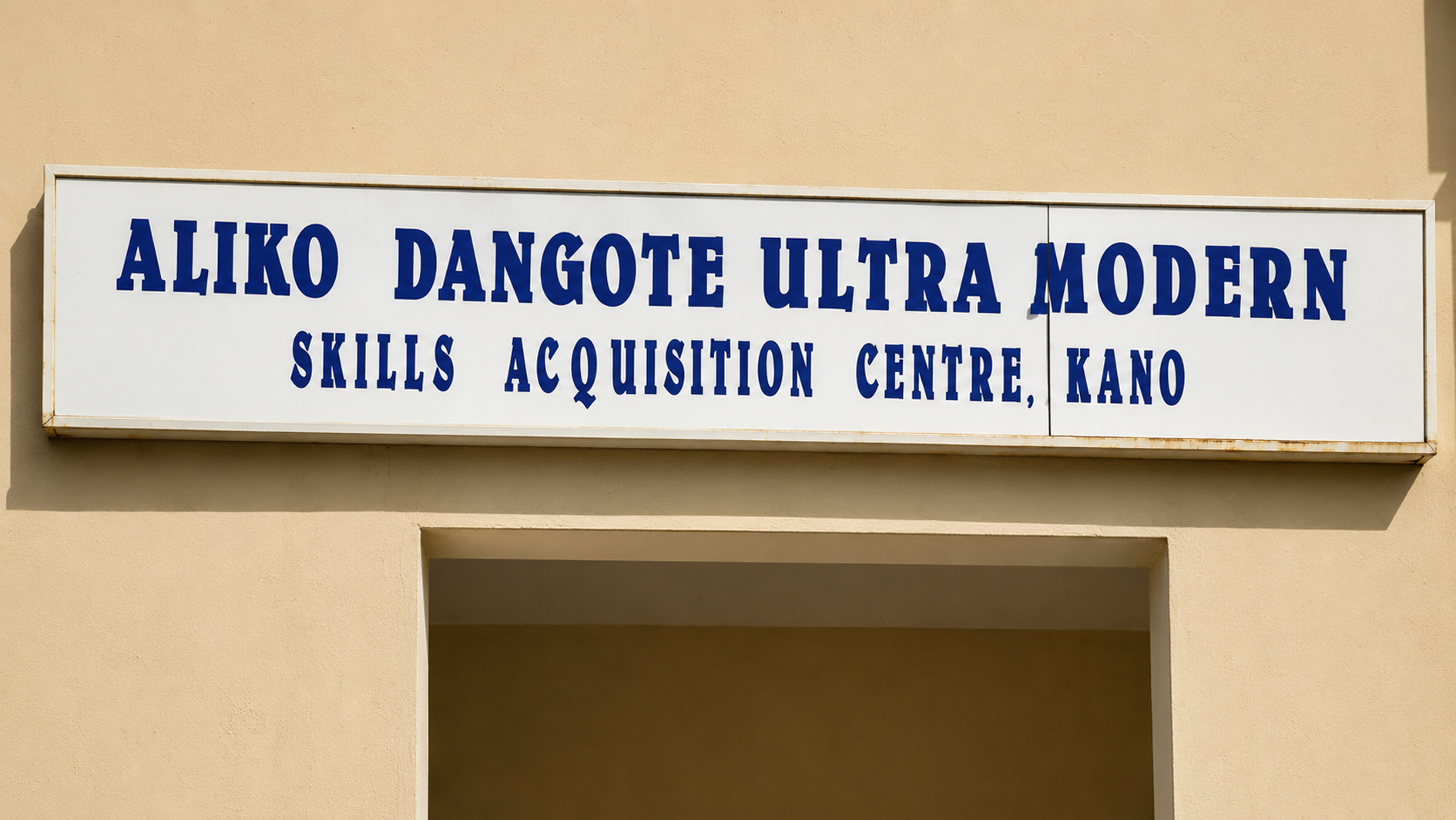
By Aliyu Aziz-Abubakar
A short citizen-journalism video has been moving steadily through Nigerian social-media feeds in the past weeks. In it, the broadcaster Bello Galadanchi walks through the Aliko Dangote Ultra-Modern Skills Acquisition Centre on Zaria Road in Kano. Room after room, his camera records the same scene: printers under a layer of dust, motherboard testing rigs sitting idle, sewing machines worth millions of naira gathering cobwebs, dismantled engines arranged for student instruction with no students present, a pigeon roosting calmly in a workshop because as the narrator observes with quiet bitterness, the bird seems to value the place more than we do.
On March 3, 2026, Daily Trust published a careful investigation confirming the substance of what the video documents. Sixty-three directly recruited members of staff had reported for duty for nearly nine months without salary. The last payment to most of them was in May 2025. The Chief Press Secretary to the Governor confirmed the basic facts: “The Governing Council had been dissolved, no replacement had been appointed and Aliko Dangote had consequently halted his contributions because there was no board to provide oversight.
On April 1, 2026, the Federal Ministry of Education issued a press statement of its own. The centre, the ministry insisted, is not abandoned. Three hundred trainees have been undergoing training there since November 2025 under the Federal Government’s Technical and Vocational Education and Training (TVET II–IDEAS) Programme, in three trades – leather works, solar photovoltaic installation and hospitality. Dangote, the Ministry disclosed, has now committed to managing the facility for the next 20 years.
Both statements are true. Both are also incomplete. The centre was designed for 20 trades and had 1000 trainees per cycle. Three trades and 300 trainees are currently active. That is roughly 15 per cent of the designed capacity. Seventeen of 20 workshops remain dormant. The directly recruited Kano workforce that built and ran the centre has, at the time of writing, still not been paid for nine months of work. The viral video and the federal rebuttal are each describing a part of the same elephant.
I write here as a structural engineer who has spent three decades at the intersection of design, regulation, and digital infrastructure – including eight years building the National Identity Management Commission (NIMC) into a system that today carries over 100 million records. The vantage point matters. The Kano centre is not, in the first place, a building problem. It is not, in any deep sense, a funding problem. It is a governance-design failure of a kind any engineer would recognise immediately: a coupled techno-institutional system commissioned without the analytical instrumentation that would have made its trajectory predictable in advance. The diagnosis is straightforward once it is named. So is the prescription.

A single point of failure permitted whole system to fail
The centre’s tripartite funding architecture – 35 per cent state, 35 per cent Dangote and 30 per cent local governments – was, on paper, fiduciarily sound. What it lacked was the most elementary engineering provision: a fail-safe for the most ordinary administrative event imaginable, namely the routine dissolution of a board at the close of a political cycle.
When the board went, Dangote’s contributions paused-and quite properly so, since no responsible philanthropist transfers funds to an entity with no oversight framework. When his contributions paused, the local governments had no incentive to continue contributing alone. When all three contributions stopped flowing in coordination, the salary line collapsed. A N5.5 billion machine, equipped with a European-imported plant and certified to the National Skills Qualifications Framework, was failed by an unfilled appointment letter.
This is the market-design equivalent of a structure with one critical load path, no redundancy, and no fuse. No chartered structural engineer would certify it for occupancy. The Kano architecture was certified to absorb the fortunes of a generation of unemployed Northern youth.
Institutional memory bleeds out while the building still stands
The 95 per cent of the curriculum that is currently dormant-automotive engineering, computer assembly, technical drawing, welding, plumbing, refrigeration, electrical installation, metalwork, electronics, fashion, leatherwork at scale, block work and concrete production, renewable-energy systems integration-was designed and delivered by people.
Trainers were recruited, certified, and given two to four years of practical experience teaching it. Every month those trainers sit at home unpaid is a month of certified institutional knowledge bleeding into the informal economy or out of Kano altogether. By the time the centre is eventually reopened in those trades, re-recruiting and re-certifying that workforce will cost many multiples of what it would have cost to retain them. This is the iron law of institutional decay: the cost of rebuilding a capability is many multiples of the cost of maintaining it.
The reputational damage to Nigerian public-private partnerships is real and quantifiable
Every potential philanthropist watching this episode is learning a lesson – a wrong one. The lesson is: governance risk in Nigeria can erase your capital regardless of how well-intentioned you are. That single sentence will quietly cost this country far more than N5.5 billion in deferred future investment over the coming decade. It will be felt in every health PPP, every transport PPP, every digital infrastructure PPP that fails to materialise because a foundation officer somewhere recalls the Kano file. Reputational capital is harder to rebuild than physical capital, and we are spending ours.
A partial federal rescue is welcome, but partiality has its own costs
The TVET II–IDEAS arrangement is to be commended in itself. Three hundred trainees in three trades is a great deal better than zero trainees in zero trades, and the Federal Ministry of Education deserves credit for moving when it did. But the design of the rescue matters as much as the fact of it.
Routing federal funds through a parallel arrangement that bypasses the centre’s directly recruited staff sets a precedent that will haunt every future state-led skills initiative. The signal it sends to subnational technical and vocational workforces is that the federal level will rescue equipment, but not people. That is unsustainable both morally and operationally. Equipment without trained operators is metal. The rescue will not endure 20 years on those terms.
What an engineered recovery would look like
A recovery worth the name proceeds in layers, none of which can be skipped without producing a temporary recovery and a second collapse within two political cycles.
In the first 30 days, the government of Kano State should settle the nine months of salary arrears as a humanitarian and contractual obligation, decoupled from any restructuring debate, and reconstitute the Governing Council by gazette with named members and published terms of reference. This is not a policy question. It is a wage question.
In the next 90 days, the centre should reopen admissions for the 17 dormant trades alongside the three federally funded ones, and commission a full equipment audit before warranty, calibration, and spare-part windows close permanently. There is a closing window here that engineers will recognise and lawyers and economists will not.
Within six months, a Kano State Skills Acquisition Authority Bill should convert the centre from a Governor’s Office appendage into a statutory autonomous agency, with a Governing Council insulated from cyclical political dissolution. The enabling law should embed what I would call a PPP Continuity Clause: if any funding partner defaults, the others trigger a 90-day cure period before any service interruption. That single provision would have prevented the present collapse.
Within 12 months, the funding architecture itself should be diversified beyond the fragile thirty-five-thirty-five-thirty model. A graduate income-share component, repayable through NELFUND-style infrastructure, would couple the centre’s revenue to the labour-market success of its alumni-precisely the feedback signal a skills institution most needs. The Tertiary Education Trust Fund, the Industrial Training Fund levy, GIZ, the Agence Française de Développement, the World Bank IDEAS facility, and the Aliko Dangote Foundation’s new ten-year ₦100 billion education programme should be brought in as standing co-financiers, not one-off rescuers.
Within 24 months, the lessons of Kano should be codified into a Nigerian TVET Continuity Code, a model legal instrument for adoption by all states with significant public-private skills assets, so that what happened in Kano cannot be repeated in Lagos, Rivers, Adamawa, or anywhere else. The Nigerian Institution of Structural Engineers, the Council for the Regulation of Engineering in Nigeria, the Nigerian Society of Engineers, the National Board for Technical Education, and the Industrial Training Fund are well placed to champion such a code jointly.
The discipline that was missing
Skills institutions are the slow infrastructure of competence. Their value compounds invisibly for years and then suddenly, decisively, becomes the difference between a country that can build and maintain itself and a country that imports its own future. Kano had assembled, at substantial public and philanthropic cost, exactly such an institution. Most of the machinery is still there.
Most of the trainers, with arrears settled and a credible governance structure restored, would come back. What is required is not heroism. It is competence. The appointment of a board, the writing of a law, the payment of a salary, the publication of a continuity covenant-these are the most ordinary acts of public administration. Their absence is what we are now paying for. Their presence is what will save the centre.
The window in which engineering thinking can still salvage the asset is finite, measurable in months, not years. After that, we will not be writing articles about how to save the centre. We will be writing articles about how it was lost.
Aziz-Abubakar is the Deputy President of the Nigerian Institution of Structural Engineers, principal partner at Integrated Engineering Associates and former director-general and chief executive of the NIMC. He continues to serve as an Ambassador for ID4Africa.

