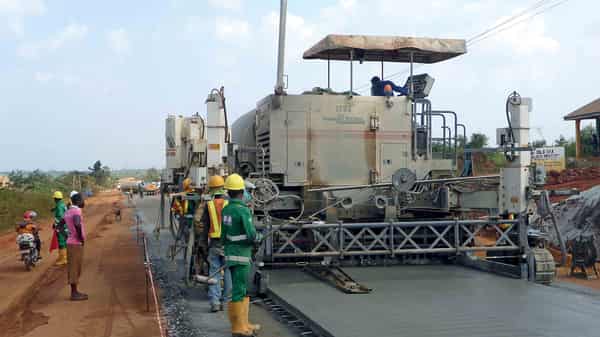
The growing preference for concrete roads across Nigeria signals a positive shift in the country’s infrastructure development strategy, with the federal government spearheading that preference. However, considering the rising cost of cement, the main ingredient in concrete roads, the government needs to collaborate with producers for a practical strategy to balance demand with supply. That synergy is the only way to sustain the envisaged advantages of concrete roads.
In recent years, the clamour for concrete roads across Nigeria has grown louder — and for good reason. Concrete roads are more durable, require less maintenance, and are better suited to Nigeria’s climate and heavy-duty traffic than asphalt alternatives.
However, as states and the federal government ramp up efforts to replace crumbling infrastructure with longer-lasting concrete alternatives, a new crisis is emerging: cement supply is struggling to keep pace. This shortfall is not just a market inconvenience — it’s a policy failure in the making. Cement, the bedrock of concrete production, is in high demand — not just for roads but also for housing, commercial development, and industrial construction.
Experts have blamed the surge in cement demand on a growing preference for concrete in road construction across the country. The Minister of Works has maintained government preference for concrete construction for 70 per cent of federal roads. Experts also noted that a kilometre of dual carriageway motorway will consume about 2,500 tonnes of cement. Following this estimate, the first phase of the Lagos- Calabar coastal highway, which is 47.5 kilometres, will consume 118,750 tonnes of cement that will construct an average of 8,500 homes.
Nigeria’s housing deficit remains a towering challenge, with over 28 million citizens in need of decent shelter. Yet, even as governments promise affordable housing and private developers eye rising urban demand, one fundamental barrier threatens to bring the entire dream crashing down: an inadequate and unstable cement supply.
Cement is the foundation—literally—of Nigeria’s construction sector. From the walls of new homes to the pillars of urban high-rises, its role is indispensable. But when supply lags behind demand, prices soar, and affordability becomes a distant fantasy for millions of Nigerians.
Over the past year, erratic cement production, supply chain disruptions, and market speculation have sent prices climbing to record highs. What was once a challenge for road and infrastructure projects has now spilt over into the housing sector, compounding an already dire crisis.
Low cement production creates an inflationary spiral. Developers, already grappling with rising costs of steel, labour, and land, are forced to pass the burden onto buyers. For the middle class, this means postponing homeownership. For low-income Nigerians, it means exclusion—shut out of the housing market and forced into overcrowded, substandard dwellings.
Public housing schemes are not spared either. Projects meant to provide affordable homes are either delayed, downsized, or abandoned entirely due to unmanageable input costs. Meanwhile, the informal construction sector—where many Nigerians build homes incrementally—is gasping under the weight of price volatility.
Nigeria’s three major cement manufacturers, despite their dominance in West Africa, are overstretched. Prices have surged, supply chains are under pressure, and the ripple effects are threatening to derail many infrastructure projects.
For policymakers, this is a crucial inflexion point. Infrastructure planning cannot be done in isolation from industrial capacity. If the national push for concrete roads is to succeed, Nigerians must urgently realign their economic and industrial policies to support it.
This is a classic case of progress outpacing preparedness. While it is commendable that governments are embracing concrete roads as a sustainable solution, the transition requires careful planning and coordination with the supply side of the equation. Without adequate cement supply, projects stall, costs inflate, and public confidence erodes.
To address this, a multi-pronged approach is needed. First, cement manufacturers must be incentivized to expand production capacity. This includes granting access to financing, tax incentives for plant expansion, and easing regulatory bottlenecks.
Second, governments must time project rollouts based on realistic supply forecasts, avoiding the clustering of major road contracts that spike demand uncontrollably. Third, we must explore alternative and supplementary construction materials. Innovations such as geopolymer concrete or the use of industrial waste in cement production could relieve pressure on traditional cement demand, while also promoting sustainability.
Ultimately, the demand for concrete roads is a sign of progress. But without strategic planning, it risks becoming a source of frustration. Nigeria must act decisively to bridge the gap between infrastructure ambition and industrial capability — because a road half built is worse than a road not started at all.
Nigeria’s infrastructure ambition must be matched by industrial foresight. If concrete roads are to be the future, the country cannot afford a cement crisis in the present. Policymakers must act now — not just to build roads, but to build the capacity to sustain them.
The role of cement producers in addressing the demand for concrete roads and ensuring the sustainability of this infrastructure shift is both strategic and indispensable. Cement producers must anticipate future demand trends and invest in plant expansion, modern equipment, and improved production technologies. Rather than reacting to shortages, they should lead in scaling up output to meet national infrastructure goals.
Producers should actively participate in infrastructure policy dialogues. A coordinated approach with the Ministry of Works, Ministry of Industry, and other stakeholders can help synchronise production timelines with project rollouts — avoiding market shocks and supply gaps.
They should innovate beyond traditional Portland cement by developing and promoting specialised products like rapid-setting or high-performance concrete suited for road construction. These can reduce construction time and improve durability. It’s not just about producing more cement — it’s also about delivering it efficiently. Cement companies should invest in robust logistics, warehousing, and distribution systems, especially in underserved regions where road projects are expanding.
Producers should collaborate with universities, research institutes, and engineering bodies to pioneer alternative cementitious materials and low-carbon solutions. This would not only reduce pressure on limestone but also align with global climate goals.
Producers have a role to play in curbing artificial scarcity and price manipulation. Transparent pricing, fair distribution policies, and responsible marketing are essential to maintaining public trust and project viability.
As beneficiaries of major public contracts, cement companies should reinvest in host communities — through employment, infrastructure, education, and environmental stewardship — helping to build the social licence for growth.
Demand for concrete roads amid cement shortfall: Matters arising