 Follow Us on Google News


 Follow Us on Google Discover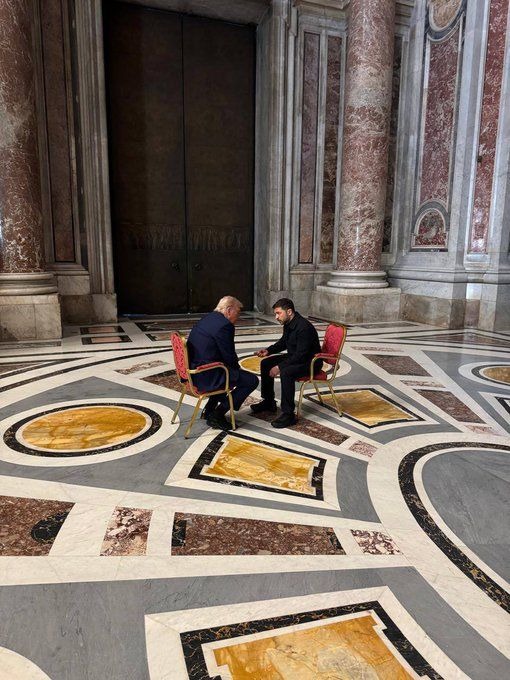
Poetry
St. Peter’s Basilica Diplomacy,
No prophet(ess) saw this prophecy.
At the end, The Church is for everybody.
So Simple,
No Table.
Two Presidents so gentle.
So Bare,
No flare,
Two a chair.
Papalplomacy
Vatican City: Papalplomacy refers to the diplomatic activities, influence, and international relations efforts conducted by The Pope and The Holy See (the central governing body of the Catholic Church). Papal diplomacy dates back centuries—long before modern nation-states—when Popes acted as mediators among kings and empires.
This has continued into modern times. The Holy See, not Vatican City itself, is recognized as a sovereign subject of international law, maintaining diplomatic relations with countries. Its diplomats (nuncios) act much like ambassadors.

The diplomatic history of the Holy See goes back to the early centuries of Christianity, when Popes served as mediators between European kingdoms and empires.
By the 15th century, the Holy See had established formal diplomatic missions, known as nunciatures, solidifying its role in European and global politics.
Despite the loss of the Papal States in 1870, the Lateran Treaty of 1929 restored the Holy See’s sovereignty through the creation of Vatican City, allowing it to resume full diplomatic functions.
Today, the Holy See maintains diplomatic relations with over 180 countries and holds observer status at the United Nations, continuing to influence global affairs through moral authority and religious diplomacy.
In my humble space—and I am not name-dropping (far from it)—I have been mingling with diplomats and ambassadors (retired, past, and present) since the early 2000s.
If my memory serves me right, the first was either Professor Bolaji Akinyemi (Nigeria’s Foreign Affairs Minister in the 1980s) or Chief Olusegun Olusola (Nigeria’s Ambassador to Ethiopia in the 1980s).
Since then, that circle has evolved and enlarged. One characteristic the public does not quite know about diplomats is that—from my proximity—most diplomats are very thoughtful Christians or Muslims.
Their religious beliefs are not meant for public consumption. Even the young diplomats I have come to know in recent years are quite religious people. I reiterate: most diplomats are religious persons. Why so?
There must be something about diplomacy and international relations that draws those in it—or who analyse it—toward God Almighty. So, I was quite intrigued to see how diplomacy on the global stage played out at St. Peter’s Basilica in Vatican City.
Presidential Padres
Like everyone else, I was glued to all available media platforms and watching the livestream of the funeral of Pope Francis. Two platforms were doing the Lord’s work professionally and seamlessly.
Notably, Vatican News and BBC World were streaming the event live on their YouTube platforms. I was also following real-time social media posts from individuals and institutions on the ground.
Whether you were a Christian or a follower of other religions, you probably must have been saying a silent prayer for Pope Francis—and yourself—during the event.
Also, you probably must have been looking at the important dignitaries and famous faces in attendance. And as an African, you probably were looking for African leaders who knew the importance of this global event and who made it in person to Rome.
From an international relations perspective, as a leader, it was not an event to delegate or to be absent from. There are some functions you don’t delegate to others.
No matter how vivid your imagination was, you could not have envisaged the iconic image that surfaced during the funeral procession of Pope Francis. It was the image of U.S. President Donald Trump and Ukrainian leader Volodymyr Zelensky discussing.
This image was from the meeting between both Presidents, which was held before the funeral of Pope Francis. It was their first physical meeting since the Oval Office shouting match cum showdown, which was televised globally.
The particular image of both leaders, where they looked minute and small in the grand interior of the Basilica, will be one of the most iconic images of this decade.
The backdrop of this fifteen-minute meeting was inside the huge, marbled St. Peter’s Basilica. Both leaders looked so engrossed in their conversation. No aides. No tables. No microphones. No egos. Just two men with a lot on their shoulders—for their countries and for different reasons.
That image showed the enormity of leadership. That image showed how humble mighty and minor men are in God’s presence. Until one of them informs the world what they discussed, we will never know. Only God knows what they talked about in His Church.
Pope’s Persona
Pope Francis was the leader of the Vatican, and a lot of pieces have been written about him. From a journalist and strategic communications perspective—and from the perspective of a writer who has written Christian content articles for the Ayoba App—one simple and easy-to-understand piece stands out.
Titled “An Intimate Look at Pope Francis’s Life at the Vatican” by Melissa Sartore for National Geographic, it speaks volumes of the Pope who was just different.
Paraphrasing Melissa Sartore:
“Each morning, Pope Francis awoke before dawn in his modest accommodation at Casa Santa Marta, the Vatican guesthouse. By midday, the Pope had undertaken any number of duties, preferring to manage his schedule personally. Phone calls to colleagues and friends, meetings, and other appointments preceded lunch, after which he took a siesta.”
She continued: “His afternoons were often spent visiting prisons and juvenile detention centers, consulting with ambassadors to the papacy, or making appointments. Once a week, he received a soccer update from a member of the Swiss Guard—a necessity since the Pope stopped watching television in 1990.”
Concluding, she stated: “His evening meal was again taken among his fellow residents at the Casa Santa Marta. True to form, he never dined alone. Once back in his austere domicile, Pope Francis ended his day as it began—quietly. Each night, the pontiff read before drifting off to sleep.”
With the stories of Pope Francis making the headlines, it is glaring he walked what he talked, even to the end. A lot to learn from him by all and sundry.
One such lesson is: don’t exclude human beings from the Church; bring them to God’s house and let God handle the rest. Another lesson is: don’t play politics in the Church, for God will always do His will.
Precise Projections
Dr. Victor Oladokun, a Nigerian Irish-American veteran media personality who grew up Catholic and attended a Jesuit Catholic high school, puts it best in a recent post: “There is an age-old Vatican adage that says, Chi entra in conclave papabile, ne esce cardinale—meaning, ‘He who enters the conclave as papabile (Pope material or a most likely candidate to become Pope) always comes out a cardinal.’
The adage carries with it a spiritual sting. It is a reminder that human ambition—even those cloaked in red robes—bows to the Holy Spirit’s unpredictable will.
All through history, Cardinals tagged as ‘Pope material’ have been known to strut into the Sistine Chapel with the buzz of certainty hanging over them like incense. However, as has often been the case, their meticulously laid plans are humbled beneath Michelangelo’s paintings.
The Holy Spirit, it seems, delights in flipping the script, choosing a dark horse, while the frontrunners clutch their rosaries in vain.
The lesson? In the conclave, as in faith, papabile who believe their own press or the pundits are often schooled in humility, as they exit once again as mere cardinals, their egos checked by a Higher vote.
After all, the conclave is not supposed to be a political race but a sacred surrender, where pride takes a back seat, and where God’s script always has an unexpected twist.”
I am not a pastor, prophet, nor do I see prophecies, but my humble opinion is that what the secular world calls momentum in politics tends to take place in the conclave. Some tend to term it momentum during elections, while some term it the movement of the Holy Spirit.
One thing is immaculately crystal-clear: as the confirmed 133 Cardinals participate in the upcoming conclave to elect the next Successor of St. Peter on Wednesday, May 7, the Cardinal who ends up being the 267th Pope will not go with the script.
That is, the favourite before the conclave’s doors are shut usually does not end up being the Pope. This was again proven by Pope Francis, vis-à-vis a verse in the Book of Isaiah.
As Isaiah 55:8–9 states: “For My thoughts are not your thoughts, neither are your ways My ways,” declares the Lord. “As the heavens are higher than the earth, so are My ways higher than your ways and My thoughts than your thoughts.”
Everything that has taken place in the last three weeks at the Vatican reiterates that God truly works in mysterious ways.
Aina a global strategic communications consultant and founder of The Write Communications.

