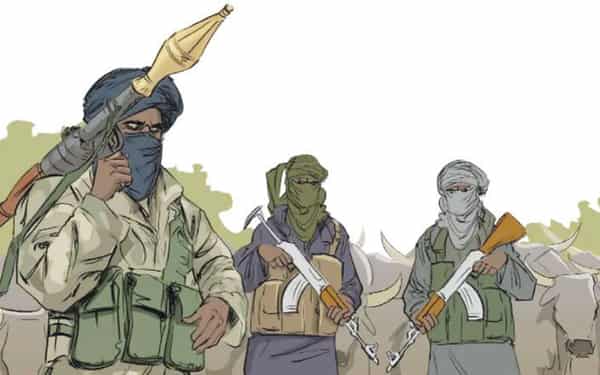
With the United States of America (USA) President, Donald J. Trump, recently announcing that he is ready to send his country’s military “guns ablazing” to flush out those he referred to as Islamic jihadists killing Christians in Nigeria, it is as if a hornet’s nest has just been stirred — with bees going amok and stinging anyone and everyone in sight.
The state of insecurity has gone so dire in a space of less than one month that Abuja the seat of federal government is said to have become no longer safe. The ugly situation has compelled the law makers who are based in Abuja to actively start helping President Tinubu seek solutions to the crisis.
And just as President Bola Tinubu’s administration was celebrating the recovery of the 24 schoolgirls abducted in Kebbi State and the 38 church worshippers kidnapped in a church Sunday , 23rd November in Kwara State — even while security agencies are still scrambling to secure the release of the rest of the more than 300 girls abducted from a school hostel in Niger State — multiple kidnappings have continued unabated across the middle and northern states of Nigeria.
In fact, in the past one month, it would appear as if no Sunday has passed without the kidnapping or attempted kidnapping of innocent Nigerians and churchgoers. Presumably, school children (students), worshippers and travelers have become easiest targets for the criminals due to the large number of persons that can be abducted in one fell swoop by criminals.
Given the state of insecurity in our country, following the heightened rate of kidnappings and killings, and as a demonstration of my consistency in calling for the deregulation and decentralisation of the Nigerian Police, l have decided to republish this article, which l originally wrote and published on January 15, 2002, about 23 years ago.
It is such welcoming news that President Tinubu appears to be on the path to becoming a jinx breaker if he follows through on all his policy pronouncements including the national state of emergency on insecurity aimed at resolving the current crisis bedeviling our beloved country.
Below is the full article which l originally published 23 years ago (when Olusegun Obasanjo was the president) in my column and multiple traditional and online newspapers.
Deregulating national security system
The belief in some quarters that the Nigerian Police has been overwhelmed by criminals may at first sound like an exaggeration of the situation but evidence abound that the nation is at the brink of anarchy owing to the spate of civil strife and armed banditry occurring around the country since the advent of democratic system of government some two years ago.
The dismal security situation in the country which has now been further exacerbated by the recent assassination of Chief Bola Ige, the nation’s charismatic Attorney General and Justice Minister has further eroded the confidence of the few Nigerians who had been loath to give up on the nation’s security system.
Apparently embarrassed by the surge in crime at the nascent stage of this administration, President Olusegun Obasanjo proposed and the National Assembly endorsed a generous increase in the year 2000 budgetary allocation to the police force. This was followed by improved welfare scheme for officers and men as well as a recruitment drive for four hundred thousand more personnel to make up for the inadequacy of human and material resources believed to be plaguing the force
Laudable as these policy initiatives are, crime and ethnic clashes in the country have been on the rise rather than decline. In the light of the above it is now apparent that the problem of the Nigerian Police does not entirely rest on lack of personnel and tools to work with. Rather, it is a question of the increasing sophistication of the Nigerian society which is geometrically proportional to the arithmetic progression of the Nigerian Police Force.
In fact, pundits argue that if there is any progress at all in the Police, it must be cumulative experience arising from persistent practice rather than adoption of modern methods of crime prevention which is the ideal expectation.
The above assertion is underscored by the fact that with the world increasingly becoming a global village via developments in information/communication technology, the interface of people in the so-called first world like Europe and the United States with people in the third world like Nigeria has remarkably increased to the extent that knowledge gap has greatly been reduced. For instance, at the click of a button, an average person in Nigeria has access to the same information as his counterpart in the United Kingdom or the United States via the Internet.
As a result of such virtual integration, the sophisticated attitudes and activities of the advanced societies have been rubbing off on our society. This implies that just as positive knowledge such as science and new technology as well as lifestyles are within the reach of every interested Nigerian so also does insidious information relating to criminality beckon to criminally minded ones.
Sadly while security systems in the advanced societies have been geared towards managing sophisticated crime in their society, our security system, no thanks to dysfunctional infrastructural facilities like electricity and telecommunications, is in quandary and therefore unable to cope with sophisticated crimes. Take for instance the professionalism applied in the assassination of Chief Bola Ige as evidenced by the fact that he was shot with a bullet that dissolved inside his body and the careful planning that ensured that his security details were effectively out of the way at the time the crime was perpetrated.
It is not by chance that the executors of this dastardly act spared no effort in ensuring that they left no trail either through the bullet or eye witnesses such as the security men who could have put up some resistance and therefore attract attention. Indeed, I am convinced that the present difficulties being experienced by the police in apprehending the culprits of this heinous crime, several weeks after, is attributable to the dexterity of the criminals.
The prayer now is that Ige’s assassination should not join the list of celebrated and unsolved murder cases by the Nigerian Police which includes the gruesome murder of Newswatch magazine Editor, Dele Giwa, via parcel bomb in 1986 and the assassination of Octogenarian nationalist, Pa Alfred Rewane in cold blood, in 1995.
Having catalogued the increasing sophistication of crime in Nigeria and the frustrations of the police that is compelled to use primordial methods and tools to fight it, it is obvious that nothing short of a radical rethinking of the nation’s security system is necessary for the ugly trend to be reversed.
One of such radical ideas that lends itself to our present situation is the deregulation of the security system in the country. Although this may sound naive and even simplistic, the truth is that the solution to the burgeoning security situation in Nigeria is the deregulation of the sector.
For the avoidance of doubt, deregulation is about private sector involvement in providing efficient and effective services hitherto considered to be social services and therefore exclusively offered by public institutions which are inefficiently managed.
Evidence of the dividends of deregulation is the current improvements in telecommunication services in Nigeria which is attributable to the licensing of second generation mobile phones (GSM), the licensing of more independent telephone operators (Multilinks and Intercellular) and the privatisation of Nigerian telecommunications (NITEL).
By the same token, the proposed deregulation of electricity generation and distribution formerly monopolised by NEPA via the establishment of independent power plant (IPPs) by private investors promises to have salutary effects on the productivity of the manufacturing sector of the economy as well as further improve electricity supply to the society. In addition, it is an open secret that the current enviable heights which the nation has attained in the fields of banking, aviation and broadcasting are products of deregulation of the sector via the structural adjustment programme (SAP) of the middle 1980s.
That these developments have had positive bearings on the efficiency of the economy in particular and society in general is incontrovertible as the benefits of deregulation are all too glaring for anybody to need further convincing. So why shouldn’t the Nigerian security system as typified by the Nigerian Police which has been generally acknowledged as inefficient and ineffective also receive the deregulation therapy? This is the billion naira question that the Nigerian authorities the Presidency and Legislators must answer.
To be continued tomorrow.
Onyibe is an entrepreneur, public policy analyst, author, democracy advocate,and development strategist. A former commissioner in the Delta State government.He sent this piece from Lagos.