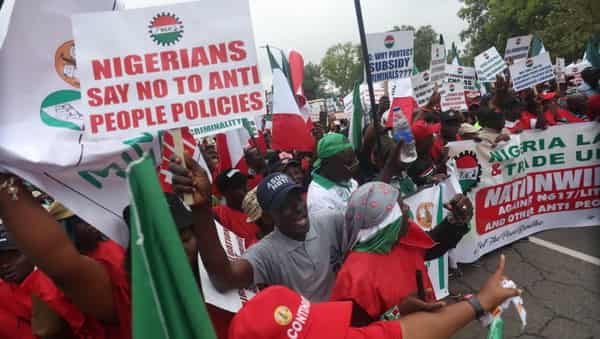
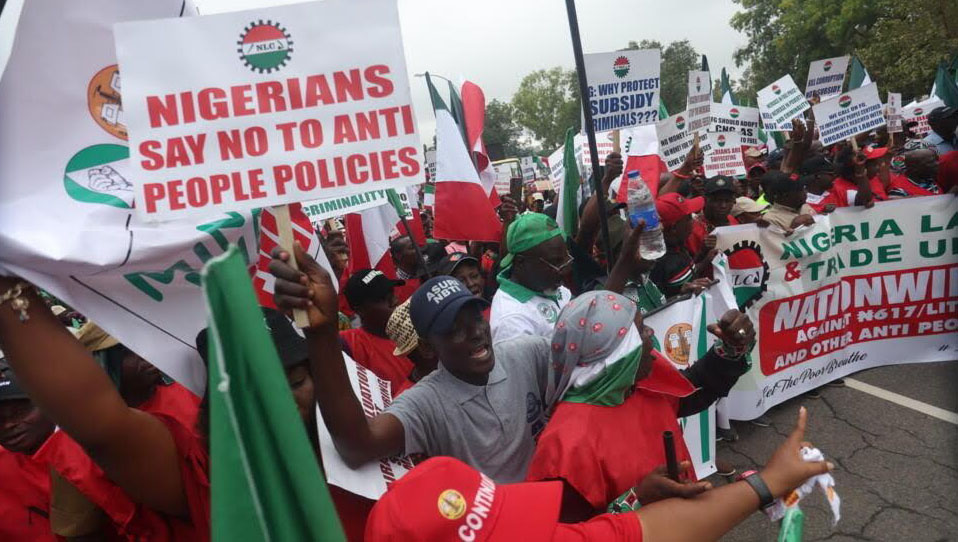
So, the authorities and Labour could not avert the nation-wide strike which promises to be total and unsparing, going by the pronouncements of the Labour leaders. There is anger in town; there is distrust and distraught. Sorrow and hopelessness overcast the horizon arising from disbelief that there is soothing light at the end of the long tunnel.
In a situation like this there is hardly room for a clash of reason, but clash of emotions. In a clash of the latter, there is no room for deep contemplation. Since there must be leaders on both sides of a divide, in this case the government and the Labour, it behoves leaders to go beyond superficiality, do hard thinking, unceasing thinking until thinking hurts.
At the heart of the present crisis is fuel subsidy removal. A great many people knew it was a fraud. Buhari alerted the nation in his days of political struggles – before he ascended the throne – that there was no subsidy. It was all a fraud. Olusegun Obasanjo long before him made efforts to get rid of the said subsidy and he dispatched Kupolokun to go round newspaper houses to alert editors and brainstorm with them.
Practically all right-thinking people thought it should go not necessarily because it was undesirable, but because successive administrations had no clue on how to go disentangling its sophisticated web. So Bola Tinubu deserves applause for his courage in kicking it out and he received it from aplenty and mostly from those politically disinterested.
As it has turned out the predictable fall-outs of the implementation were not thoroughly thought through. For a policy with such wide-ranging implications, select influential or powerful stakeholders should have been put into confidence. Bola Tinubu had three months before being sworn in to tap their brains under confidential cover. “Comrade, have you observed there is no provision in the budget my Administration is inheriting? It takes effect from June? Joe, what do you think? I myself have always maintained that fuel subsidy had to go.”
That would be addressing Comrade Ajaero one on one and putting him into a strictly confidential picture. Then there is brainstorming on the policy and the aftermath effects. Their meeting should not be mentioned to anyone. A similar but separate discussion should also have been held with his opposite number in TUC. He should have also met with Aliko Dangote as well to extract firm commitment to getting his refinery operational July ending the world was told would happen at the plant’s commissioning by former President Buhari at the tail end of the curtain being drawn on his tenure. Unofficial reports now say the refinery would go into operation in 2025.
The President’s broadcast of Monday was conciliatory as it acknowledged the harrowing experiences Nigerians are grappling with in their daily living and plans to alleviate them. The plans raise hope. The N8,000 to be given to the most vulnerable as palliatives for six months is fair. In the hinterland where people live in utter penury where N500 is a rarity, beholding N8, 000 will be considered manna from Heaven. To the cityman it may mean nothing.
Even if it will not go far enough, the government cannot be seen to be doing nothing in the economic circumstances of the land for some time and today. That would be considered as insensitive. It is in realisation of the circumstances that some state governments have rolled out support in various forms to their worker as well as the citizens in general while more sustainable programmes are being worked out. We cannot afford to plunge the country into chaos. The cooperation of the Labour is essential. President Bola Tinubu should be allowed to settle down a little more.
Strike by nature raises the temperature in the polity. Tension will be high in the days ahead if both parties do not quickly reach an agreement and the strike called off. What is left of the economy will get worse. Incidents during strike are unpredictable. The gate to the National Assembly was yanked off the way as angry protesters stormed the Green Chamber yesterday, for example.
The strike by House Doctors is taking its own toll on the health and economy of the nation already.
I find it germane to recall my thoughts on strikes which I wrote 30 years ago on this page as some of the points made then are as relevant today as they were at the time! It was captioned: “In the grip of strikes.” It reads:
The country is in the grip of one crisis or the other. Not long after a determined strike that ended in triumph for the academics in the universities, non-academic staff began protesting their condition and, indeed, teachers throughout the land took over, in a long-drawn battle. The crisis has been so wide-spread, coming in quick succession that one can hardly say who is left in the public service who has not taken his turn to walk out on his job until the government meets his demands.
Currently it is civil servants who are taking their chance in muscle-flexing, to compel state governments to pay a parity with their counterparts at the federal level. I am informed some categories of Federal civil servants were also agitating and they participated in the strike. Altogether, 11 unions were reported to have taken part in the industrial dispute.
I cannot claim to have a good grasp of the issues involved case by case. The bottom-line, it would appear, is a streamlining of pay, first to keep pace with opposite numbers in other tiers of public service, and secondly to have something reasonable to cushion wallets against the relentless gale of inflation making nonsense of earnings. When inflation enters a land, its first casualty is wage-earners. So dreaded is this pest on the economy that Germany learnt a long time ago, during World War 1 to declare inflation as Enemy No.1. The Bundesbank today has the responsibility not to give inflation any quarters whatsoever.
Seeing how inflation is sweeping the land unrestrained, an observer is bound to be touched and he would say the workers’ cause deserves sympathetic consideration, more so that they have watched how the engine of public spending has progressively broken loose such that, as per last reckoning, the budget was overspent by a whopping N43 billion! There is thus a justifiable clamour for equitable sharing.
Government’s sound that workers were free to negotiate with their respective state authorities did not hold water. The state governments were to pay according to their ability, not necessarily the 45 per cent the Federal decided for its own employees. The workers are saying governors are paid equal salaries, so are local government chairmen. And what is good for the goose is good for the gander. Why should the situation vary when it comes to paying civil servants? The workers contend.
It is an argument that the government will have difficulty overturning. Two reasons are responsible. The country has been running a Unified salary structure since Udoji. Because of prolonged military rule with the attendant command control, the Federal system has gradually been weakened. Abuja has been regarded as the dispenser of blessings and favours. The Federal Authority has held on to the chunk of the Federally-collected revenue. All roads have led to Abuja. State governments predicate their budgets, not on their strength or on the sweat of their brow, but on what comes from Abuja. The Federal Government has retained this wrong notion in its eagerness to see arise even development in all parts of the country.
The Aboyade Committee on Revenue Allocation Formula was not persuaded by this eagerness, well-meaning and high-minded as the protagonists were. Aboyade did not fail to point out that, in allocation of revenue, the executive capacity of the states should be taken into account. You can’t give million of Naira to a man who is just learning to manage a few hundreds or thousands of Naira. He would not know what to do with it. He would squander it. The Shagari Administration would hear none of that. The Aboyade Revenue Allocation Formula was thrown out of the window! Since the first false steps at making Nigeria’s many fingers equal at all costs, it has been impossible to let the government see the unwisdom in its action.
The principle of each state, each council paying according to its resources is a wise and sound one, and it is one Nigerians must come to grips with, with the passage of time. Union leaders and political leaders may wish to educate their followers on this principle such that even in the current agitation, there will be give and take to strike an equilibrium. The parlous state of the economy should be put into consideration on the eventual gains of the current agitation.
Even if the government is able to sustain this level of recurrent expenditure, which is doubtful, how will the state governments, the councils and the private sector be able to do so knowing full well that we are in the era of cost-push inflation. Every award granted today will be matched in no time, and worse off, the workers will resume agitation within the next six months on finding that they have been returned to the Ricardian World.
In David Ricardo’s world, workers would receive only the minimum necessary to live, not more than that so that they can continue to work. It is a vicious cycle. Thus, this game of topping salaries when prices gain an upper hand is a dangerous game without an end. But how many people in the land are so persuaded at this time and will be willing to let the sleeping dog lie peacefully? Who will, when rents are tearing away? Who will when school fees are shooting beyond the roof and even garri is becoming unaffordable? Public transportation has for long been a nightmare and owing one’s own car has been of little or no comfort under scandalous maintenance costs. Life must go on.
It does not matter really whether the Gowon Administration cash flood taught this country any lesson at all. That lesson is that bigger salaries are not the answer to inflation. The answer lies in high productivity and industries re-opening and new ones being established to produce abundance of goods. These are the real sectors of the economy—agriculture and manufacturing before which we ought to lay a red carpet.
The answer ultimately lies in the knowledge of balance, the Law of Balance in the necessary exchange involving taking and giving. In simple terms, employers and workers should not take more from the kitty they deserve. It is a natural law, a simple breach of which will result in manifest distortions. Anyone can try out this law in a simple experiment on the breathing mechanism. Fill the lung gluttonly with air but miserly decline to give something back to the environment! Anyone who has seen a recovered drowned body knows the cause of death.
There was no balance in the ingestion of water and its elimination. Taking and giving must always cancel out for healthy mechanism. Why do doctors set a drip for a feeble, sick person if not to restore the impaired salt balance in the disarranged balance in the system? We enjoy electricity in our homes and in our cars but hardly figure out what is going on. Indeed, two opposite poles, the positive and the negative, maintain that necessary balance between giving and taking for a healthy mechanism. One brings in power, the other takes it away!