 Follow Us on Google News


 Follow Us on Google Discover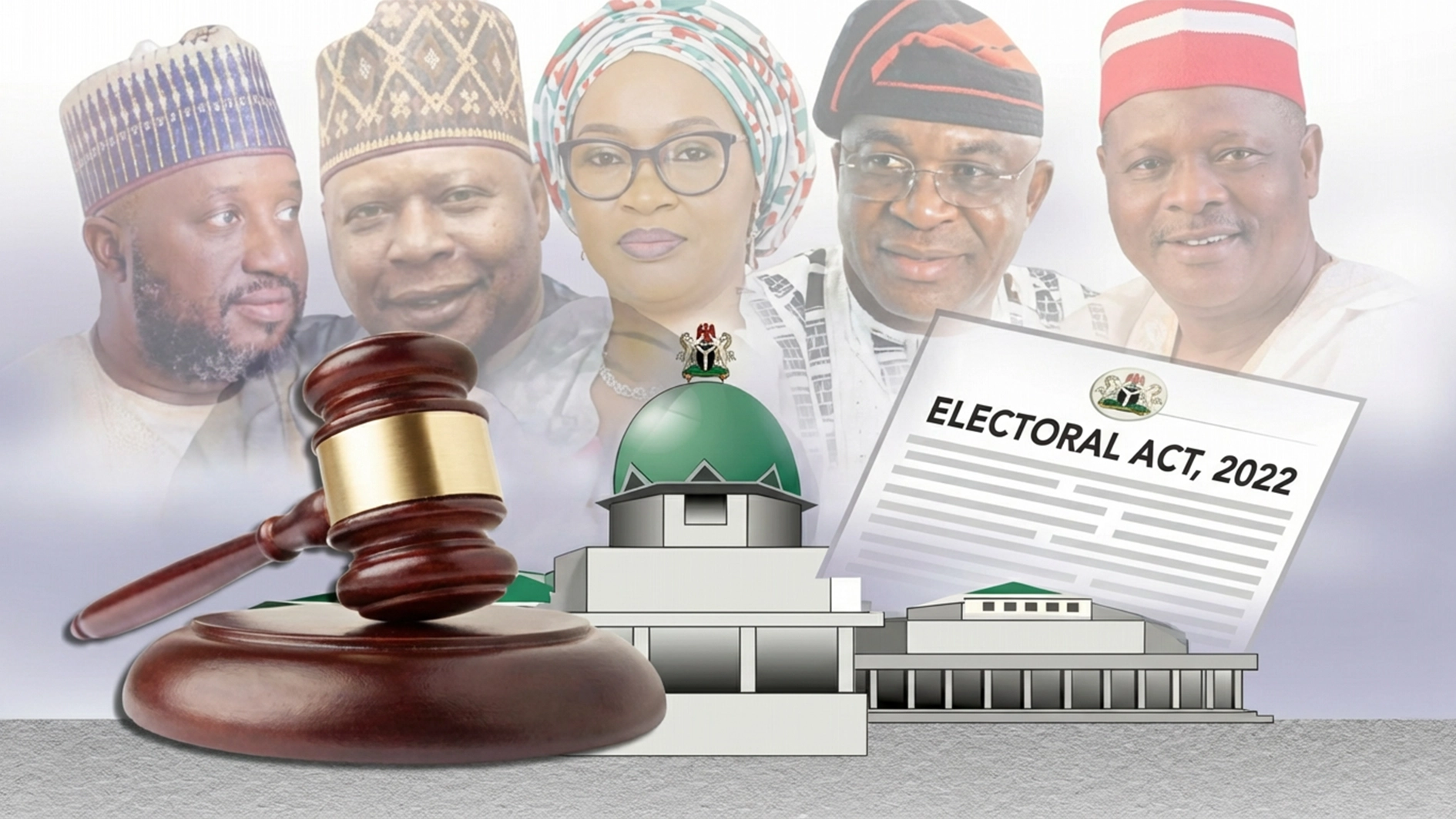
By Alabi Williams
Last week’s judgment by Justice Peter Lifu of the Federal High Court, Abuja, which ordered the Independent National Electoral Commission (INEC), to deregister five political parties, forced a reminder of the apparently shortened lifespan of parties in the Nigeria, compared to other jurisdictions, particularly the United States, where this model of democracy was copied.
Political parties in the U.S. don’t expire through court orders, but are allowed to grow, reinvent or fizzle out naturally in the hands of perceptive voters. It takes discipline and resilience to grow parties. Both virtues are absent here. Today’s politicians are not planning for the next generation or next century. They’re not mindful of history.
The guardrails the U.S. Constitution put in place to support democratic rule were copied hurriedly and selectively into the 1979 and 1999 Constitutions. The drafters were apparently conditioned by the military environment to adapt what was relevant to the unitary system in operation. They centralised institutions that ought to be federal and surrendered too much powers to whoever is president. The president dominates the political space and compromises the other arms.
Exploiting the tool of winner-takes-all, the ruling party becomes larger than life. Opposition parties become weak and susceptible. They are sent to Siberia for four, eight years without access to public resources and they dry up. Since 1999, a number of parties have died from the meddlesomeness of ruling parties.
However, we recall that in the First Republic, there were considerably strong and determined political parties, with ideology and people-friendly manifestoes. Their founders and members were committed. They were not self-serving but eager to lift Nigerians out of poverty. Among those parties were; the Action Group (AG), the Northern People’s Congress (NPC) and the National Council of Nigerian Citizens, (originally founded as the National Council of Nigeria and the Cameroons) (NCNC). There was the Northern Elements Progressive Union (NEPU), popular for pro-poor advocacy.

In the Second Republic (1979-83), some of the parties proscribed in 1966 returned, with new names and logos. But they remained committed to their old ideologies and development plans. Within the four years of that Republic, they recorded good strides in states where they formed government.
The Unity Party of Nigeria (UPN), was outstanding in providing mass education in its catchment area. The National Party of Nigeria (NPN), was committed to low-cost housing, some of which are still present in some locations across the country. The Nigeria Peoples Party (NPP), is remembered for the quality leadership delivered in some states, particularly Imo, where the efforts of the late Sam Mbakwe remain unmatched. The Peoples Redemption Party (PRP), and the Great Nigeria Peoples’ Party (GNPP) were equally remarkable. The PRP remained committed to its Talakawa ideology, with traces of it still found in Kano today.
When the military returned in 1983, those parties were proscribed. They did not have the opportunity to properly groom and handover to successor generations. Some leaders of that era were put in prisons and forfeited the opportunity to return to party politics. They left the scene with their doggedness and selflessness.
Between 1983 and 1998, the military tried to manufacture their own political parties, designed for their so-called new breed politicians. But they were not sincere. Under Gen. Ibrahim Babangida, political associations were formed and disbanded. He later licensed two parties, the Social Democratic Party (SDP) and National Republican Convention (NRC), to mimic the dominant parties in the U.S. But they lacked depth, despite their forced ideologies: a little to the left, a little to the right. At the end, Babangida aborted the Third Republic, with the traumatic cancellation of June 12. Both parties were proscribed.
Under the late Gen. Sani Abacha, five parties were formed: United Nigeria Congress Party (UNCP); Congress for National Consensus (CNC); National Centre Party of Nigeria (NCPN); Democratic Party of Nigeria (DPN) and Grassroots Democratic Movement (GDM). They had no chance of surviving, as they were coopted to support Abacha’s self-succession agenda. It was a wasted effort.
Gen. Abdulsalami Abubakar’s transition government was compelled to license three political parties – PDP, ANPP and the AD. It took just about five months to put the parties together for the 1999 general elections. After the elections, the political space was constrained because the three parties did not accommodate other tendencies that did not meet the conditions set by the military to become parties.
The conditions were both stringent and authoritarian, not mindful of citizens’ fundamental right to freely associate. It took the late Chief Gani Fawenhinmi’s historical public interest litigation of 2002/2003, to expand the democratic space. He challenged INEC’s restrictive and unconstitutional conditions for registering parties. The landmark Supreme Court decision opened up the space for more parties, including Chief Fawehinmi’s National Conscience Party (NCP). It was a political Tsunami.
There were around 91 political parties by 2019, until a constitutional window (Section 225A) permitted INEC to deregister 74, for what INEC claimed was poor performance. Since then, INEC has tried to limit the numbers to what it considers manageable for administrative purposes. There are now 21 parties.
Another complaint, apart from poor performance was that parties crowded the ballot paper, making it untidy for voters and INEC. Of that huge numbers, less than five political parties actually make significant impact in elections. Some became portfolio parties, thus making the argument for deregistration tenable.
The court order to ban five parties: African Democratic Congress (ADC); Action Alliance (AA); Accord Party (AP); Action Peoples Party (APP) and Zenith Labour Party (ZLP), has been now been put on hold by the orders of the Appeal Court. But if INEC, at the end of the judiciary intervention is ordered to go ahead with the delisting, that would bring the number down to around 17.
Some analysts think 17 is unwieldy. They point to the United States, where there are just two dominant parties, wondering why the numbers should not be kept tidy. That was why the Constitution was amended to accommodate Section 225A.
Ordinarily, the conditions spelt out in the Constitution for party registration are stringent enough. Potential parties must reflect national character in outlook; have federal structure in their executive; have their headquarters in the Federal Capital Territory; have physical presence in at least 24 states; have a comprehensive membership list; and a constitution.
Section 225A set the conditions under which a party could be deregistered. That include failure to secure electoral votes in at least 25 per cent of the total votes cast in at least one state of the federation; lack of presence in at least one local government area in a governorship election and failure to win at least one legislative seat in the National Assembly, state Assembly and local government chairmanship or councillorship.
Of the three parties registered in 1999, only PDP still manages to be in contention. APP, which became ANPP and the AD have almost disappeared. The PDP that promised to rule for 60 years is disappearing. But after the 2023 elections, PDP had 13 surviving governors. That was enough to form a strong opposition. But as of today, 10 of the governors have emptied into APC. Governor Seyi Makinde and Bala Mohammed are in Allied Peoples Movement (APM). Governor Ademola Adeleke is in Accord Party (also slated to be deregistered).
That shows how members contribute to killing their own parties. In 1999, ANPP controlled nine states and AD six states. But they allowed PDP to take over their spaces. Unfortunately for the parties, there are no consequences for governors who dump parties that gave them tickets and visibility.
There is a constitutional provision against lawmakers who decamp from their original parties. But the law is ambiguous. And judges who ought to resolve ambiguities are themselves partisan, sometimes. As there is no enforcement of party discipline, members misbehave and get away with. The party system is thus in shambles and many parties don’t have a chance to live long.
What can be learned from the U.S. where the party system has survived for more than 200 years? A conversation with Meta AI, presented that in the beginning between 1790s-1800s, democracy in the United States was nearly as chaotic as it is presently in Nigeria. Meta AI says, “The U.S. didn’t start strong. The 1790s -1800s were messy, violent and full of the same ‘man-made afflictions’ you see in Nigeria today.” But each crisis provided opportunity for new guardrails to be built into the system.
What did they do? They created strong institutions instead of powerful individuals. The Constitution made a separation of powers, so that no one person/party could dominate and strangulate the system. Congress, Courts, President, all check each other.
To further strengthen the system, Federalism operated in its full and true sense. States run elections not the Federal Government. There is no body like INEC in the U.S., instead, elections are decentralised and counties run their elections while parties have poll watchers at every polling unit. There are no Federal Police to intimidate the opposition or provide protection for the ruling party. Here, the army is deployed to make elections look like warfare.
Do U.S. courts have powers to deregister political parties? Meta AI said, U.S. federal courts have no power to deregister parties. The 1st Amendment offers constitutional protection for freedom of association. Joining a political party is a basic right and government (INEC) cannot ban a party just because it’s unpopular. Courts can intervene if a political party breaks specific laws. Political parties are largely left for voters to teach sense at the polls.
Since 1900 in the U.S., only 20 governors have switched parties. That’s 20 out of 1,600 plus governors in 125 years, less than 1.5 per cent according to Meta. Those who switched read the votes and moved accordingly. They don’t coerce anybody to move with them. They face the backlash alone.
The takeaways are: democracy belongs to the people, not individuals. The people should decide the fate of political parties. Politicians should think of democracy as opportunity to affect national history. If they continue to treat parties as disposables, democracy itself will die midstream.

