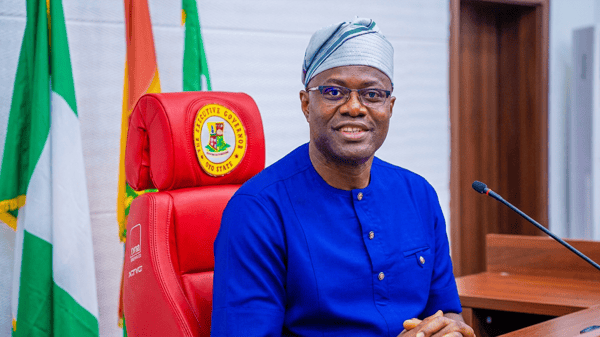
Oyo State Governor, Seyi Makinde, has dismissed speculation that he plans to defect to the ruling All Progressives Congress (APC), insisting that he remains firmly in the Peoples Democratic Party (PDP) despite the opposition party’s ongoing leadership crisis.
Makinde gave the assurance yesterday, during the launch of a book by a former Minister of Information, Lai Mohammed, titled “Headlines & Soundbites: Media Moments That Defined An Administration,” held at the Shehu Musa Yar’Adua Centre, Abuja.
He said he had no intention of joining the ranks of PDP governors who have defected to the APC, saying: “I am not an APC member, and I am not about to be in APC.”
The governor said that Nigeria’s progress depends on sincere collaboration among leaders across political divides, stressing the need for what he described as an “elite consensus” on the country’s future.
He accused the political elite of deepening the country’s divisions through personal ambition, noting that ordinary Nigerians largely desire unity and peaceful coexistence.
According to him, this shared aspiration is often undermined by the manipulation of religious, ethnic and regional differences by the elite seeking political advantage.
Makinde also criticised the “winner-takes-all” approach to politics, saying that it promotes exclusion and weakens national cohesion.
He, therefore, called for deliberate efforts to design political and governance arrangements that emphasise fairness, inclusion and stability.
He said that Nigerians at the grassroots had already reached a consensus on national unity, but divisions were largely being fuelled by the ruling class.
The governor, while explaining his presence at the event, said the author of the book attracted Nigerians from different backgrounds, making it an appropriate platform to call for unity.
Makinde recalled that Nigeria’s independence negotiations were anchored on federalism and multi-party democracy, given the country’s multi-ethnic composition, but said the civil war shifted focus towards a more unitary structure in the interest of national unity.
He, however, said that Nigeria’s current challenges were different and required fresh thinking.