 Follow Us on Google News


 Follow Us on Google Discover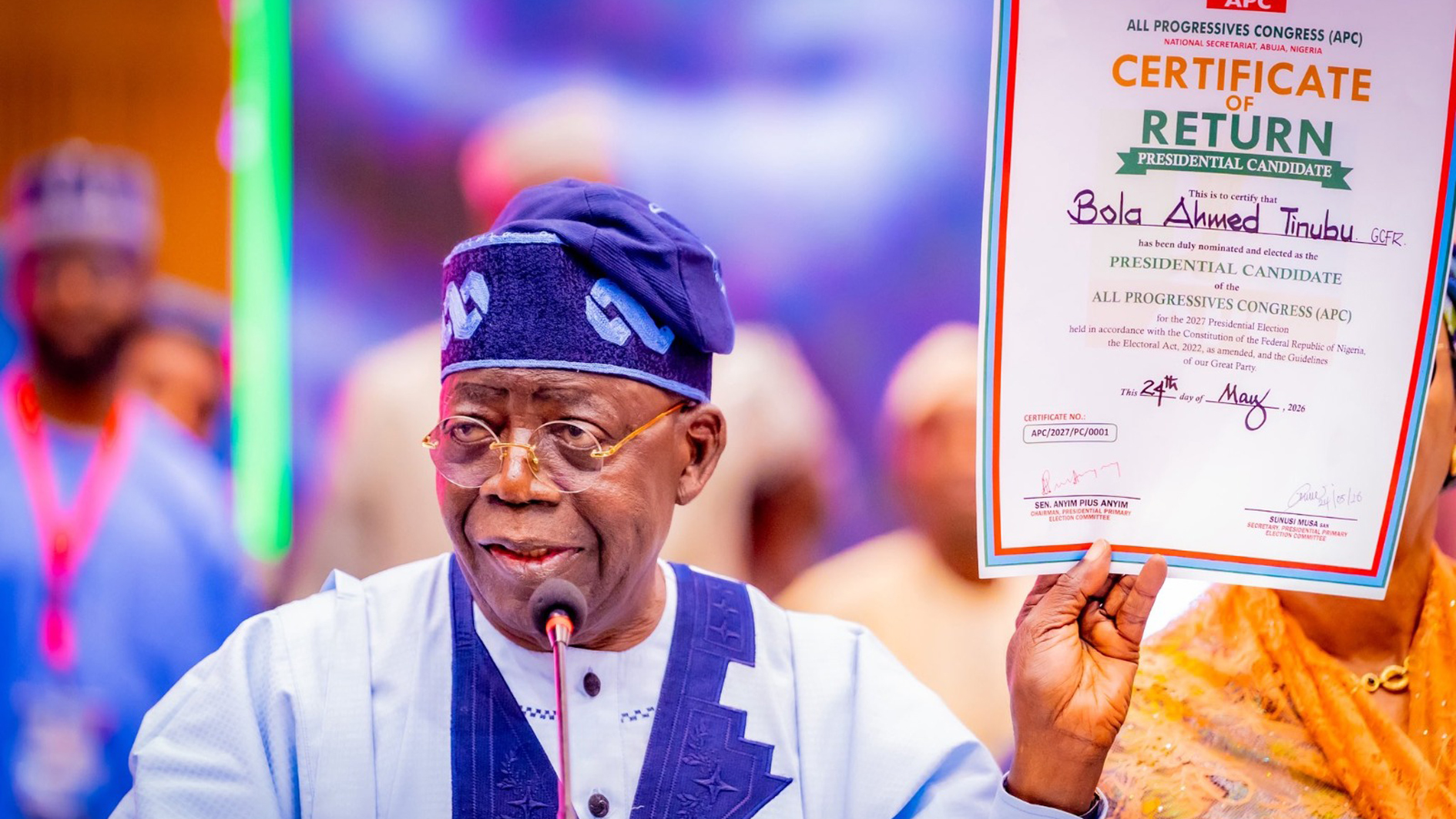
• Figures exceed President’s 2023 election tally
• Critics question credibility as APC defends transparency of poll
• Tinubu vows to sustain economic reforms
• Osifo accepts defeat, pledges support for Tinubu
• Okechukwu warns on hardship, insecurity, unemployment
• Analysts fear impact on 2027 electoral credibility
• Party fixes deadlines for primary, by-election results
President Bola Tinubu’s sweeping victory in the All Progressives Congress (APC) presidential primary has intensified debate over electoral credibility, governance performance and democratic legitimacy, as critics questioned the massive vote figures while party leaders projected confidence ahead of the 2027 general election.
The APC yesterday recorded a total of 10.9 million yes-votes to endorse President Bola Ahmed Tinubu’s aspiration for a second term in office.
Chairman of the party’s Presidential Primary Election Committee, Anyim Pius Anyim, who released the state-by-state vote tally, said the President emerged victorious after polling 10,999,162 votes to defeat his challenger, Stanley Osifo, who secured 16,503 ballots in the nationwide exercise.
The Guardian reports that President Tinubu’s vote tally at the straw poll exceeded his winning votes in the 2023 general election by 2,204,436, despite the absence of serious opposition or contest during the symbolic primary.
However, outraged by the President’s huge tally, critics dismissed the APC presidential primary, arguing that the “manufactured ballot figures” could undermine the transparency and credibility of the 2027 general election.

Prominent Nigerians, including political economist and former presidential aspirant, Pat Utomi; South-west PDP National Vice Chairman, Kamorudeen Ajisafe; President of Yoruba Ronu Leadership Forum, Akin Malaolu; and Ohanaeze chieftain, Goddy Uwazurike, described the figures used to endorse Tinubu’s second-term bid as unrealistic and dangerous for Nigeria’s democracy ahead of the 2027 general election.
This came as a founding member of the ruling party, Osita Okechukwu, urged the President to leverage the second-term endorsement to urgently address hunger, insecurity and unemployment as part of ongoing efforts to improve the party’s chances in the 2027 general election.
Nonetheless, in his acceptance speech after being declared the winner, President Tinubu said that although the reforms introduced by his administration had been painful, he remained determined to sustain them in a second term.
Insisting that the country must not “go backwards” after years of painful economic restructuring, the President urged Nigerians to support his party and renew his mandate for another four years.
He promised to deepen reforms, expand infrastructure, tackle insecurity and consolidate what he described as the economic gains of his administration, noting, however, that the widespread hardship and rising cost of living did not outweigh the benefits.
Tinubu maintained that his administration had, in the last three years, stabilised the economy through fuel subsidy removal, exchange rate reforms, improved revenue generation and fiscal restructuring.
Defending his administration’s record in education, power and infrastructure, Tinubu cited the student loan scheme, electricity metering rollout, highway construction projects and renewed investment in the oil and gas sector as key achievements.
“We moved away from wasteful fuel subsidies, unstable exchange rates and weak infrastructure. Today, we are witnessing a turnaround,” he declared.
He added that although security challenges persist in parts of the country, his administration would intensify efforts to restore peace and stability nationwide.
Tinubu also backed the establishment of state police, describing it as a national emergency, while accusing the opposition of being populated by “politicians with no clear alternative vision.”
Warning Nigerians against entrusting power to what he described as a clueless opposition, the President said: “This next election must not merely be a contest of parties or ideas, but a reaffirmation of Nigeria’s democratic maturity.”
Despite the lack of transparency in the accreditation and collation of votes, the APC presidential primary election results showed that Tinubu recorded some of his highest votes in his home state of Lagos, where he garnered 814,988 votes, as well as in Adamawa (644,149); Kaduna (618,914); Imo (582,960); and Kano (500,852).
For the challenger, whose participation merely gave the primary an element of contest, Osifo failed to secure any vote in the Federal Capital Territory. He recorded his highest tally in Niger State, where he polled 5,248 votes, followed by Kano with 2,675 votes and Bauchi with 2,650 votes.
The preponderance of protest votes for the President’s challenger provided a faint picture of subdued discontent among some party faithful over the undue prominence allegedly given to state governors above members of the National Assembly.
Details of the affirmative primary revealed that the President polled 467,003 votes in Katsina; 450,517 in Gombe; 414,988 in Borno; and 407,646 in Delta State. Tallies from other South-South states included Rivers with 280,082 votes and Akwa Ibom with 389,197 votes.
In Ogun State, the President secured 374,787 votes, as well as 389,197 votes in Benue and 36,103 in the FCT.
However, amid concerns over slight discrepancies in the cumulative state figures and the official totals announced at the collation centre, APC National Chairman, Nentawe Yilwatda, defended the credibility and transparency of the exercise.
Yilwatda said the APC had successfully conducted primaries for state assembly, National Assembly and governorship positions before concluding with the presidential contest.
He stated: “We started with the primary election from the House of Assembly, the National Assembly, governorship, and we climaxed with that of the President.
“Accreditation and voting took place across wards nationwide, while collation was conducted at local government, state and national levels. To ensure that we also have a transparent system, we decided to make this programme live. It is on five TV stations, it is online.”
The APC chairman acknowledged that disputes and corrections emerged during collation but maintained that the issues were resolved openly in consultation with representatives of both aspirants.
“There have been challenges to the results. It shows that APC is open when challenges arise and mistakes are made. Corrections were done based on the suggestions of the representatives of the two aspirants,” he added.
He commended APC governors and returning officers for supervising the exercise in their respective states and praised the committee led by Anyim for coordinating the process.
The development has, however, sparked fresh debate across political circles, especially as Tinubu secured 8,794,726 votes to win the 2023 presidential election against former Vice President Atiku Abubakar of the Peoples Democratic Party, Peter Obi of the Labour Party and Rabiu Kwankwaso of the New Nigeria Peoples Party.
Utomi described the figures as evidence of the deepening crisis of credibility within Nigeria’s democratic system, warning that persistent manipulation of electoral processes could further alienate citizens from governance.
“Democracy has become a complete disgrace in the eyes of many Nigerians. Many citizens now see the democratic process as a joke rather than a genuine system of representation and accountability,” he said.
The economist argued that legitimacy remains the foundation of stable governance, insisting that no government can effectively lead when the public loses confidence in the credibility of elections.
“What is troubling is that many politicians do not understand the long-term consequences of these actions. Through electoral manipulation and abuse of power, they weaken the legitimacy of authority itself. Once public trust erodes, the process of power erosion also begins gradually but steadily,” he added.
According to him, continued misgovernance and manipulation of democratic institutions could push the country towards instability and deepen public frustration.
Malaolu also rejected the figures, insisting that the economic hardship, rising hunger and worsening insecurity under the APC administration made such a massive turnout implausible.
“From every realistic and scientific assessment, Tinubu could not have secured such votes under the present condition of the country. The hardship, insecurity and public dissatisfaction are too glaring for such figures to be believable,” he stated.
He alleged that the primaries witnessed low enthusiasm in many states, claiming that only Lagos recorded visible political activities.
Malaolu further recalled the controversial 2018 Lagos APC governorship primary, in which former Governor Akinwunmi Ambode lost to incumbent Governor Babajide Sanwo-Olu amid allegations of inflated figures.
“This pattern of announcing figures that surpass realistic participation is not new in APC politics. Nigerians should not be taken for granted,” he warned.
Ajisafe, on his part, cautioned Nigerians to prepare for “worse developments” ahead of the 2027 elections if political actors fail to respect democratic norms and transparency.
“We are yet to see anything. The political class must be careful not to push the country into avoidable tension,” he said.
The PDP chieftain, however, appealed to Tinubu to govern with humility and avoid actions capable of undermining democratic institutions or provoking public distrust.
For Uwazurike, the situation bears a disturbing resemblance to the events that preceded the collapse of the Second Republic under former President Shehu Shagari in 1983.
“President Tinubu appears to be heading in the same direction Nigeria witnessed in 1983 when allocated figures and electoral manipulations threw the country into crisis and eventually paved the way for military intervention,” he said.
Political analysts believe the controversy surrounding the APC primary figures may further intensify concerns over the credibility of future elections and deepen public scepticism about the nation’s democratic process.
Despite the criticisms, APC officials maintained that the exercise was peaceful, transparent and reflective of Tinubu’s growing acceptance within the ruling party ahead of the 2027 presidential election.
Okechukwu said the overwhelming votes recorded during the APC direct primary across the country should not be taken for granted, stressing that the outcome had placed huge responsibility on the President, APC governors and party leaders to urgently address the plight of Nigerians.
According to him, growing hunger, worsening insecurity, unemployment and poor power supply could weaken the party’s electoral fortunes if decisive action is not taken before the polls.
He stated: “My fears regarding the tall-order results are guided by many factors, among which are the history of low voter turnout, hunger in the land, palpable insecurity, gross unemployment, epileptic power supply, and the unfavourable debt-to-service-revenue ratio (DSR).”
The erstwhile Director-General of the Voice of Nigeria (DG, VON) noted that while the primary election reflected confidence in Tinubu’s leadership within the APC, the party must work harder to justify the massive support it received from members nationwide.
He cited voting figures from several states as evidence of the President’s popularity among party faithful, including Ogun State with 322,485 votes, Benue State with 374,787 votes, Rivers State with 280,082 votes, Delta State with 407,646 votes, Abia State with 161,005 votes and Osun State with 100,880 votes.
Okechukwu urged the President and the 31 APC governors to prioritise citizens’ welfare and security concerns, arguing that Nigerians were currently more preoccupied with survival and safety.
Drawing from Maslow’s hierarchy of needs, he maintained that economic hardship and insecurity remained the critical issues likely to shape voter behaviour in 2027, adding: “We have less than seven months to the D-Day general elections.”
The APC chieftain nevertheless congratulated President Tinubu on emerging as the party’s presidential candidate, describing the direct primary conducted across the country’s 8,809 electoral wards as a demonstration of internal democracy and adherence to the rule of law within the ruling party.
National Chairman of the APC, Prof. Nentawe Yilwatda, maintained that the ruling party is increasingly becoming the preferred political platform for Nigerians ahead of the 2027 general election.
Speaking to journalists at the Bola Ahmed Tinubu International Conference Centre, Abuja, ahead of the collation of results of the party’s nationwide presidential primary election, he explained that the massive turnout recorded across the states was a clear indication that the APC remained the dominant political force in the country.
He stated that thousands of party members participated in the congresses held to nominate President Bola Ahmed Tinubu, describing the exercise as a “mock demonstration” of what Nigerians should expect during the 2027 elections.
His words: “The APC is becoming the rallying point for all political parties. Everybody wants to be in the APC. The competition to be in the APC is quite high, and we see thousands of people buying our forms. It shows how our party is accepted by Nigerians and by the people.
“If you see the mass turnout yesterday in all the congresses held to nominate the President, the numbers were in their thousands, and this is just a mock demonstration of what the general election will look like.
“It shows clearly that no other party would win the election because the numbers turning out are in the thousands. Believe me, no political party can showcase one-tenth of what we presented in their own congresses. It shows that we are on the path, and the winning path.”
Responding to concerns over rancour arising from the party’s governorship, Senate and House of Representatives primaries in some states, the APC chairman admitted that contests for political offices were naturally intense but insisted that the party had established mechanisms to resolve disputes.
Osifo accepts APC primary defeat, pledges support for Tinubu in 2027
Businessman and contender for the All Progressives Congress presidential ticket, Stanley Osifo, yesterday said his defeat in the party’s primary would not deter him from working for its success in the 2027 elections, declaring that “God knows better.”
Osifo spoke shortly after the collation and declaration of results at the Bola Ahmed Tinubu International Conference Centre, Abuja.
He polled 16,503 votes against President Bola Tinubu’s 10,999,162 in the nationwide direct primary conducted across 8,809 wards on Saturday.
Asked whether he was satisfied with the outcome, Osifo said: “I’m not okay with the outcome of the results. And I’m working with the party, I’m working with the candidate of the party as well. I have no problem with it.”
He said his decision to purchase the N100 million nomination form and contest the primary was not driven by personal rivalry with Tinubu but formed part of a legitimate internal democratic process within the party.
“We are one party, we are members of the All Progressives Congress, we are one family. So we are not challenging ourselves. What we did was to have within ourselves who will become the candidate of the party. So where we are now, we have that already today,” he said.
On Tinubu’s statement that he bore no grudge against him, Osifo said the feeling was mutual.
“That is why we are working together. We are one party, so we must work together. Nobody is an island. Even if I had become the candidate today, I cannot work alone. I need a team. So offering an olive branch is something that everybody would want to support the president for,” he said.
Osifo also expressed gratitude to his supporters across the country.
“My supporters that voted for me, including those clapping for me, I want to deeply express my gratitude to them. It’s not been an easy task.
“We have 36 states in Nigeria including the FCT, 37, and we have coordinators in all the states, in all the local governments, in all the wards. They have done marvellously well,” he said.
He added: “I am a very young man. I have a lot of years ahead of me, so it’s possible for things to happen. But I think God knows better, and God knows tomorrow. So let’s just hope on God and work as we move forward.”
Osifo purchased the nomination form after a planned consensus arrangement collapsed, becoming the only aspirant to formally contest against President Tinubu.
He reportedly scored zero votes in several states, including the FCT, Delta, Kogi, Ebonyi and Jigawa.
APC fixes deadlines for submission of primary, by-election results
The All Progressives Congress has announced timelines for the submission of reports and result sheets for the ongoing 2027 general election primaries and legislative by-elections.
In a statement issued yesterday by the party’s National Publicity Secretary, Felix Morka, the APC directed all Primary Election Committees to ensure the timely submission of all required documents.
According to the statement, the directive was issued by the party’s National Organising Secretary, Sulaiman Muhammad Argungu.
The party stated that today has been fixed as the deadline for the submission of governorship, senatorial, House of Representatives and State House of Assembly primary election results and reports.
It also disclosed that the submission of legislative by-election results and reports would commence on Saturday, May 30, 2026.

