Former President Olusegun Obasanjo on Saturday explained the political considerations behind the opposition by himself and then-President Goodluck Jonathan to Aminu Waziri Tambuwal’s emergence as Speaker of the House of Representatives in 2011.
Obasanjo said their position was guided by party interest and the desire to sustain gender inclusion in the leadership of the National Assembly.
He spoke at a leadership colloquium and 60th birthday celebration organised in honour of Tambuwal, a former Speaker of the House of Representatives, ex-governor of Sokoto State and current senator.
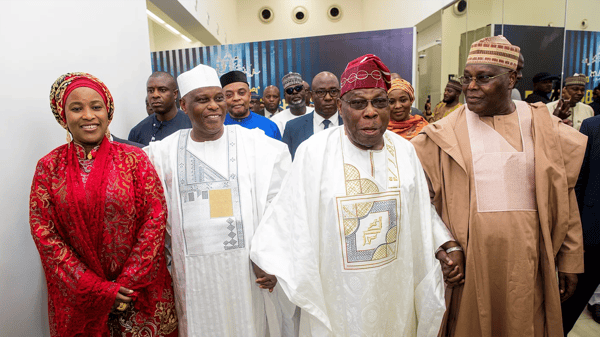
The event, which focused on leadership, democracy and nation-building, drew several prominent political figures, including former Senate President David Mark, former Vice President Atiku Abubakar, Peter Obi, Adams Oshiomhole, Kayode Fayemi and Mulikat Akande-Adeola.
Others in attendance included the President of the Senate, Godswill Akpabio, represented by the Senate Minority Leader, Senator Abba Moro; Catholic Bishop of Sokoto Diocese, Matthew Hassan Kukah; former Speakers of the House of Representatives, Patricia Etteh and Yakubu Dogara; Senator Eyinnaya Abaribe; and the Minister of Housing, Ahmed Musa Dangiwa.
Former governors present were Rotimi Amaechi (Rivers), Kayode Fayemi (Ekiti), Aminu Masari (Katsina), Udom Emmanuel (Akwa Ibom), Ibikunle Amosun and Otunba Gbenga Daniel (both Ogun). Also present were former Deputy Speaker of the House of Representatives, Emeka Ihedioha, and National Secretary of the ADC, Rauf Aregbesola.
Tambuwal, then a second-term lawmaker and former Deputy Chief Whip from the North-West, defeated Akande-Adeola, a Yoruba lawmaker from the South-West, in a keenly contested election.
Despite not enjoying the support of President Jonathan at the time, Tambuwal polled 252 votes against Akande-Adeola’s 90, out of 340 votes cast.
The defunct Action Congress of Nigeria (ACN), then an opposition party led by Bola Tinubu, had directed its members to support Tambuwal, a development that marked one of the rare instances in Nigeria’s Fourth Republic when the legislature openly defied executive preference.
In a reflective address, Obasanjo confirmed that both he and Jonathan initially opposed Tambuwal’s emergence.
“Our thinking was that if, for the first time, a woman had become Speaker of the House, she should be encouraged to remain there,” he said, referring to Akande-Adeola, who was backed by the Peoples Democratic Party (PDP).
Obasanjo, however, noted that lawmakers exercised their constitutional independence and insisted on Tambuwal.
“But your members thought otherwise, and you made your decision. And we supported your decision. Initially, even you were not sure of where we would stand, but we stood with you.”
He described Tambuwal as a humble leader whose rise underscored the autonomy of the legislature.
“One thing I saw in you was humility. Greatness that does not include humility is greatness that is hollow. Your greatness is not hollow,” Obasanjo said.
Jonathan, who addressed the gathering virtually, corroborated Obasanjo’s account and acknowledged disagreements between the executive and the House during Tambuwal’s tenure as Speaker.
“When he was Speaker, I was the President, and we had some disagreements,” Jonathan said. “But one thing I must give to Tambuwal is that members of the House believed so much in him.”
He added: “He held the House together. His colleagues always believed in him, and as President then, I appreciated that quality of leadership, even when we disagreed.”
Former Senate President David Mark narrated how Tambuwal and his deputy approached him before the election.
“They came to me and said, ‘Sir, whether you like it or not, you are adopting us as your sons,’” Mark recalled.
“They told me clearly that whether the President and the party wanted them or not, they would emerge Speaker and Deputy Speaker, and that I would sponsor them.”
Mark said he was caught between party loyalty and legislative independence, admitting that he ignored pressure from the PDP leadership on the eve of the election.
“For once, Mr President, I disobeyed you,” he said, drawing applause from the audience.
Former Vice President Atiku Abubakar said he cut short a vacation abroad to attend the event, describing Tambuwal as “a leader in the making.”
“We are celebrating a remarkable Nigerian leader. We hope he will live up to the prayers and expectations of Nigerians,” Atiku said.
Peter Obi described Tambuwal as a bridge-builder committed to justice, consensus and national unity.
“He is a man deeply committed to the unity of this country and to building consensus for development,” Obi said.
Adams Oshiomhole praised Tambuwal’s ability to manage a politically fragmented House and recalled how the former Speaker visited him to commiserate after the death of his wife.
Akande-Adeola dismissed suggestions of lingering animosity over the 2011 contest.
“Only what God wills comes to pass. Tambuwal has been Speaker and a leader. There is no animosity among us,” she said.
Kayode Fayemi warned that democracy was under threat globally and urged Nigeria to safeguard legislative independence.
In his remarks, Tambuwal said Nigeria was at a critical juncture and urgently needed salvation from years of poor governance.
He said the country’s current state had fallen far short of the ideals of its founders, stressing that recovery would only be possible if Nigerians acknowledged that something was fundamentally wrong.
Tambuwal warned that national rescue must transcend personal ambition, ethnicity and party politics, urging political leaders to abandon the practice of imposing unworthy successors.
According to him, such actions continue to undermine democracy and weaken institutions.