 Follow Us on Google News
 Follow Us on Google Discover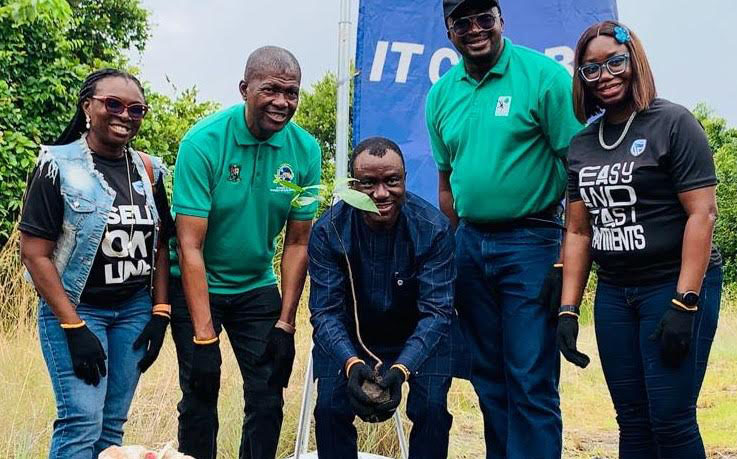

Plans to increase Nigeria’s forest cover from its current meager five per cent to the recommended 25 per cent of national land cover by 2050, have received a boost, with Stanbic IBTC Holdings initiative to plant 30,000 trees across 10 states.
[ad]
The initiative, which will cover Edo, Ogun, Katsina, Ebonyi, Plateau, Rivers, Cross River, Taraba, Jigawa, and Yobe by the close of 2023, targets 3,000 trees in each state under the Green Recovery Nigeria (GRN) Programme in collaboration with the Nigerian Conservation Foundation (NCF).
The tree planting ceremony was kicked off recently at the NCF’s Lekki Conservation Centre (LCC), where Stanbic IBTC reaffirmed its commitment to the scheme. The project would enhance the nation’s forest cover, not only grants access to valuable forest resources and sustenance but also biodiversity and curbs the transmission of zoonotic diseases between wildlife and humans.
The ceremony was led by the Chief Executive of Stanbic IBTC Holdings, Dr. Demola Sogunle, accompanied by the Head of Sustainability, Risk, and Capital Management at Stanbic IBTC, Mrs. Tosin Leye-Odeyemi, among other dignitaries.
Sogunle said the tree-planting initiative aligns seamlessly with Stanbic IBTC’s core values, which encompass a profound commitment to social, environmental, and economic impact within society.
NCF Director General, Dr. Joseph Onoja, who commended the bank, expressed hope that both public and corporate entities in Nigeria will toe the line and engage in large-scale tree planting across the country’s geopolitical zones. “I recommend this practice to every Nigerian; planting trees plays an essential role in our ecosystem and contributes significantly to a sustainable and healthier planet,” he said.
Representative of the Lagos Commissioner of Environment and Water Resources and Deputy Director, Conservation and Ecology in the ministry, Mr. Olabode Adeola, emphasised the necessity of citizen involvement in this endeavour. He urged citizens to plant trees in their own spaces, cultivate rooftop gardens, and participate in community gardening projects to make a substantial impact.

Adeola also underlined the significance of collaboration between state governments and financial institutions. He said: “By partnering with these stakeholders, we can develop innovative solutions, share resources, and create a collective impact that will transform our city into an oasis of green.”
[ad]

