 Follow Us on Google News


 Follow Us on Google Discover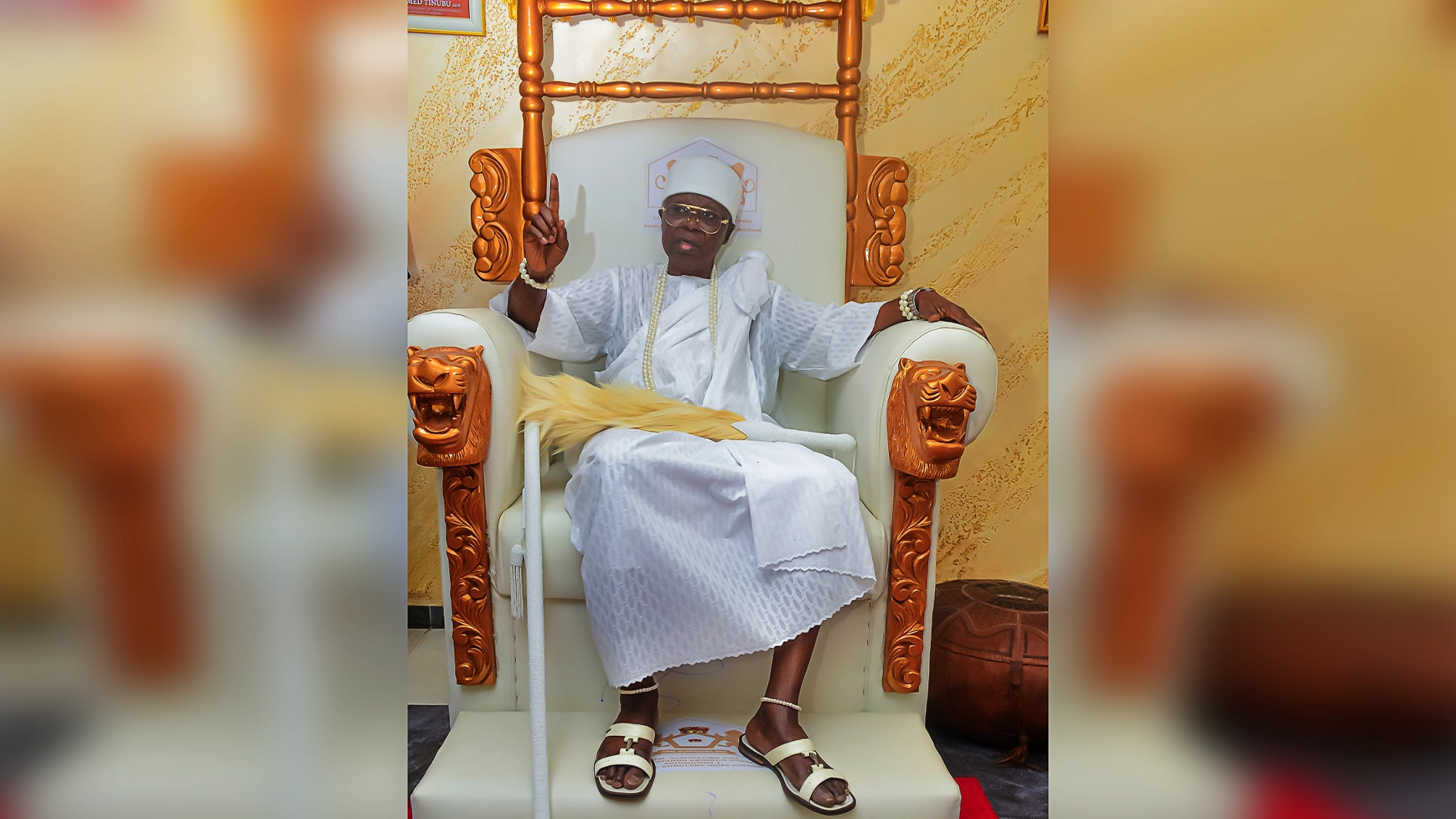
The relationship began with an audacious declaration in a London shop nearly 45 years ago. “You are my wife,” Lateef Adams told a woman he had just met, convinced, he said that God had revealed she was destined to become his life partner. Decades later, the couple not only built a successful fashion empire together but also found themselves occupying a royal throne neither had planned for. Their story is one of faith, perseverance, business success and an enduring commitment to improving the lives of people in Ikate Surulere. SULIYAT TELLA had a chat with Oba Lateef Adams as he and his Olori mark 10 years on the throne.
LONG before he became the Onikate of Ikate, Surulere, Oba Lateef Adams had already established himself as one of Nigeria’s leading fashion entrepreneurs. As founder and chairman of Latris Fashion, he built a reputation that took him from a modest upbringing in Lagos to the wardrobes of presidents, military rulers and business moguls. Yet, despite the prominence he attained in business, he insists that kingship was never part of his ambitions.
Born at Massey Hospital and raised in Isale Gangan, Lagos Island, Adams describes his childhood as one shaped by discipline rather than privilege. His father, a Nigerian Railway worker, ensured that all his children received an education despite the family’s modest means. Unknown to him at the time, his paternal lineage was royal, while he was only aware that his mother’s family in Sagamu, Ogun State, had royal roots.
The first hint of his royal destiny came while he was still in his 20s. During a visit to his mother’s hometown, she sought spiritual prayers for her son and was told that a crown rested upon his head. The prophecy meant little to him then. “I never knew my father came from a royal family. I simply continued with my life. I believed in hard work and wanted to build a good name for myself.”
That good name eventually came through fashion. Driven by his love for elegant dressing, Adams ventured into clothing design and textile importation after questioning why Nigerians depended heavily on imported fashion products.
“I was always known for dressing well. I kept asking myself why we should continue giving our money to foreigners for things we could produce ourselves.”

The decision proved transformative. Latris Fashion quickly became one of Nigeria’s most respected fashion houses, winning the Daily Times Fashion House of the Year Award around 1989/1990.
Over the years, Adams designed clothes for former military president Ibrahim Babangida, former Presidents Olusegun Obasanjo and Goodluck Jonathan, among several prominent Nigerians. The only former president he never dressed, he jokes, was Muhammadu Buhari.
His breakthrough into elite circles, however, came through a simple act of humility.
At a social function many years ago, Adams spotted the late Chief Moshood Kashimawo Olawale (MKO) Abiola among the guests. Rather than admire him from afar, the young entrepreneur introduced himself respectfully, identified himself as a fashion designer and handed over his business card.
“I recognised him immediately as someone I needed to meet. I approached him humbly, introduced myself and gave him my card. That was how our relationship started.”
That encounter blossomed into a lasting relationship, reinforcing what Adams now describes as his greatest business lesson.
“In business, you must never feel too big for your customers. Humility opens doors.”
His growing clientele also brought him into contact with other influential figures, including President Bola Ahmed Tinubu, relationships he said later became significant in his journey to the throne.
Despite the prophecy of kingship years earlier, Adams remained entirely focused on business until members of his ruling house approached him shortly before his 50th birthday. Initially, he declined.
Although family elders had already endorsed his candidature, he questioned whether the community even had a proper palace and preferred to remain a Baale rather than embark on what appeared to be a difficult process.
His perspective changed during an encounter with Juju music legend, King Sunny Ade, and Oba Fatai Irawo of Odi Olowo Mushin at a social gathering.
“King Sunny Ade told me that remaining Baale would not take me far but becoming an Oba would place me in a much higher position. That conversation changed everything.”
Even then, the journey was anything but straightforward. Although there was no opposition to his nomination and the process passed through all statutory requirements, including publication without objection, it still took about a decade before he was finally crowned Onikate of Ikate Surulere.
Throughout the lengthy process, Adams said several influential individuals, particularly President Tinubu and former Lagos State Governor Babatunde Raji Fashola, encouraged him to persevere.
Ten years after ascending the throne, Adams believes the greatest measure of his reign lies not in titles but in the transformation of Ikate.
He recalled inheriting a community plagued by insecurity, with notorious area boys making movement difficult for residents.
One of his earliest actions was to petition government authorities, leading to security interventions while also working with members of the Oodua People’s Congress to restore peace. “Today people can move freely. There is peace.”
Infrastructure has also improved considerably during his reign. Roads that were once nearly impassable have been rehabilitated, developments he says have significantly increased property values across the community.
He also revealed that there had been many empowerment programmes executed by him to make the people within his kingdom happy. He was quick to point out that many of the interventions that resulted in the distribution of food items were funded personally.
“I don’t wait for government. I spend my own money because a king must ensure his people benefit from his reign.”
That philosophy is shaping activities marking his 10th coronation anniversary. Rather than distribute food items alone, Adams and his wife are providing industrial sewing machines, grinding machines, salon dryers, deep freezers and financial support for aspiring sachet water entrepreneurs.
“We want to give people tools to earn a living, not just temporary relief.”
The idea, however, came largely from his wife, Olori Risikat Adams. For her, sustainable empowerment offers greater dignity than one-off donations. “I told my husband that after 10 years, we should give people something that would change their lives permanently,” she said.
To identify beneficiaries, she personally visited businesses and households across Ikate. One encounter left a lasting impression. She met a young tailor who had completed his apprenticeship three years earlier but remained unable to purchase an industrial sewing machine after losing his mother.
“When I told him we would provide one, he burst into tears. That confirmed we were doing the right thing.”
Her commitment to the project reflects the same values that have defined their marriage for over four decades.
Their love story began unexpectedly in London nearly 45 years ago. She had entered a shop on Liverpool Street when she greeted a mutual acquaintance who happened to be with Adams. She barely noticed him.
Later that day, she was surprised to learn that a man had come looking for her. When she opened the door, Adams looked at her and declared with remarkable confidence: “You are my wife.”
“I asked him, ‘Whose wife?’” she recalled with laughter. He explained that the moment he saw her, he believed God had revealed she would become his wife.
Although she initially dismissed the claim, Adams remained persistent. After both returned to Nigeria, he traced her to her residence on Glover Road in Ikoyi, where their courtship truly began.
Nearly 45 years later, she describes their marriage as one built on faith, responsibility and unwavering support.
She said her husband has always been deeply devoted to his family. She remembered discouraging him from driving to the airport in the early hours of the morning to receive their children arriving from London.
“He refused. He said he must personally bring his children home.”
She also credits his strong Islamic faith, describing him as a devout Muslim who prays five times daily and whose compassion extends naturally to others.
When the opportunity for kingship emerged, she never hesitated. “If people wanted him to lead them, it meant they saw something good in him. I supported him completely.”
Despite becoming queen, Olori Adams said little has changed about her personal life. She continues to manage Latris Fabrics, the textile business she and her husband built together more than 40 years ago, maintaining close relationships with loyal customers while still visiting the market herself to select fabrics.
She has also retained the friendships she cherished before entering the palace.
“I don’t believe becoming queen should make someone proud.” Nor has palace life prevented her from caring personally for her husband.
Although the palace employs a chef, she insists on preparing his meals herself. “I’m the one who knows what is good for his health,” she said. “I monitor his medication, remind him to rest and make sure he eats properly.”
His favourite meal, she revealed with a smile, is a simple plate of well-cooked beans.
For Oba Adams, the journey from fashion entrepreneur to traditional ruler has reinforced a philosophy that has remained constant throughout his life: humility, hard work and service to others.
Whether approaching MKO Abiola with a business card decades ago, building one of Nigeria’s foremost fashion brands, accepting a crown he never sought or investing personal resources in community development, he believes the same principle applies.
“When God blesses you, remain humble. That is what opens doors and allows you to touch other people’s lives.”

