 Follow Us on Google News


 Follow Us on Google Discover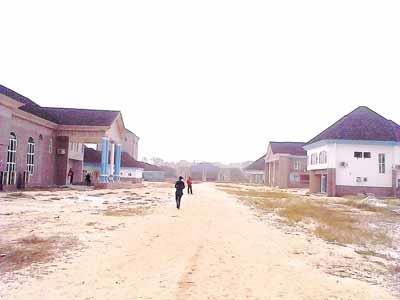

Anxiety Mounts Over FG Move To Strip Niger Delta Of Maritime Institution
ALL seemed set for a smooth takeoff of the Nigeria Maritime University in Warri South West council, Delta State, in September 2015, until the Minister of Transport, Rotimi Amaechi, made a disturbing pronouncement.
The university had been in top gear to open its doors to its pioneer students. It had even appointed a Vice Chancellor in the person of Professor Ongoebi Maureen Otebu, and a Registrar, Anho Nathaniel Esoghene. It had also created an Internet admission portal for the intake of new students. Community leaders told The Guardian at Kurutie, site of the temporary campus, that hundreds of students from different parts of the country had visited the place seeking admission into the institution.
Amaechi clogged the takeoff while briefing the Senate Committee on Marine Transport about the activities of his ministry on January 19, 2016; he announced a ‘proposed cancellation’ of the University. He was quoted as saying: “We are not going ahead with the university project proposed by NIMASA because we have an institution in Oron; we have Nigeria Institute of Transport Technology, Zaria; and we have the Nigerian College of Aviation in Zaria, which we could upgrade to university status and NIMASA is proposing to build a new one.” Amaechi asked: ‘Who will attend the university? How many parents will allow their children to go to such place where it proposed to site the university?”
Facts on ground show that immense work is ongoing at the permanent site at Okerenkoko, while the temporary site, which will tentatively host the university, pending when the permanent campus is completed, seems ready with lavishly decorated structures and imported learning tools and equipment.
The temporary site, a gigantic complex at the end of the laid back riverine community of Kurutie, is surrounded by water and mangrove. The site, in all fairness, is an architectural wonder, especially when someone notes that virtually everything used in its construction was brought in barges and boats from Warri and other places, some good distances away.
The temporary site is an array of state-of-the art buildings lined up on both sides of a road running through the campus and terminating at a second gate on its far end. The buildings comprise several lecture theatres; the biggest, tastefully furnished, can conveniently sit a thousand students. The male and female hostels, at the remote end of the campus are fitted with beds, kitchen equipment, reading arenas and conveniences. There are also several well-furnished administrative blocks, laboratories, engineering workshops, multi-purpose hall that can sit over 5000 students, lecturers’ quarters, Vice Chancellor’s lodge, and generator house. The diving training facility housed in the tallest building on the site is imposing.

To ensure that students and staff do not lack water, a treatment plant with a massive overhead tank capable of containing about 50,000 litres was constructed. Also, to keep would-be lecturers from worrying about the schooling of their children and wards, a nursery and primary school with all the trappings of modern learning environment.
An engineer working at the permanent site who visited the temporary site for the first time, last Monday, told The Guardian he was impressed with the modern facilities and the comfort provided there. He joked that the student would be distracted by the luxury that awaits them. He was particularly worried whether the generators at the site would be able to cope with the air conditioning system in all the buildings including the hostels.
A community leader at Kurutie who identified himself as Monday Seitabakro said the temporary site was initially built by Chief Government Ekpemupolo, alias Tompolo, for his diving company, Mieka Diving Limited. He said when the Nigeria Maritime University was created and given approval to operate, the Federal Government approached Tompolo on the possibility of using the school’s facilities as proposed take off campus for the new university. An agreement was reached and a deal was sealed. He disclosed that the government arrived at the temporary site option because it wanted the university to begin academic activities in earnest, as waiting for the permanent site at Okerenkoko to be ready would delay take off.
The Guardian also visited Okerenkoko community to assess the level of progress there and discovered that an appreciable amount of work had been done and is still going on, in spite of the uncertainty that now surrounds the institution.
The permanent campus is situated about a kilometre from the main Okerenkoko town and spreads across an expansive land of about two-kilometre radius. Judging from the structures on ground, it has practically gone beyond ‘feasibility stage’. A map showing the entire layout of the campus revealed that the permanent site would have a three-storey administrative block, which is still at the foundation stage, and 15 three-storey buildings for lecturers’ quarters, seven of which have begun and are nearing the first-floor level. A massive three-storey hostel is also at foundation level.
The workshop building is nearing roofing stage. The generator and the gate houses have reached advanced point. The water treatment plant, fuel station, power substation are at different stages of completion but have gone above 40 per cent. Other faculty structures are still at the foundation level.
Since a large percentage of the permanent site is marshy and waterlogged, massive reclamation is ongoing. It was learnt that during the rainy season work was stopped as movement was hindered by large pool of water at the site. This situation is compounded by the fact that the main roads to the various departments are sandy, yet to be tarred.
“You can see that work is going on and structures are on ground. The gate house, lecturers’ quarters, admin block and others are ongoing. The water treatment plant is at roofing level,” said site engineer, Justice Benson.
Although eleven contractors are said to be engaged in the construction of the permanent campus, only Oyeinteke Global Network Nigeria Limited, which reportedly has a large chunk of the job, was seen working when The Guardian toured the site.
Asked why the other contractors are not on site, the engineer said only the consultants can give an explanation. It was gathered, however, that some of the contractors demobilized from site due to financial constraints, leaving their equipment behind.
Oyeinteke, according to the site engineer, is handling the Engineering complex, Institute of Financial Studies, lecture theatres, Faculty of Natural Science, administrative block, Vice Chancellor’s lodge, lecturers’ quarters, faculty’s buildings, and gate house, among others.
On how Oyeinteke is still sourcing funds to continue with the project despite the alleged freezing of accounts relating to the construction, the site engineer again urged The Guardian to ask the project consultants.
FOUNDING secretary of the Ijaw National Congress (INC) and former acting Managing Director of the Niger Delta Development Commission (NDDC), Power Aginighan, at an emergency meeting of the Ijaw National Congress (INC) in Warri, a few weeks ago, passionately appealed to the Federal Government not to scrap the Nigerian Maritime University (NMU). He warned that the move could shatter the peace being enjoyed in the Niger Delta region as a result of the amnesty programme.
He argued that the idea of establishing a tertiary institution in the crude oil and gas-rich Gbaramatu Kingdom in Warri South West Local Government Area of Delta State was first proposed and adopted under the administration of President Olusegun Obasanjo, as a critical component in the roadmap to peace and sustainable development of the Niger Delta; that Gbaramatu Kingdom and other communities in the coastal belt of Nigeria, spanning Eastern Obolo/Ibeno in Akwa-Ibom through Rivers, Bayelsa, Delta and Edo to Ilaje and Ese-Odo in Ondo State account for over 70 per cent of the crude oil and gas output of Nigeria with concomitant devastation of the environment and threats to means of livelihood; and that the territory had been paradoxically alienated from the mainstream of national development without any vector of development.
Aginighan, who is also a chieftain of the All Progressives Congress (APC) in Delta State, said: “This explains the boundless joy that greeted the decision of the Federal Government to establish the Nigeria Maritime University at Okerenkoko, facilitated by the Nigeria Maritime Administration and Safety Agency (NIMASA) with a temporary site at Kurutie, having satisfied the requirements of the National Universities Commission (NUC). With Governing Council inaugurated, Vice Chancellor and other Principal Officers of the university appointed and takeoff fund in NIMASA 2015 Appropriation Act passed by the National Assembly; it is clearly an error of judgment to contemplate scrapping the Nigeria Maritime University.
“I will rather appeal to the Honourable Minister to review his position on this matter in favour of the immediate takeoff of the university by directing NIMASA to release the already appropriated takeoff fund to the Nigeria Maritime University. For the Niger Delta and the nation in general, the advantages of having the university far outweigh every argument to the contrary. Apart from capacity building for Nigerians in the maritime industry, bringing in direct foreign investment and arresting capital flight, the Nigeria Maritime University will play a key role in the reintegration phase of the Amnesty Programme. Scrapping it has the high potential of shattering the peace of the graveyard being enjoyed in the Niger Delta because of the Amnesty Programme.”
The Ijaw Youth Council, the youth wing of the INC, after a meeting in Bayelsa, wrote President Muhammadu Buhari, to protest the proposed plan to cancel the university. The IYC pointed out that the Maritime University at Okerenkoko is part of the post amnesty development plan of the Niger Delta region, and that the reasons advanced by the Minister for wishing to cancel the university are not tenable.
The letter, jointly signed by the IYC President, Udengs Eradiri, and spokesman Eric Omare, stressed that the fact that there are institutes in Zaria and Oron should not be used as excuse to cancel the university at Okerenkoko. The IYC said the institutes in Zaria and Oron and the university in Okerenkoko have different roles to play in the development of the rich but underdeveloped maritime sector in Nigeria. The group said the institutes in Oron and Zaria are meant to produce medium-class manpower in the maritime sector while the Maritime University, Okerenkoko would provide world-class technical and managerial manpower and would address the problems of capital flight, especially with Nigerians being sent to universities in the Philippines, Romania, Egypt and other countries to train at great cost to the country.
But there are some notable Niger Deltans who believe the university is “a questionable project” through which public funds were misappropriated. For instance, an activist and the national coordinator of the Niger Delta Peace Coalition, Mr. Zik Gbemre, said he was not surprised that President Buhari is contemplating scrapping the institution because several federal projects under the Jonathan administration only served as avenues to misappropriate public funds.
Gbemre said: “Is it (Maritime University) an immediate need of the people of the Niger Delta? Does having a Maritime University in Delta State address the immediate needs of impoverishment, empowerment and infrastructural development of the region in the long run? I absolutely do not think so. Rather than the establishment of a Maritime University, what I believe we need in the Niger Delta region is the development of all the riverine/coastal regions, transforming them into tourist attraction spots and seaports, like we have in Singapore, some parts of London like Maritime Greenwich and North Greenwich, areas that are practically built around rivers, but are today tourist spots for foreign attraction.
“Even the whole of Amsterdam, as well as the Houses of Parliament in Central London are all built around rivers. But when you go to these places, you can hardly tell that they are built on and surrounded by water. The advantage of developing coastal regions, like we have in the Niger Delta area, cannot be overemphasized. We can turn these riverine areas in the Niger Delta region to developed tourist attraction centres and holiday or relaxation spots. It will bring about increase in the number of hotels and revenue generation. The possibilities are endless.
“Look at Dubai and other parts of the United Arab Emirates (UAE) that were once desert regions. Today, they have artificial rivers and beaches, just to create tourist attraction. In fact, in spite of their vast resources in natural minerals (just like Nigeria is blessed), they still depend on only seven percent of their oil, gas and condensate revenue to develop their nation. The government gets the remaining national revenue from trading, tourism, and banking, etc. Here, we have such natural environments, like the riverine areas and coastal regions of the Niger Delta, but what are we doing with them?”

