 Follow Us on Google News
 Follow Us on Google Discover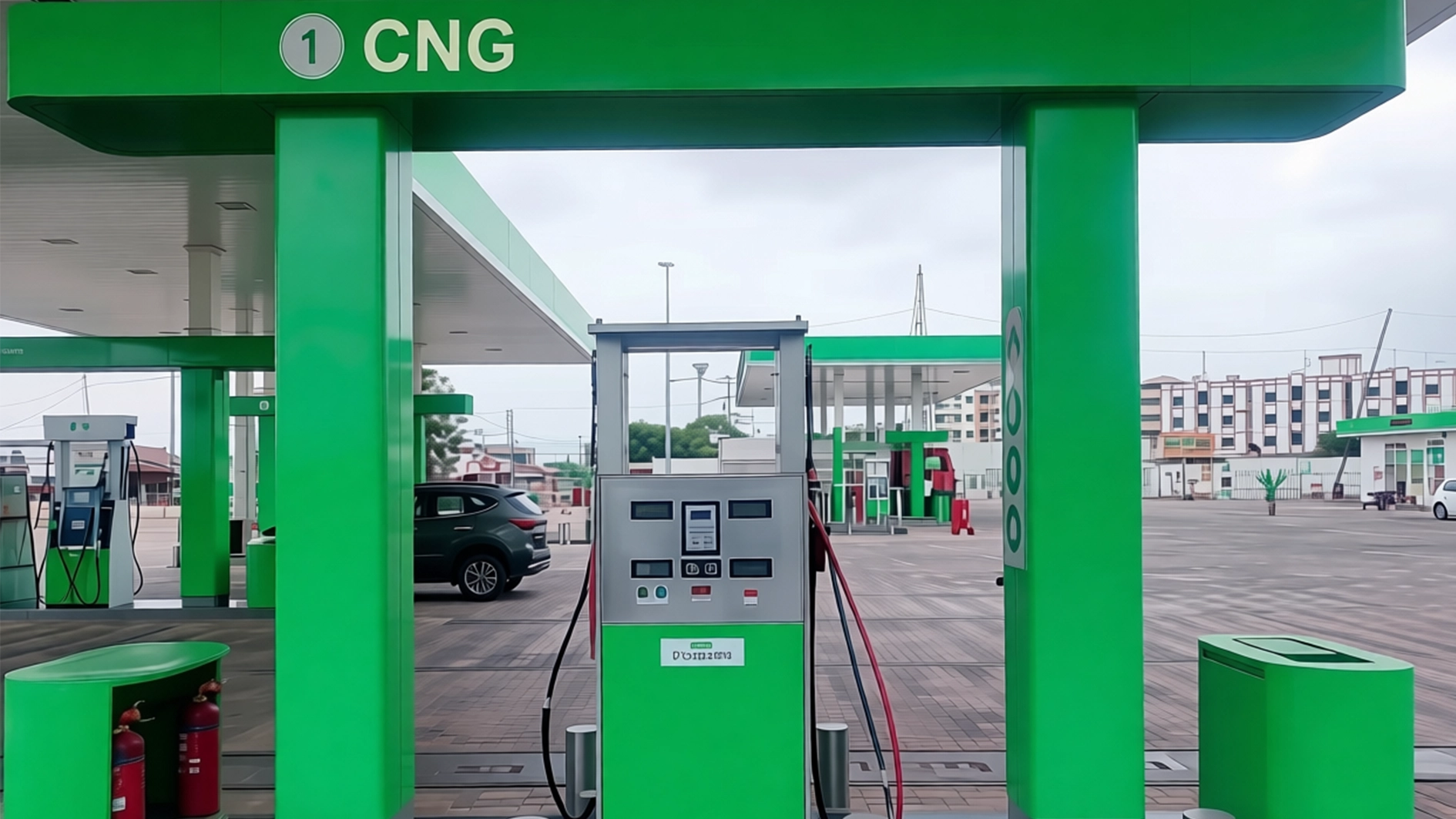
Scarcity of Compressed Natural Gas (CNG) is hitting Lagos and other major cities across the country very hard, as motorists spend hours in long queues at CNG refuelling stations.
This is raising concerns about the country’s readiness to support the growing adoption of gas-powered vehicles under the Federal Government’s energy transition programme.
Across several CNG dispensing points in Lagos, commercial drivers, fleet operators and private vehicle owners are spending hours waiting to refill their tanks, a situation industry stakeholders said reflects infrastructure deficiencies rather than a shortage of natural gas.
Speaking on the development, Executive Director of the Emmanuel Egbogah Foundation, Prof. Wumi Iledare, warned that Nigeria’s CNG market was beginning to mirror the challenges that once characterised the premium motor spirit (PMS) market.
According to him, the growing queues are primarily the result of limited dispensing stations and inadequate supporting infrastructure.
He noted that the trend was strategically worrisome and highlighted the need to revisit the original objectives of the Presidential CNG Initiative.

He said: “Nigeria’s CNG market is beginning to resemble the old PMS market, with growing concerns over product availability and long queues at filling stations. The problem is not necessarily a shortage of gas, but rather the limited number of dispensing stations and inadequate supporting infrastructure.
“CNG should not be treated merely as a temporary palliative for fuel subsidy removal. Instead, it should be developed on its own economic and environmental merits as a sustainable transportation fuel, supported by deliberate investments in refuelling infrastructure, distribution networks, vehicle conversion capacity and a predictable regulatory framework.”
The energy expert cautioned that without a corresponding expansion of infrastructure to meet rising demand, Nigeria risks exchanging one fuel-queue challenge for another.
Also commenting on the situation, Energy Partner at Bloomfield Law Practice, Dr Ayodele Oni, attributed the persistent queues to a widening gap between demand and available infrastructure.
Oni explained that the initiative would quickly succeed in stimulating demand, with conversions now past 100,000 vehicles, while refuelling infrastructure was still limited.
He explained that the concentration of stations in a few states, combined with logistical challenges associated with transporting gas over long distances, had also significantly constrained supply.
He said: “The stations are heavily concentrated in a few states, and much of the gas is still trucked over long distances, so logistics and low pressure at the pump throttle supply.
“The subsidy removal then unsettled the predictable availability motorists had come to rely on, which itself triggers panic queueing.”
Oni stressed that Nigeria’s vast gas reserves were not the problem.
He noted that Nigeria holds some of the largest gas reserves in the world, but like others, Oni said inadequate infrastructure was confronting the motorists.
“The bottleneck is delivery capacity, not the resource,” he added.
According to Oni, while the technical challenge may be infrastructure-related, motorists experience it as fuel scarcity.
Providing insight into the country’s current CNG infrastructure, Oni said official figures often masked the reality on the ground.
To address the challenge, Oni advocated a combination of regulatory reforms, infrastructure expansion and improved logistics.
“The Initiative cites upwards of 75 refuelling stations. The June 2026 breakdown is more sobering: of 63 mother and compression stations, only about 28 are operational, and of more than 175 daughter stations, roughly 72 are active.
“Realistically, we have somewhere between 70 and 100 functional dispensing points nationwide, against a 2027 target of 2,322. The gap speaks for itself.
“Four things are needed in parallel. Fast-track permitting so existing petrol stations can add CNG dispensing, which is quicker and cheaper than building new ones. Fix gas delivery by siting more compression and L-CNG plants near pipelines instead of relying on road haulage.
“Skew infrastructure incentives toward underserved regions like the North-East and South-East to correct the geographic imbalance. And sequence the programme sensibly: infrastructure should lead, with adoption following, not the reverse,” he said.
The concerns come as more Nigerians continue to embrace CNG as a cheaper alternative to petrol following the removal of fuel subsidies and rising transportation costs.
However, industry players warned that unless infrastructure investments keep pace with adoption rates, long queues and operational bottlenecks could undermine confidence in the government’s gas-powered transportation agenda.

