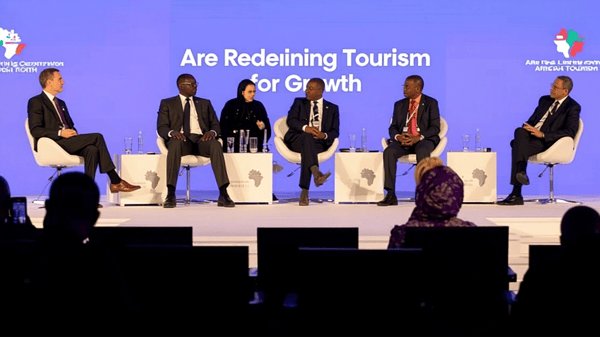
The United Arab Emirates has announced a $6 billion investment plan aimed at supporting tourism development in Africa. The announcement was made at the recently held “UAE Africa Tourism Investment Summit 2025” in Dubai.
This initiative marks a new stage in the country’s influence strategy, as Abu Dhabi strengthens its position as a crossroads between Europe, Asia and Africa.
The “UAE Africa Tourism Investment Summit” provides insight into how the Emirates use tourism as a strategic instrument on the international stage.
By choosing to unveil their investment plan in this setting, Abu Dhabi and Dubai directly tie their influence strategy to an agenda of economic cooperation with Africa.
In a speech by the Minister of Economy and Tourism, Abdulla bin Touq Al Marri, set the direction stating: “A resilient and sustainable” tourism sector, anchored in an unprecedented mapping of projects across Africa covering aviation, logistics, infrastructure and the digital sphere, amounting to $6 billion and 70,000 potential jobs.
The signal is as political as it is economic: the Emirates intend to place themselves at the centre of future tourism corridors.
This strategy follows a model of vertical integration already tested in the country, particularly in Abu Dhabi. On Yas Island, the Emirati group Miral has built an entire destination from the ground up, welcoming several million visitors per year around attractions and new projects with international visibility, the most recent being the announcement of the development of Disneyland Abu Dhabi.
The Emirates are positioning themselves as the driving force behind a booming sector in the Middle East. The Dubai summit shows that this expertise is now presented as an exportable product for emerging markets.
A summit reflecting the reshaping of global tourism.
This strategic shift is part of a broader trend: global tourism growth is gradually moving towards emerging markets, notably Africa. The continent records one of the fastest increases worldwide, supported by the rise of a middle class and a young demographic. In this context, the Emirates seek to position themselves as a platform for exchanges and investment.
The forum’s discussions highlighted priority needs: air connectivity, public–private partnerships, immersive technologies, hotel infrastructure and digital transformation. Aviation, in particular, occupies a central place in the debates, as major Gulf carriers seek to strengthen their routes with a continent where demand is rising.
The ministerial roundtable led by Abdulla bin Touq Al Marri, attracted over 20 African ministers, resulted in a joint communiqué outlining a roadmap for infrastructure modernisation, expansion of air routes, support for SMEs and a shared commitment to “green and inclusive” growth.
In the background, the Emirates showcased their own momentum. The global entertainment industry is expected to grow by 11.4% yearly by 2035, a trend from which Abu Dhabi intends to capture a share by developing new offerings. The summit presented this move upmarket as a model that could be replicated in Africa, where Miral is already exploring projects, particularly in Morocco.
Africa, a strategic partner
For the Emirates, this summit marks a milestone in the structuring of a strategic relationship with Africa. The Emirates already welcome more than 750,000 African tourists per year, a steadily increasing figure supported by the multiplication of air links, geographical proximity and the gradual easing of visa procedures.
At the summit, African representatives highlighted the diversity of the continent’s assets: coastlines, cultural heritage, historical sites and potential for coastal tourism development. The Emirati minister stressed that these resources constitute “a gateway” for investment and the expansion of Gulf companies.
The stated objective is to transform these opportunities into concrete, co-financed and operational projects.
Africa is not merely a destination: it is a structured market. Its entertainment industry is worth more than $60 billion, with music, video games and digital platforms. This dynamism interests the Emirates, who see complementarities with their own content and leisure ecosystem.
The momentum generated during the summit is expected to continue at the end of March 2026, with the holding of FHS Africa in Kenya, presented by the organisers as the next decision-making venue to convert the $6 billion investment plan into “projects, partnerships and opportunities” for African economies.