 Follow Us on Google News
 Follow Us on Google Discover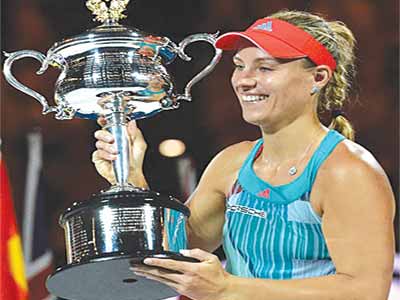
THE results of the 2016 Australian Open Tennis Championships are summated in the rhyme of an anonymous sage: “0f all sad words of tongue and pen, the saddest are ‘it might have been.’” These are the words that must still be ringing in the mind of Japanese player, Misaki Doi, ranked 64th in the world.
In a first round match with seventh- seeded Angelique Kerber on Show court 2 played on Tuesday January 19, Misaki took the first set 7/6 (in 61 minutes) and was one point away from victory. To prevent an upset, Kerber saved match point and won the second set tie break with eight points to six. Doi fought hard in the decider but lost the set 6/3 after 50 minutes. She was on the way back to Tokyo and Kerber was on the way to the title.
Those words of regret might also echo in the mind of Andy Murray, concerning the 80-minute second set he lost to Djokovic in the Finals. In every sport, there are basic requirements for winning. In a crunch, a seasoned competitor goes back to the rudiments. A truism of tennis is that fewer errors defeat more winners. It is called successful defense of (your) baseline: to get the ball back on the opponent’s side of the net.
Murray hit more winners but Djokovic won more points! How? It is a mathematical fact. In every game, there are 30 percent winners made to 70 per cent errors committed. Errors can be forced by the sheer power of the opponent, or unforced when a player fails to get a simple ball back on the other side of the net.
Djokovic had 18 forced and 41 unforced for a total of 59 points. Murray had 27 forced and 41 unforced for a tally of 92 points lost. That was the final match in a nutshell.
In the statistics released by the organisers of the “friendliest” of the four major tournaments in the world of tennis, the figures of the big servers also confirm the basics.
John Isner topped the list with 119 followed by Raonic’s 107, Murray’s 76, Federer’s 65. Djokovic was 10th with 60 aces. Maria Sharapova topped the women with 55, followed by Serena Williams’ 53. The champion Angelique Kerber placed seventh with 20 aces. Big serves alone do not win matches. That great teacher of champions, Harry Hopman, always yelled (lovingly but firmly) at his protégées that they must never miss an approach shot or a first volley because seven out of 10 times, the opponent will miss while attempting to pass. As in a game of chess, you hit the routine shot and quickly position yourself in the centre of your opponent’s possible returns.
Beyond the technical details, the annual tennis fiesta on the banks of the Yarra River in Melbourne Park holds the accolade of the world’s greatest tennis spectacle. This is made possible by the participation of corporate organizations. Kia Motors is the main sponsor since 2002, beaming its brand and “the power to surprise” mission to viewers all over the world.
In addition, there are associate sponsors. ‘Jacob’s Creek’ from Pernod Ricard’s Winemakers got on board in 2006, offering Cool Harvest Hill where spectators can watch matches on Big Screen outside the three major bowls.
The company also sponsored production of “Made By” documentary on Novak Djokovic’s journey from a war-torn Serbia to the top of tennis.
Since 2010, ANZ, a major regional bank in Asia and the Pacific, is the official banker. The Bank partnered Tennis Australia in a tennis grassroots development programme, tagged “ANZ Tennis Hot Shots’ in which 500,000 primary school children participate annually.
Other sponsors are Accord Hotels and Blackmore’s “Be a well being” Company. IBM is the ICT partner, while Rolex is the Official Timekeeper.
The corporate sponsorship makes it possible to finance the Australian Open without government involvement. This is a template for other countries, especially in Africa.
Roll-call of Champions at the 2016 Australian Open
Men’s Singles: Novak Djokovic (Serbia)
Ladies Singles: Angelique Kerber (Germany)
Men’s Doubles: Jamie Murray (Great Britain) and Bruno Soares (Brazil)
Women’s Doubles: Sania Mirza (India) and Martina Hingis (Switzerland)
Mixed Doubles: Bruno Soares (Brazil) and Elena Vesnina (Russia)
Junior Boys’ Singles: Oliver Anderson (Australia)
Junior Girls’ Singles: Vera Lapko (Belarus)
Junior Boys’ Doubles: Alex De Minaur and Blake Ellis (Australia)
Junior Girls’ Doubles: Anna Kalinskaya (Russia) and Tereza Milahikova (Slovakia)
Men’s Wheelchair Singles: Gordon Reid (Great Britain)
Women’s Wheelchair Singles: Jiske Griffioen (Nederland)
Men’s Wheelchair Doubles: Nicolas Peifer and Stephane Houdet (France)
Women’s Wheelchair Doubles: Marjolein Buis (Nederland) and Yui Kamiji (Japan)
Quadrangular Wheelchair Singles: Dylan Alcott (Australia)
• Jacob Akindele is a member of the United States Tennis Writers Association and the United States Professional Tennis Association.
Quote
A truism of tennis is that fewer errors defeat more winners. It is called successful defense of (your) baseline: to get the ball back on the opponent’s side of the net. Murray hit more winners but Djokovic won more points! How? It is a mathematical fact. In every game, there are 30 percent winners made to 70 per cent errors committed. Errors can be forced by the sheer power of the opponent, or unforced when a player fails to get a simple ball back on the other side of the net.

