 Follow Us on Google News


 Follow Us on Google Discover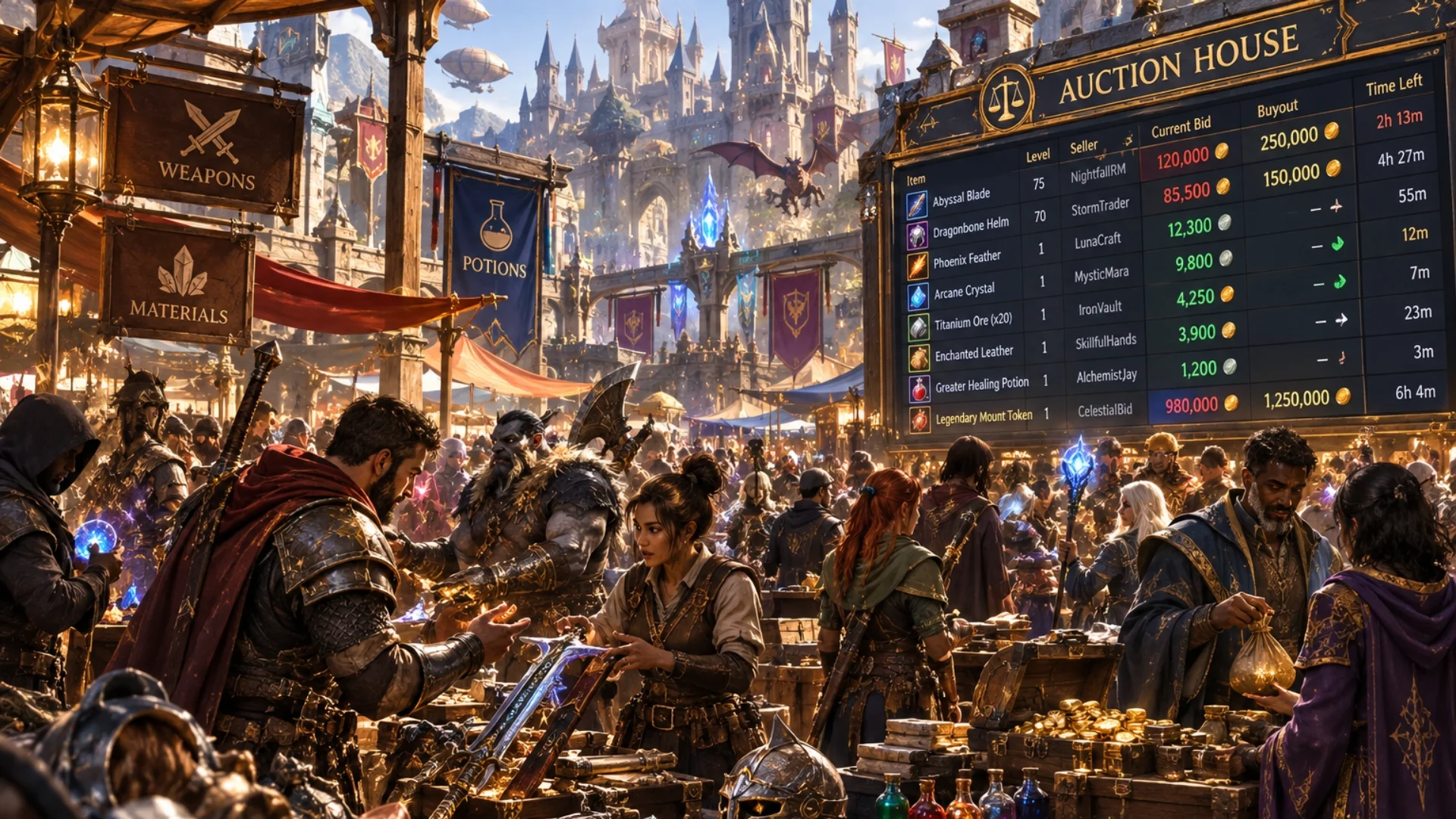
Put thousands of strangers into one persistent world, give them a currency, some scarce materials and the freedom to trade, and something strange happens: they build a working market without anyone asking them to. Prices form, bargains disappear, speculators appear, and within weeks the economy starts behaving in ways its designers did not predict. That is one of the least discussed but most fascinating parts of online role-playing worlds, and it explains why some virtual towns feel alive while others feel like empty sets.
Where the Gold Comes From and Where It Goes
Every shared game economy runs on two kinds of plumbing. Designers call them faucets and sinks. Faucets create value out of thin air: a monster drops coins, a quest pays a reward, a mine spits out ore. Sinks remove value permanently: repair bills, travel fees, crafting costs, taxes on trades. If the faucets run faster than the sinks, money piles up and prices climb. If the sinks win, players feel poor and stop spending.
Keeping those two in balance is closer to running a central bank than to writing a story. A single patch that doubles the gold from one popular dungeon can quietly inflate the price of everything for months, because thousands of players suddenly carry more money and chase the same limited goods.
Prices That Nobody Sets
The most interesting moment in any shared economy is when the developers stop deciding what things cost. Auction houses and player marketplaces hand that job to the crowd. In well-designed MMORPG games, the price of a rare sword is not a number in a spreadsheet at the studio; it is whatever the most impatient buyer and the most patient seller agree on that afternoon. Players quickly learn to buy at quiet hours, sell after big updates and hoard materials that a new recipe is about to make valuable.
Economists noticed this early. In 2001, Edward Castronova studied EverQuest’s world of Norrath and found that about 12,000 people treated it almost as a permanent home, with some 60,000 present at any given time. He tallied the wages players effectively earned at around USD 3.42 an hour and estimated a GNP per capita for the virtual world somewhere between Russia and Bulgaria. The same paper described an economy marked by extreme inequality, which anyone who has played a mature online world will recognise immediately.
That inequality is not always a design failure. Some players simply enjoy trading more than fighting, and they become the merchants, bankers and speculators of their servers. They buy low from people who need quick cash, sell high to people in a hurry and spend hours reading market trends the way a trader reads a stock chart. Their presence actually helps everyone else, because a market with active middlemen rarely runs out of stock. The downside is that a handful of determined traders can corner the supply of a key material and hold the whole server to ransom until the developers step in.

When Real Money Leaks In
Virtual currencies are supposed to stay inside the game, but players rarely respect that boundary. When time in the game produces something valuable, some people will pay real cash to skip the effort, and others will happily sell it to them. The result is a hidden industry built on repetitive play.
A 2008 working paper from the University of Manchester looked at this phenomenon, known as gold farming, and described how it had quietly employed vast numbers of people, hundreds of thousands by the paper’s estimate, with China at the centre of the trade, producing in-game currency and items for paying customers. For designers, that kind of outside supply is a headache. It floods the market with gold that no sink was built to absorb, pushes prices up for honest players and turns a fantasy economy into a labour market with its own wages and working conditions.
Developers have tried many responses, from banning accounts in waves to offering official ways to exchange time for premium currency. None of them completely solves the problem, because the underlying demand comes from the same place every time: players who want the reward without the grind. Some studios have concluded that it is safer to control the exchange themselves than to leave it to shady websites, since at least then the flow of currency can be measured, taxed and slowed down when it gets out of hand.
Inflation, Crashes and Rich Veterans
Long-running worlds face a problem that new ones do not. Veterans accumulate wealth year after year, while newcomers arrive with empty pockets into a market priced for millionaires. That gap can make a world feel unwelcoming, and it is part of why some players describe busy trading hubs as stressful games within the game, where one bad sale can wipe out a week of effort.
Crashes happen too. When an update makes a once-rare material easy to gather, its price can collapse overnight, and players who stockpiled it lose a fortune in a single evening. The same shock that hurts hoarders often helps newcomers, who can finally afford gear that used to be out of reach. The business of making games faces its own version of these swings, and Nigeria’s growing scene is now debating how to build studios that last, focusing on the business side of play rather than talent alone.
Every Coin Has Two Owners
A shared economy works only when players believe the rules are fair. If gold feels endless, nothing feels earned. If it feels impossible to earn, people leave. The best designers treat their currency the way a careful finance ministry treats its own, watching the numbers, adjusting slowly and explaining changes before they land.
For players, the lesson is simpler. Every coin in a shared world belongs, in a sense, to everyone who uses the same market. Spending it, hoarding it or dumping it changes someone else’s evening. A crafter who floods the market with cheap potions makes life easier for beginners and harder for rival crafters. A guild that buys up every rare gem to equip its raid team pushes up costs for everyone else. That invisible connection between strangers, who may never meet or even share a language, is exactly what makes these worlds feel real.

