 Follow Us on Google News
 Follow Us on Google Discover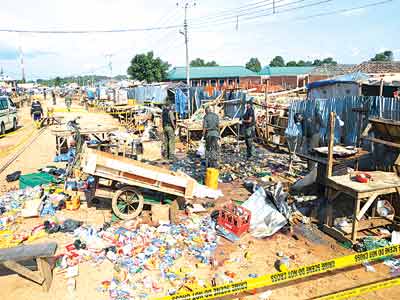

Bemoan ‘Unnecessary’ Disruption To Daily Life
THE only thing Kuje and Nyanyan satellite towns have in common is the fact that majority of those on the payroll of the federal government resides there. Private business owners whose enterprises are located in Abuja city centre and those working with the private sector also reside in the areas. With the exorbitant rent charged for accommodation in the city centre, coupled with the fact that a good number of well structured houses are locked up, simply because people cannot afford the asking prices from landlords and developers, Abuja residents have for long resorted to staying in satellite towns around the FCT, of which Kuje and Nyanyan are just two.
Apart from residents taking shelter in these two satellite towns, their features in other ramifications are worlds apart. Kuje is located off the popular Airport Road; such that a new entrant into the city might not easily notice the existence of life inside what seems like a jungle, save for a link road constructed by the company handling the Airport Road.
Accommodation is relatively cheap in Kuje, due to its location; hence a lot of people, in recent time, have moved to the area. This, again, has given it further facelift far from the sleepy town it used to be. But even at that, the kind of movement and human traffic in Kuje is infinitesimal compared to what is obtainable in a place like Nyanyan.
Nyanyan is a border satellite town between the FCT and Nasarawa State. Whoever is traveling from any part of the country to Jos and the North East, en route Abuja, is bound to pass through Nyanyan. Therefore, at any point in time, vehicular and human movement in the area is unquantifiable.
The bomb attacks, which happened simultaneously on Friday, October 2 was a rude shock to people of these areas. It was not as if the attacks were the first in the Federal Capital but a lot of people had relaxed their guard, given assurance that the federal government was adequately tackling insurgency. Nyanyan had been hit before but Kuje did not look like where insurgents would want to launch any attack. Still basking in the euphoria of the country’s independence celebration, the time of the night when the bombs were detonated was not what the people envisaged either. Early sleepers had already retired to their beds; others still engaged in petty trade transactions. Lazy talks and relaxation over bottles of drink spelt the mood when the deafening explosions rocked the two satellite towns and their environs.
Since that night, life has not been the same, both for victims of the blast and those who saw and heard about the incident.
The main issue the residents raised when The Guardian visited, last week, was that their means of livelihood have been grounded and that they need to open up their businesses again, as life must go on, irrespective of what had happened, especially when they have to feed themselves and their families. They insisted they wanted a return to normalcy. The presence of stern security operatives in the areas, however, has continued to send shivers down the spine of the people. According to them, it is not that they do not appreciate the presence of the officers but their businesses have been hampered seriously, owing to the fact that they were not allowed to continue with their daily routine.
Jude Akpan who resides in Kuje said he needs to resume his petty trading, to ensure the survival of his family. Though he was not directly affected by the bomb blast, he said the cordon by security operatives has made life difficult.
He said: “I know the security people will want to argue that they are doing their job but I want to believe that we would not have been in this kind of mess had the job been properly done in the first place. The way they forced us away from our daily routine is what I don’t understand. We were told that government would foot the bills of the victims. That is a good development. But who will pay our own bills when we are not allowed to do our daily jobs in order to take care of our families and ourselves. That is where my concern lies.”
Roadblocks had always been mounted at the entrance of Kuje, off the airport axis, and at the other exit road to Gwagwalada. These were, however, dismantled at the order of President Mohammadu Buhari when he assumed office. Now, the roadblocks have resurfaced.
One resident who did not want his name mentioned was livid with rage. His grouse was with the army who had, over time, mounted roadblocks with the aim of checkmating the insurgency. He queried the significance of these roadblocks, especially if Boko Haram fighters could still gain access to the town.
“I have issues with the army. What they do is only harass innocent passers-by. For instance, if you are driving in your car or happen to be a passenger in another person’s car and you pick a phone call, then you are courting trouble. These army guys conclude that anyone answering a phone call at the time he passes a checkpoint is a Boko Haram informant. What sort of thinking is that? As a result, they reprimand people and make them do all sorts of inhuman punishments. Now, how did the ones who bombed the town come in? Did they not pass through the same checkpoints? They had two such points in Kuje alone, yet this happened.
“Another thing I find laughable is when government officials ask people to be vigilant. Yes, it is good to be vigilant. But how do we go about this advice. If I begin to look at all faces I meet on the road and read Boko Haram into them, then someone could go nuts in not too long a time. I see this sort of advice coming from people who do not know what to say but who still want to talk, so that the media will have their names and pictures everywhere.
“The government should do what it ought. The ideology behind these attacks is what we should address, and also the sponsors. There was a time in this country when some top names were mentioned as being Boko Haram sponsors – governors and powerful people – what happened to that information? Who is protecting whom? Let’s know them, so that Nigerians can ask them questions. We heard in the news recently too that some leaders from the North East do not want the insurgency to end. The President must know by now that he will have to step on toes, if he must achieve anything in this fight. He should not be afraid; we will support him. Nigerians will also hold him responsible for lapses.”
The story is not different in Nyanyan. The people said they want to return to their lives. As always, the roadblock along the Asokoro/Nyanyan road was in place with armed military officers. Again, residents of the area questioned the usefulness of such checkpoints, calling for improved intelligence gathering by the military rather than what they described as show off.
One resident who identified himself as Jubril said security operatives need not impress anybody. Rather, they should allow their success to speak for them. He said it is not as if residents are unconcerned about the plight of the victims but that life has to move on, no matter what happened.
He said: “This roadblock has only resulted in terrible gridlock, nothing else. I have not been to America but if what I see in their movies is anything to go by, then our army and other security agencies ought to know that their job is not about trying to impress anyone. I feel sorry for this country. Nigerians will definitely know when the war is won; we don’t need anybody to sing that to us. Let them work silently and deliver results to the people. Enough of all these shows! They are purely entertainment!

