 Follow Us on Google News
 Follow Us on Google Discover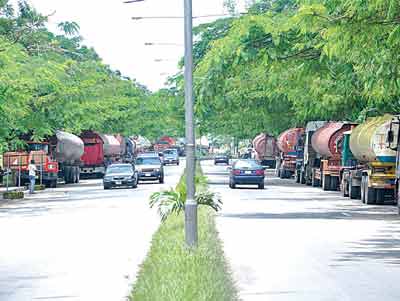

As ‘Parked Monsters’ Gridlock Calabar Roads
THE Murtala Mohammed dual carriage highway, the only gateway into Calabar, has been taken over by petrol tanker drivers. Many of these tankers or trucks are parked along the highway. They occupy the driving space of other motorists, while waiting to load petroleum products at various depots of tank farms in Esuk Utan, Calabar Port and Calabar Free Trade Zone (CFTZ).
The trucks numbering over 150 park daily on both sides of the highway between the Zone 6 Police Station and Nigeria Television Authority (NTA), Calabar, obstructing free flow of traffic. Some of the trucks are also parked along the Calabar/CFTZ road, stretching off the highway and further down to the port and Zone.
Often, and especially at the peak hours of 7am and 4pm, traffic at this section of the highway becomes hectic, as motorists waste additional 30 minutes to one hour before arriving at their destinations.
The situation along the port or harbour road is even worse, as trucks have completely taken over a greater part of the road, causing untold hardship to motorists hoping to do business at the port, Zone or at other companies.
“This is not good,” said Peter Eze, a motorist, warning of the risk posed by the trucks. “It is very dangerous to have trucks, which carry highly inflammable products, parking along the highway. In the event of a fire, many lives and property would be lost,” he said.
“Beside the issue of accidents, it is really an eyesore to have a long queue of tankers and trucks parked by a highway, which is the only entry road into Calabar. It was not like this before and we are surprised to see this new development this year. The state government should do something urgently to stop it,” he added.
One tanker driver, Audu, however, explained: “We don’t have anywhere to park. We come from the North to buy PMS (Premium Motor Spirit) and other products, and the tank farms do not have enough space for us to park our trucks. That is why we park here. If government or the tank farms give us space, we will move.”
Another tanker driver who pleaded anonymity said: “The tank farm owners are supposed to provide us with a park but they are only interested in selling their products and making profit. They are not interested in creating parks for us. For instance, NorthWest Petroleum is a big farm, yet it does not have a convenient park for tankers.”
Indiscriminate parking of trucks was also noticed along Calabar-Ikom-Ogoja highway, a situation which forced the Ikom council, under the then Chairman, Dr. Tony Ngban, to declare the stretch of the Federal Highway at Ikom Calabar Road between Nde 3 Corners and Okuni Town, a no-parking zone for all trailers, lorries, oil tankers and other articulated vehicles. He warned that any of the operators of the above mentioned vehicles, who convert any part of the stretch to a parking lot, risk arrest and prosecution, and impounding of the vehicle.
“It was under these circumstances that my administration undertook the construction of a permanent park at Atimaka at a cost of N6,000,000, with a parking lot for more than 100 tankers at a time, and which is now completed,” he said.
The Guardian, however, noticed that though some trucks use the park provided, others still park on the highway.
The Cross River State Governor, Senator Ben Ayade, few days after he was sworn into office, had given the truck drivers along the Murtala Mohammed highway three days to vacate the place. But they are still there.
As a follow up to the governor’s directive, the State House of Assembly set up an ad-hoc committee on the problem. But since the report of the committee was submitted to the House in August this year, nothing has changed.
While submitting the report, the chairman of the committee, Mr. Idagu Ajor Agaji, said the indiscriminate parking of trucks, trailers and other vehicles along highways in the state “has assumed alarming dimension” and “the menace has extended to minor roads within residential areas of Calabar.”
Agaji explained that with the Calabar-Odukpani highway as the only gateway in and out of the capital city, the presence of dangerous and menacingly parked trailers on both sides of the road could put off visitors and tourists to the state.
The committee noted that the provision of parks and other facilities would allow government to keep track of commercial activities at the already congested depots, as well as justify collection of parking fees from tankers, to enhance revenue to government.
The committee recommended, among other things, increase of the staff strength of the Petroleum Equalization Fund (PEF) to accelerate issuance of permits to tanker drivers at the Calabar depot, so that they could leave immediately after loading. On the other hand, tank farm owners would only allow tankers scheduled to lift products into Calabar.
The Speaker, Mr. John Gaul Lebo, commended the ad-hoc committee on the report, which was committed to the House Committee on Business and Rules, noting that already the state government was looking into the matter for a lasting solution.
The chairman of the PEF, Nigeria National Petroleum Corporation (NNPC), Calabar Unit, Elder Edem Okono, pleaded with members of the public to bear with them, as plans are on the way to move the tankers to a park.
He said: “For the trucks parked along Murtala Mohammed highway, we are pleading with the public to cooperate with us because we are still partnering with the state government to give us a place where our trucks can park. Majority of these truck drivers are our Northern brothers. We don’t have enough parking spaces. That is why they have parked by the highway. So, we are appealing to people that whenever you get to Zone 6, slow down. You may not spend up to 30 minutes or one hour and you will pass. We pray government to assist us.”
Okono also appealed to the Federal Government to intervene urgently on the bad Calabar-Itu and Calabar-Ikom highways. He said: “To me, nothing is for ever. One day, they will fix the road, no matter the challenges. We believe that one day, they will. Our prayer will make them remember us. But we advise our truck drivers also to go along the road slowly. It is mostly those that have not experienced Calabar roads that come in with speed and get involved in accidents.
“We have lost trucks and lives. We have had meeting with Federal Road Safety Corps (FRSC), so that they can help curtail trucks that over speed. We believe that with the intervention of the FRSC, the rate of accidents will reduce.”

