 Follow Us on Google News


 Follow Us on Google Discover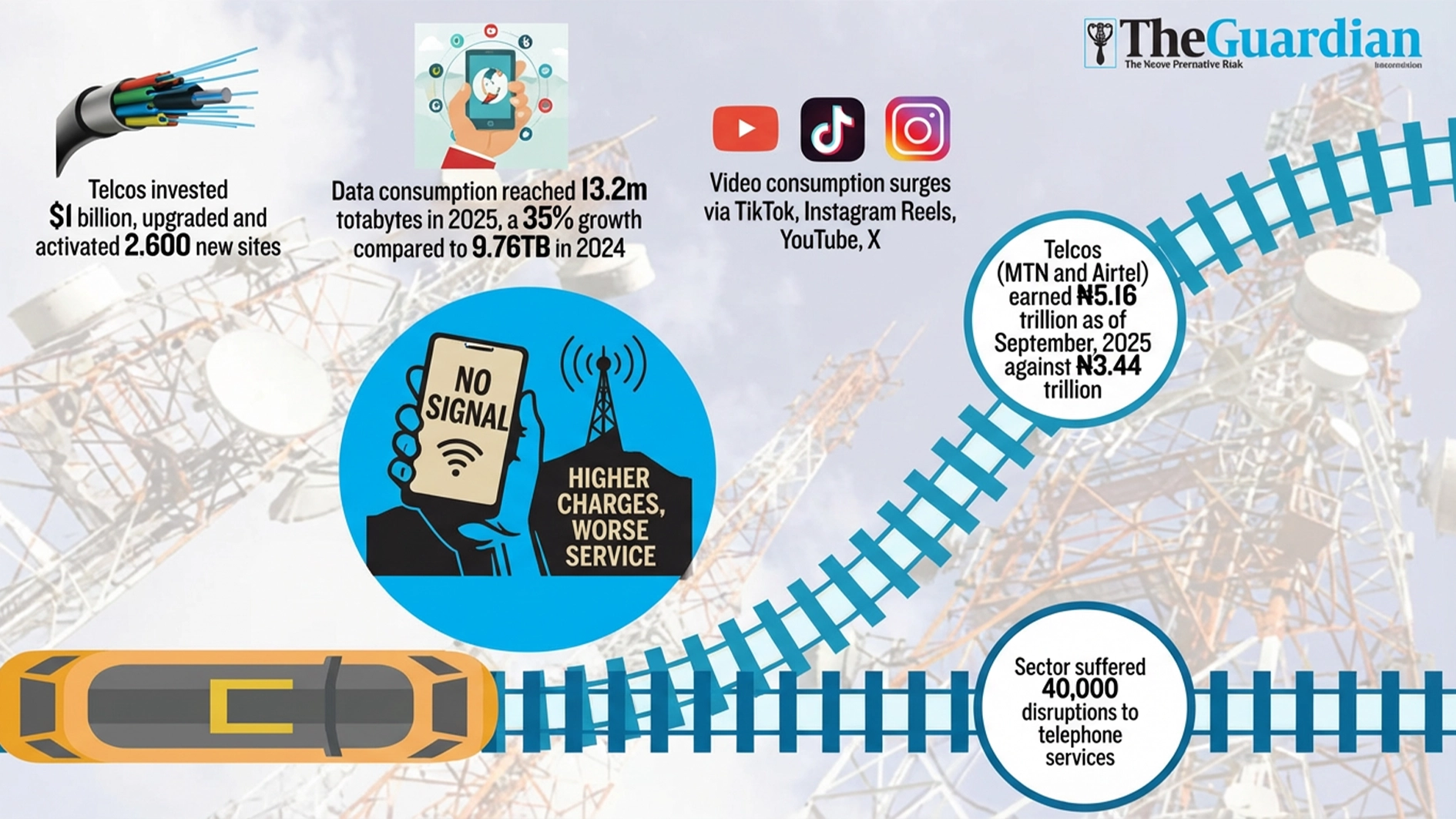
• Quality of service dips despite $1 billion infrastructure upgrade
• MTN, Airtel revenue up by 50 per cent
• Over 40,000 disruptions, fibre cuts compound subscribers’ woes
• ATCON seeks stricter enforcement of CNII to curtail misfortunes
Exactly a year after the Nigerian Communications Commission (NCC) approved a landmark 50 per cent increase in telecommunications tariffs, millions of Nigerian subscribers are still holed up in the familiar, frustrating crisis – paying more for unreliable services.
When the current price structure was implemented on January 20, 2025, it was framed as a ‘sustainability intervention.’
The logic was clear: the industry was suffocating under the weight of a high inflation rate, a weakened naira and soaring diesel costs.
In exchange for the tariff relief, the NCC and major mobile network operators (MNOs) promised a visible leap in the quality of service (QoS). Now, 12 months later, the leap feels more like a stumble for the consumers.
The 50 per cent hike had pushed the floor price (minimum acceptable price) of calls to N9.6 per minute from N6.40 and made the ceiling price (maximum acceptable price) of calls N50. The cost of SMS was raised to N6 from N4, while the cost of 1GB of data went up to N431.25 from N287.5.

Undoubtedly, operators have seen improved earnings, ensuring they continue to smile at the bank.
For instance, MTN Nigeria had a strong financial turnaround in 2025, recording N3.7 trillion earnings in the first nine months, driven by data and voice growth. The full-year financials are not ready, but an annualised revenue heads to N5 trillion.
It swung back to profitability with a N750.2 billion profit after tax in the first nine months, ending years of losses and even declaring an interim dividend late last year.
For Airtel, in the first nine months of 2025 (ending September 30), its revenue surged to approximately $699 million (N527.81 billion), a significant jump from the previous year, courtesy of tariff hikes and higher data demand. Its PAT reached $376 million, supported by a substantial foreign exchange gain.
Checks showed that MTN and Airtel earned N5.16 trillion ($3.63 billion) in the first nine months, partly attributed to the 50 per cent tariff hike. The earnings were N1.72 trillion or 50 per cent (coincidentally) higher than the N3.44 trillion earned in the same period of 2024.
Globacom and 9mobile, being limited companies, are not under any obligation to disclose their financials.
Last year alone, the operators ramped up investment to the tune of $1 billion; MTN Nigeria alone poured over N560 billion into infrastructure. But the user experience remains erratic, data from the latest NCC’s Quality of Experience (QoE) report is a mockery of the financial health of the telcos and investment.
For instance, across the board, dropped calls and one-way audio continued to plague the last mile.
Social media has become a battlefield, with subscribers accusing telcos of involvement in data depletion. Operators attributed the complaints to higher 5G speed, but consumers insist the billing structure lacks transparency.
Despite the marketing blitz, 5G coverage remains exclusive to affluent customers and urban centres, leaving the vast majority of the 177 million active subscribers struggling with congested 4G and 3G networks.
For the average Nigerian, the investment numbers do not matter as much as the bars on their phone.
Speaking with The Guardian, a digital entrepreneur in Yaba, Tunde Adeoye, said: “Last year, I spent N5,000 a month on data. Today, I spent N8,000 for the same volume, yet I still have to stand on my balcony to make a clear WhatsApp call. The only thing that has improved is the speed at which my credit finishes.”
The President of the National Association of Telecoms Subscribers of Nigeria (NATCOM), Deolu Ogunbanjo, echoed the sentiment further, saying the belief was that services would improve greatly this year, especially with the 50 per cent tariff hike, “but our hopes appeared to have been dashed as services remained one year after.”
Ogunbanjo said there can never be any QoE without improved telephony service across board, stressing that the telecoms sector has become a major pillar for the economy, serving as infrastructure of infrastructure. He said the stability of the sub-sector holds greater prospects for the entire ICT sector.
Amidst all these, the question has been, why is it that the billions have not fixed the signal yet? Industry experts and bodies, including the Association of Licensed Telecommunications Operators of Nigeria (ALTON) and the Association of Telecom Companies of Nigeria (ATCON), have pointed to a continuous siege on infrastructure in the country.
Telecom Expert, Kehinde Aluko, said: “The tariff hike solved the liquidity problem, but it didn’t solve the security problem. In 2025, operators recorded over 19,000 incidents of fibre cuts and equipment theft. They are building in the day, and vandals are stripping the towers at night.”
Also, he said the reliance on diesel to power base stations remains a massive drain, stressing that despite a 50 per cent increase in revenue per user, the cost of keeping the lights on in a country with a perennially failing national grid has neutralised much of the gain.
NCC said telephony services were impacted negatively last year by over 40,000 disruptions, including 19,384 fibre cuts, 3,241 cases of equipment theft and over 19,000 denials of access to telecom sites, resulting in prolonged outages, significant revenue losses, increased security costs, and delays in restoring services for millions of users.
As it is, public patience has reached a breaking point and the Executive Vice Chairman of NCC, Aminu Maida, has admitted that telephone services have not been optimal and has signalled that 2026 will be the year of consequences.
According to him, in 2026, the commission is moving from encouraging investment to enforcing performance.
He disclosed that operators deployed more than 2,800 new and upgraded sites in 2025, which have helped to lift broadband subscriptions to about 109.6 million by December, up from 96.3 million a year earlier. Broadband penetration rose to 50.58 per cent, compared with 44.43 per cent at the end of 2024.
As the industry enters the second year of the new tariff era, the narrative is shifting. It is no longer a question of whether the telcos have enough money to survive, but whether they can provide services that justify the billings.
On this, ATCON President, Tony Emoekpere, said the sector was emerging in 2026, with renewed confidence, underpinned by the combined efforts of industry players, regulators and the government to deepen digital inclusion.
He described 2025 as a year defined by careful capital discipline and stabilisation. According to him, the industry did not retreat despite economic challenges such as rising energy costs, foreign exchange, import pressures on equipment and right-of-way challenges.
“Instead, telecom operators, tower companies, and Internet service providers focused on demystifying networks in high-demand corridors, transitioning to solar and hybrid energy systems to reduce diesel dependency.
“If 2025 was about endurance, 2026 must be about execution, speed, and scale, driven by rising digital demand from fintech and AI workloads. The industry plans to intensify investment in data centres and last-mile broadband access,” he said.
According to Emoekpere, who gave an outlook of the industry in 2026, a critical factor for success in 2026 will be the visible enforcement of a critical national infrastructure designation for telecom assets.
He called for coordinated action to protect fibre routes and towers from infrastructure risks, alongside the harmonisation of right of way (RoW). He also underscored the need to reduce multiple taxation.
Already, Maida said it would hold telecom operators accountable to ensure significant improvement in consumers’ experience.
As such, NCC EVC said it expected operators to invest deliberately in expansion, capacity and resilience; reduce avoidable outages while strengthening incident response plans and ensuring transparent communication with consumers during service disruptions.
He urged operators to simplify tariffs and improve pricing clarity, in line with regulatory guidance.
Maida, in a document titled ‘2026: Delivering Better Quality of Experience to the Nigerian Consumer’, said operators must protect the integrity of the ecosystem, including timely settlement with critical suppliers and supporting service sustainability.
Operators are expected to comply with the guidelines on corporate governance for the industry as well as other extant regulatory obligations.
“Put simply, stronger networks, clearer communication, better customer care, stricter compliance,” Maida stated.
NCC, on its part, according to the NCC EVC, said it will prioritise quality of service and network resilience. On this, he said the commission will deepen its QoS monitoring, strengthen major incident reporting and escalation, and drive practical measures that improve availability and performance, especially in high-traffic areas and persistent black spots.
According to him, the Commission will be high on consumer protection and transparency.
“We will reinforce tariff transparency, accuracy of billing, customer care standards, and protections against misleading practices. Consumers will also see more consistent public communication during major service incidents,” he stated.

