 Follow Us on Google News
 Follow Us on Google Discover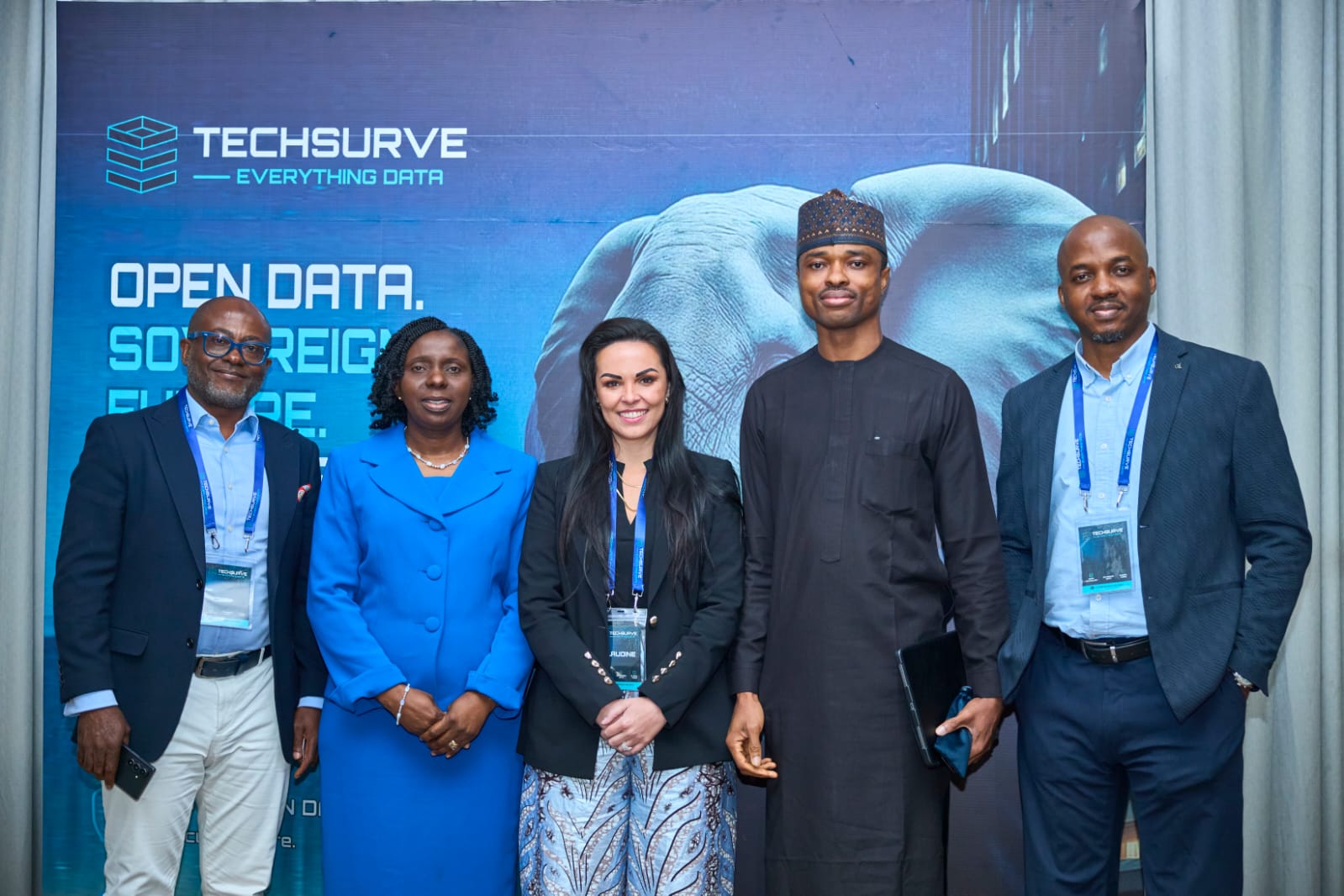
Nigeria’s race to build a globally competitive digital economy is entering a new phase, one in which access to technology may no longer be enough.
The bigger question is increasingly who controls the infrastructure, data and technology on which Nigerian businesses depend.
That challenge emerged strongly at the launch of TechSurve and the Nigeria PostgreSQL Forum, where technology and business leaders argued that Nigeria must move beyond being predominantly a consumer of global technology and accelerate the development of local capability, digital infrastructure and commercially viable innovation.
From telecommunications and databases to data sovereignty and open-source technology, speakers made the case for a digital economy that is not only connected, but increasingly resilient, cost-efficient and capable of competing on its own terms.
For MTN Nigeria Chief Information Officer Bukola Ajayi, the issue is particularly urgent.
Ajayi warned that excessive dependence on foreign-controlled technology could leave Nigerian organisations exposed to economic, operational and geopolitical risks, even where the physical infrastructure hosting their data is located within Nigeria.

She argued that the conversation around data sovereignty therefore needs to move beyond simply asking where Nigerian data is stored.
True sovereignty, she said, must also consider who controls the databases, applications and underlying technologies that make that data usable.
“A sovereign data centre with a foreign-controlled database inside is like owning the building but renting the foundation,” Ajayi said. “You own the building, but you don’t control the infrastructure that runs your business.”
The distinction is significant as Nigerian organisations prepare for an increasingly stringent data-localisation environment.
Ajayi said the Central Bank of Nigeria’s data-localisation requirement, which she noted would become binding from January 1, 2027, should be treated not merely as a compliance obligation but as an opportunity to strengthen local technological capability.
That opportunity could also accelerate the adoption of open-source technologies.
Ajayi pointed to PostgreSQL as an example of how organisations can reduce their dependence on expensive proprietary database systems without necessarily sacrificing the reliability required for large-scale enterprise operations.
And she offered evidence from within one of Nigeria’s largest telecommunications operators.
“At MTN, we also use Postgres,” she said, explaining that one of the company’s critical subscription platforms operates on PostgreSQL and processes millions of calls.
“So I can tell you that Postgres works.” The significance extends beyond the choice of database technology.
For Nigerian businesses facing foreign-exchange pressure, rising technology costs and growing volumes of data, greater adoption of enterprise-grade open-source technologies could potentially change both the economics and strategic ownership of their technology infrastructure.
The challenge, however, is not solved by technology alone. It requires companies capable of turning that technology into competitive businesses.
Nigeria needs challengers, not copies of incumbents. Briclinks Africa Plc Chief Executive Officer, Mohammed Buhari, argued that Nigeria’s next generation of technology and telecommunications companies will have to resist the temptation to imitate established operators.
“You don’t beat the incumbent by becoming another incumbent,” Buhari said. “You beat the status quo by doing things differently.”
Speaking on “Building a National Telecoms Challenger in the Market,” Buhari described an industry in which new entrants face formidable barriers: infrastructure is expensive, capital remains costly, technology is evolving rapidly and customers increasingly expect better service at lower cost.
But those disadvantages can also create an opening. A challenger unburdened by legacy infrastructure and entrenched operating models can potentially move faster, partner differently and deploy capital more selectively.
His argument reflects a broader shift taking place across technology industries globally: competitive advantage increasingly comes not from owning every piece of infrastructure, but from orchestrating networks, platforms, partners and customer relationships more intelligently.
“The future of telecommunications will not necessarily belong to a company that owns everything,” Buhari said. “It will belong to a company that connects everything most intelligently.”
Nigeria’s emerging Mobile Virtual Network Operator ecosystem could provide one test of that proposition.
Buhari said the regulatory framework supporting MVNOs creates an opportunity for new operators to use existing infrastructure and spectrum while developing differentiated services and reaching markets that traditional operating model may have underserved.
That matters because the economic role of telecommunications has expanded dramatically.
“Telecommunications is no longer just about voice and data,” Buhari said. “It’s about the digital economy, it’s about connecting businesses, it’s about enabling young people, it’s about financial inclusion, it’s about education, it’s about healthcare.”
For Briclinks Africa, he said, the ambition is therefore not simply to capture a small portion of an existing market.
“We want to help reshape the market,” Buhari said. “We want to compete on service, we want to compete on innovation, we want to compete on efficiency, and we want to compete on integrity.”
Yet infrastructure and regulation are only part of the equation. Nigeria also needs entrepreneurs willing to build.
Buhari argued that one of the country’s most important assets is its human capital, but converting that talent into globally competitive businesses requires a change in ambition.
“We must believe that a Nigerian company can build a world-class telecommunications business,” he said. “We must believe that Nigerian talent is capital. We must believe that innovations can come from here, and we must be willing to build for the long term.”
BluDive Chief Technology Officer, Abu Musa, took that argument a step further, identifying fear of failure as one of the barriers that can prevent entrepreneurs and technology professionals from attempting meaningful innovation.
Failure, he argued, is not necessarily the opposite of innovation. In many cases, it is part of the process.
“Failure on its own isn’t entirely a bad thing. It’s only if you are able to learn from it,” Musa said.
He urged Nigerian innovators to combine ambition with practical execution.
“Be bold, be innovative, be applicative with your innovation,” he said, adding that organisations capable of learning quickly from setbacks can limit their impact and continue moving forward.
Dr Adelana Olamilekan also stressed the commercial dimension of the technology conversation, arguing that digital tools must ultimately translate into stronger businesses.
For companies seeking growth, he said, technology should improve visibility, enable expansion and increase operational efficiency rather than simply exist as another corporate investment.
Taken together, the discussions pointed to a larger question facing Nigeria.
The country has already demonstrated its capacity to consume digital technology at enormous scale. It has produced major fintech businesses, built one of Africa’s largest telecommunications markets and developed a deep pool of technology talent.
The next challenge is more ambitious: how much of the infrastructure underpinning that digital economy can Nigeria control, build, operate and commercialise itself?
That requires more than localisation rules. It means developing local technical expertise. It means giving Nigerian businesses credible alternatives to costly proprietary systems. It means building partnerships that allow emerging companies to compete without recreating every piece of infrastructure from scratch. And it means creating an environment in which Nigerian technology companies can move from serving local markets to competing internationally.
Open-source technology is one part of that equation. Data sovereignty is another. Capital, regulation, infrastructure and entrepreneurial confidence matter too.
But the underlying message from the forum was clear: Nigeria’s digital future cannot be measured only by how much technology the country adopts.
Increasingly, it will be measured by how much of that technology Nigerians are capable of understanding, controlling, building, and ultimately owning.

