 Follow Us on Google News
 Follow Us on Google Discover
For most of the past two years, the story of artificial intelligence at work has been the story of a chat box. You open a tab, you type a question, you copy the answer somewhere useful, and you close the tab. It is a useful pattern, but it is also a strangely passive one. The intelligence waits. It knows nothing about your inbox, your deadlines, the deal that has gone quiet, or the meeting you just left. Every conversation starts from zero.
A quieter shift is now under way, and it borrows an old idea from computing to describe it: the daemon. In software, a daemon is a background process that runs continuously, watching for events and acting without being asked each time. Applied to knowledge work, a “personal AI daemon” is an assistant that does not sit behind a prompt waiting for instructions. It stays connected to the tools you already use, keeps context across all of them, and surfaces what matters before you go looking for it.
From answering to noticing
Consider how a typical professional actually spends a Monday. Email in one window. A messaging app in another. A task tracker somewhere. A calendar. Notes scattered across documents. A customer record hidden in yet another tool. The human brain becomes the integration layer, constantly switching contexts and quietly losing information in the gaps between apps.
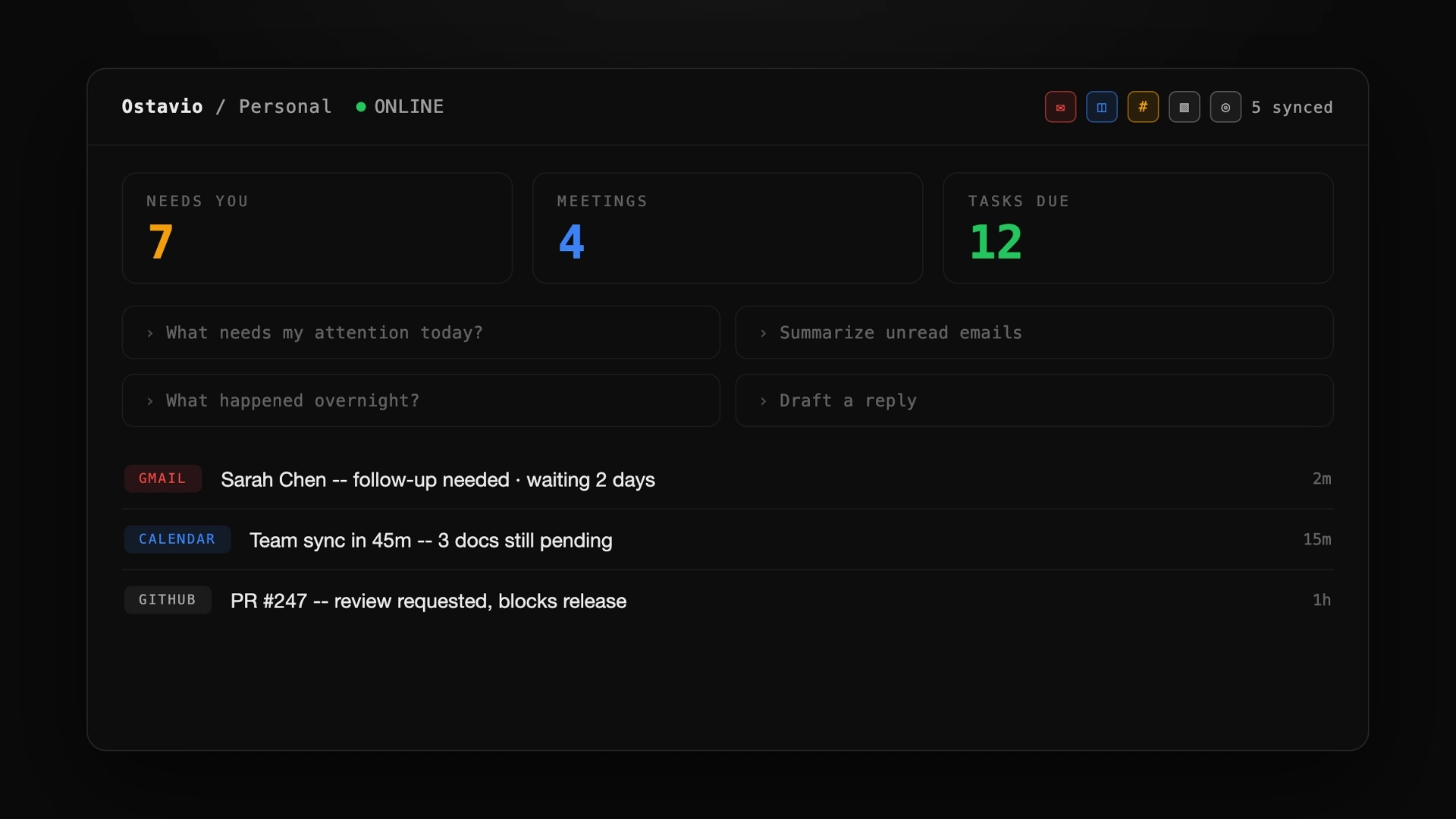
That is the premise behind platforms such as Ostavio, which frames itself around a single promise — one AI brain for all your work. A daemon-style assistant inverts the usual arrangement. Instead of asking you to carry context from tool to tool, it holds the context itself. Connect an account such as Gmail, Slack, GitHub, Google Calendar or Notion, and the system reads across those sources as one continuous stream rather than a set of walled gardens. The value is no longer a clever answer to a question you thought to ask. The value is the reminder you would have forgotten, the follow-up you did not schedule, the task buried in a paragraph of a meeting that never made it onto any list.
This is the difference between a tool that answers and a tool that notices. Noticing requires persistence, and persistence is precisely what a background process provides.
The context engine is the product
The technically interesting part of this generation of tools is not the language model. Capable models are now widely available, and most products can bring their own. What separates them is the layer underneath — the engine that connects modules so that email, tasks, meetings and customer relationships inform one another.

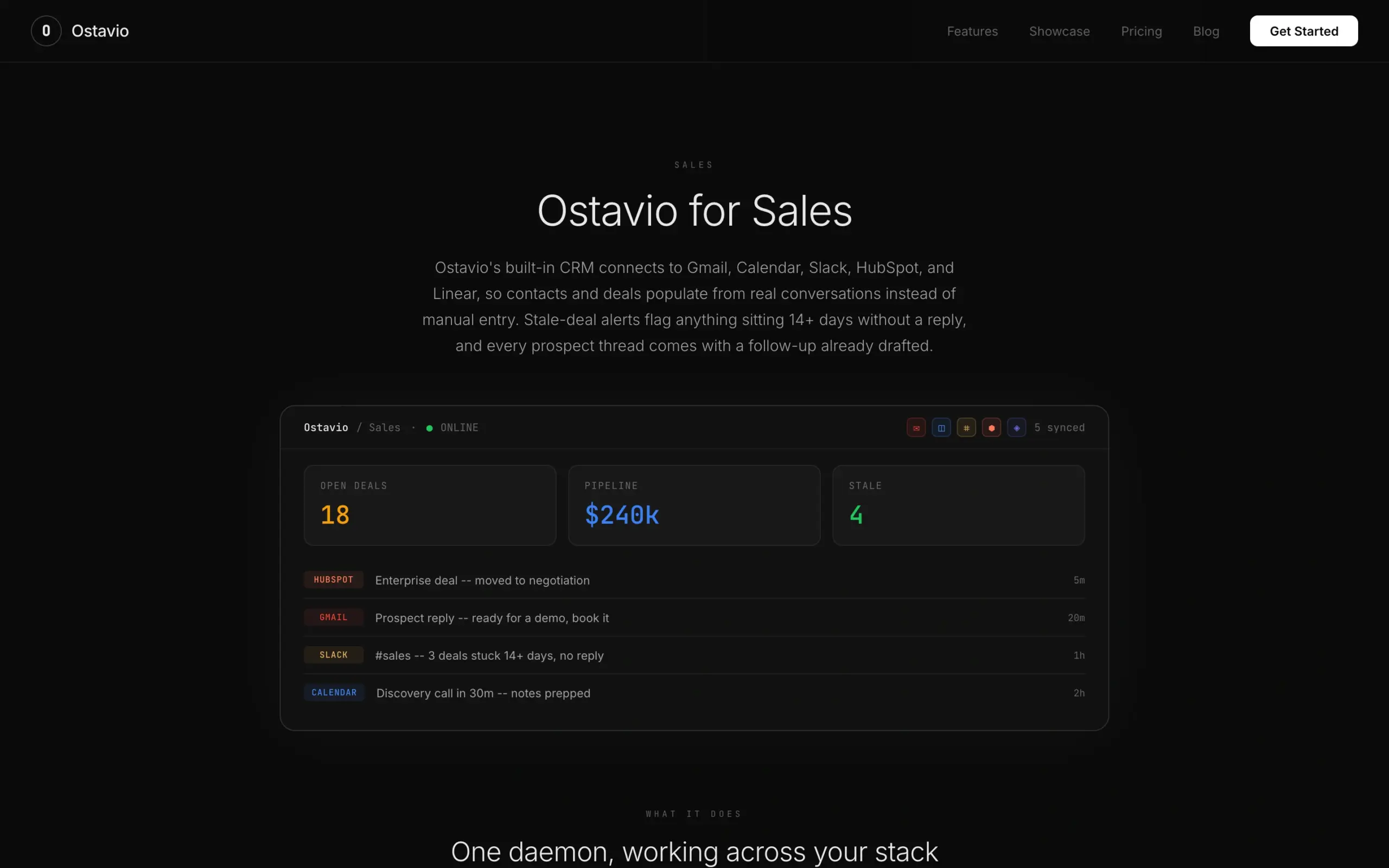
Take customer work as an example. A conventional setup keeps your sales pipeline in one silo and your email in another, and asks you to reconcile them by hand. An AI-native CRM built on a shared context engine treats them as the same fabric. A conversation in your inbox can update a deal. A pipeline that has not moved in weeks can raise a stale-deal alert on its own, rather than waiting for a quarterly review to expose the problem. The point is not to add another dashboard. The point is to remove the manual stitching that dashboards usually demand.
Meetings show the same pattern. When an assistant can transcribe a call, generate structured notes, and then create the resulting tasks automatically, the meeting stops being a black hole that swallows action items. What was discussed becomes what gets done, without a person retyping decisions into a separate app afterwards.
One brain, many trades
Perhaps the most telling sign that this category is maturing is how quickly it has stopped being generic. The daily rhythm of a retail shop is nothing like that of an accounting practice, a recruitment desk, a logistics operator or a clinic — and an assistant that treats them identically helps none of them well. The newer platforms lean into this with live industry showcases that demonstrate the same context engine running a sales pipeline, a bookkeeping workload, an HR funnel or a healthcare front desk, each with its own vocabulary, priorities and alerts. The underlying daemon is identical; what changes is what it has learned to notice.
That pattern — one engine, many trades — also explains where these products come from. Ostavio, for instance, is the self-serve sibling of Eucalipse (eucalipse.com), a studio that builds bespoke AI-agent systems for individual firms. The custom work reveals what dozens of industries actually need an assistant to watch for; the product distils those lessons into something an individual can switch on in an afternoon, without hiring anyone.
Lowering the cost of adoption
None of this matters if switching is painful, and historically that has been the wall every productivity tool hits. People do not abandon the systems they already live in, however imperfect, because migration feels like starting over.
This is where the practical details earn their keep. Features such as one-click migration from established tools like Linear, Jira, Trello, Asana, HubSpot or a plain CSV export are not glamorous, but they decide whether a product is adopted or admired from a distance. Combine that with passwordless login and the option to bring your own AI key, and the friction of trying something new drops to something close to zero. A free tier lets an individual start alone; a modest paid plan extends it as the work grows.
What this means for Nigerian knowledge workers
For a fast-growing professional class — founders, freelancers, small agencies and lean teams across Lagos, Abuja and beyond — the appeal is straightforward. These are exactly the operators who cannot justify a stack of expensive, specialised enterprise tools, and who feel tool sprawl most acutely because there is no operations department to absorb it. A single, affordable system that unifies mail, tasks, customer relationships and meetings does more than save money. It removes an entire category of coordination overhead from people who are already wearing every hat in the business.
The broader lesson is that the next phase of workplace AI will not be won by whoever has the smartest chatbot. It will be won by whoever most convincingly makes the intelligence disappear into the background — always on, always aware, quietly doing the remembering so that people can get back to the thinking. The daemon, it turns out, was the right metaphor all along.

