 Follow Us on Google News
 Follow Us on Google Discover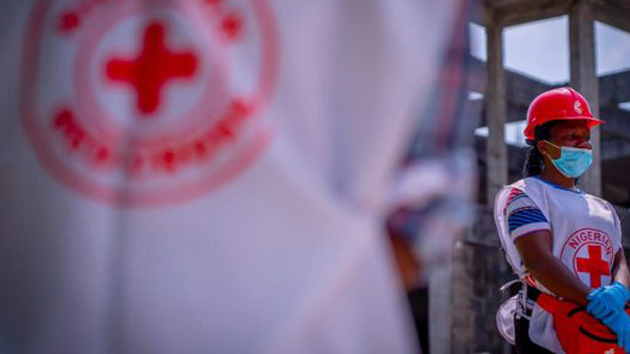

The Nigerian Red Cross Society (NRCS) said it will downscale training on response coordination regarding the virus across the 774 Local Government Areas (LGAs) to prevent a humanitarian crisis.
[ad]
The National President, NRCS, Prince Oluyemisi Adeaga, made this known at the end of a Three-Day Train the Trainer Capacity Building workshop for States’ Sub-national Teams, organised in partnership with the Nigeria Centre for Diseases Control (NCDC), weekend in Abuja.
The President pointed out that the NRCS is spread across all the LGAs in Nigeria with a total membership of 800,000, which it intends to leverage to scale down the training for awareness creation on the infectious viral disease.
He said, “The NRCS is spread through all the 774 local governments we have in Nigeria, and we have a total membership of about 800,000 as of today.
“However, when you compare it against what we have as the national population of 220 million, practically we might not be there, but then we ensure that we have presence in all the local governments, and we can easily mobilise from surrounding local governments if there are challenges.
[ad]
“In all areas of health challenges and humanitarian challenges, the Red Cross is always ready to mitigate by collaborating with essential organisations and institutions to mitigate against disasters and all disastrous incidences. We are always involved in ensuring the treatment of such citizens by providing equipment and personnel where we can.”
He noted that when it comes to promotion and awareness creation, the organisation has skill units, inter-agents in higher institutions, and also partnerships with churches and mosques in addition to its spread branches to coordinate response to all humanitarian crises effectively.
Senior Epidemic Preparedness and Response Officer, NCDC, Dr. Odianosen Ehiakhamen, revealed that Nigeria will in a few days roll out vaccination against the virus in a state considered ‘high burden’ to curb further spread.
[ad]
While noting that the Nigerian government has done a lot of work in containing the virus, he stressed the importance of multi-sectoral and multi-disciplinary coordination to tackle and prevent the spread of the virus.

Dr. Ehiakhamen said, “We actually have an EOC (Emergency Operation Centres), for Mpox, it’s a multi-sectoral, multi-disciplinary coordination for the Mpox response, and the Red Cross had thought it wise to support training and capacity building of state officials to be able to respond adequately.
“As we know, we have over 90 confirmed cases so far in the states, about 25 states and the Federal Capital Territory, (FCT), and we think it is important to be able to improve the capacity of health workers to be able to properly respond.”
He said the incident response plan for Nigeria, which is used to coordinate the response to Mpox, has the Red Cross, the WHO, NCDC, Breakthrough Action, and many other partners that will support the response through the Federal Ministries of Health, Agriculture, and others.
[ad]

