 Follow Us on Google News
 Follow Us on Google Discover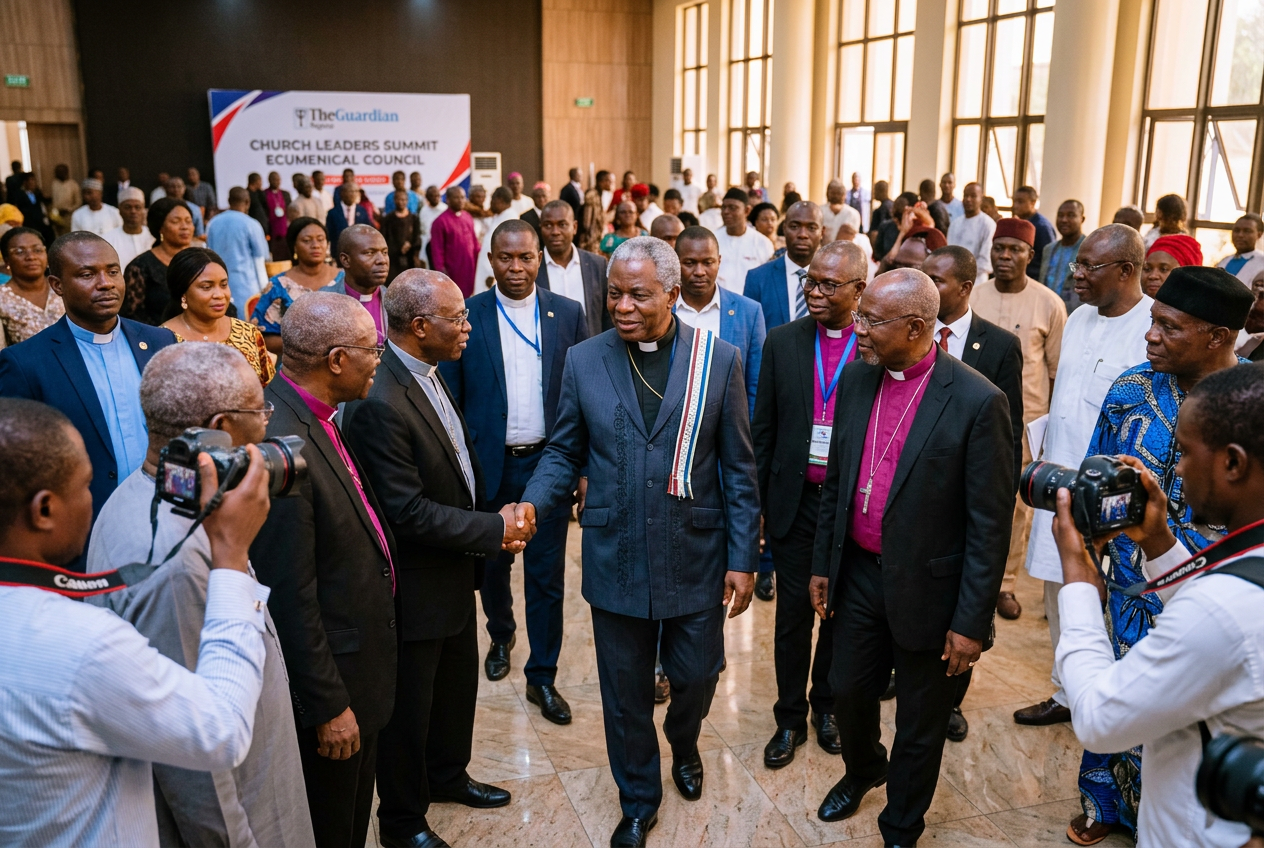
Welcome, and do pull up a chair, because this one genuinely surprised me. I have spent months chasing this question through church constitutions, plenary communiqués and Abuja press statements, and after years of writing about Nigerian faith and public life I can tell you that almost everybody who asks who is the head of Christianity in Nigeria is expecting a single name. One man. A sort of Nigerian pope. The honest answer is that no such office exists, although the umbrella body that speaks for the country’s Christian denominations comes closer than anything else we have.
That is not a dodge. It is the whole story. Nigerian Christianity is not a pyramid with one man at the apex. It is closer to a federation, and like our political federation it argues with itself constantly, speaks with several voices at once, and somehow still manages to show up together when it matters. Understanding that structure is the difference between sounding informed at a wedding reception in Owerri and repeating something you half remember from a WhatsApp broadcast.
So let us take it properly, layer by layer.
Who is the leader of Christians in Nigeria today?
If you want the closest thing Nigeria has to a national Christian leader, the name is Archbishop Daniel Chukwudumebi Okoh.
He is the President of the Christian Association of Nigeria, elected in July 2022 and serving a single five year term. Before that he was General Superintendent of Christ Holy Church International in Onitsha, and he remains international chairman of the Organisation of African Instituted Churches. When he was chosen, The Guardian reported his first public appeal, which was a plea for dialogue rather than confrontation across Nigeria’s fault lines, and that has more or less been the tone of his tenure ever since.
Here is what makes his position unusual. Okoh became the first person from the African Instituted Churches bloc ever to hold the office. For decades the presidency had rotated among the Catholics, the mainline Protestants and the Pentecostals, and the aladura churches, the white garment tradition that most Nigerian families have at least one relative attending, were treated as junior partners. His election quietly ended that.

What does the job actually involve?
Less than people imagine, and more than people notice. He cannot appoint a bishop. He cannot discipline a pastor. He cannot tell the Redeemed Christian Church of God what to preach on a Sunday morning, and if he tried, the phone call would be extremely short. What he can do is convene, and speak, and be received.
That last part matters more than it sounds. When the presidency wants to address Nigerian Christians, it goes through him. In late 2025 he led a delegation to the President’s Lagos residence, where the discussion turned on new security approaches and the promise of state and community policing. By mid 2026 his tone had hardened considerably, and at the National Church Leaders Summit in Abuja he called for a nationwide state of emergency on security after a run of attacks on churches, schools and rural communities.
That is the office in a sentence. Convening power, moral authority, and a direct line to Aso Rock. No canonical authority whatsoever.
The federal government treats Christianity as a structured partner in other ways too. The Nigerian Christian Pilgrim Commission, a statutory body established by an Act of 2007, regulates and supervises Christian pilgrimage from Nigeria to Jerusalem and other holy sites, working through state pilgrims welfare boards. There is no equivalent office for internal church governance, and there never has been, which tells you something about how the state understands the church: as many bodies to be coordinated, not one body to be recognised.
So if a stranger corners you at a naming ceremony and asks who leads Nigerian Christians, Okoh is your answer. Just be ready for the follow up question, because it is the better one.
How to work out who actually speaks for Nigerian Christians on any given question
Over the years I have developed a rough method for this, mostly because I kept getting it wrong in print. Here it is.
- Start by asking whether the question is national or denominational, because that single distinction resolves about eighty per cent of confusion before you go any further.
- If it concerns Christians as a bloc in national life, security, elections, tax policy or interfaith relations, look to the Christian Association of Nigeria and its president.
- If it concerns doctrine, sacraments, ordination or church discipline, ignore the national body entirely and go to the specific denomination involved.
- Identify which of the five recognised blocs the church in question belongs to, since each one has its own leadership and its own internal politics.
- For Catholic matters, go to the Catholic Bishops’ Conference of Nigeria, and remember that its presidency changes hands every four years.
- For Anglican matters, go to the Primate of All Nigeria, whose authority over his own province is genuine and considerable.
- Check the date on whatever source you are reading, because Nigerian church leadership turns over more often than most reference pages bother to reflect.
That last step is not padding. I have lost count of the reference pages still naming a bishops’ conference president who left office months ago.
So who is the head of Christianity in Nigeria, exactly?
Now for the direct answer, because this is the section you scrolled for.
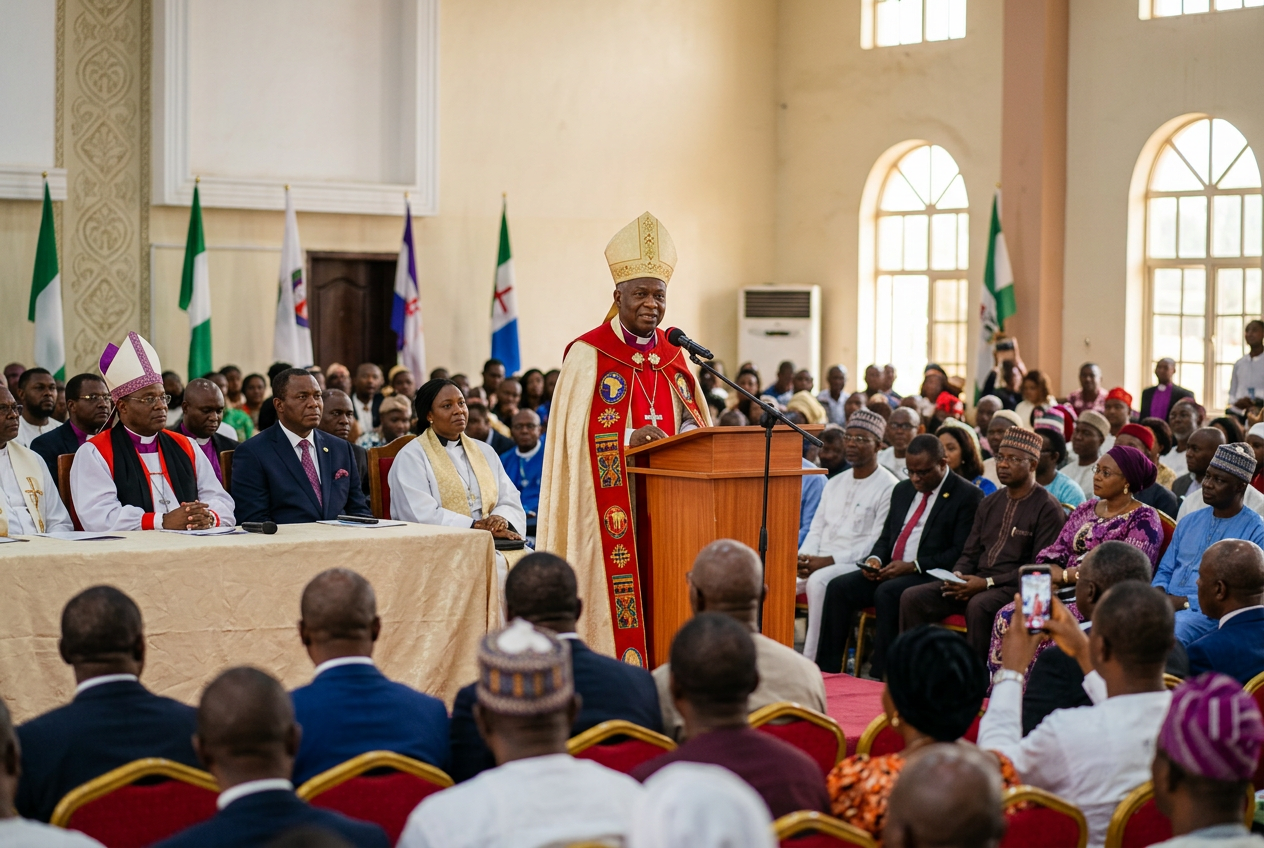
There is no single head of Christianity in Nigeria. The nearest equivalent is Archbishop Daniel Okoh, President of the Christian Association of Nigeria, who serves as the collective voice of Nigerian Christians in national affairs but holds no spiritual or doctrinal authority over any church other than his own. Real authority sits with the leaders of the five constituent blocs: Archbishop Matthew Man-Oso Ndagoso of Kaduna, who has led the Catholic Bishops’ Conference of Nigeria since February 2026; the Most Reverend Henry Chukwudum Ndukuba, Primate of All Nigeria in the Anglican Church of Nigeria; Bishop Francis Wale Oke, President of the Pentecostal Fellowship of Nigeria; the leadership of the northern evangelical churches gathered under the Fellowship of Churches of Christ in Nigeria and the Evangelical Church Winning All; and Okoh himself in his separate capacity over the African Instituted Churches. Above all of them, for Catholics only, sits the Pope in Rome.
Read that list again and you will see the shape of the thing. Five blocs, five centres of gravity, one shared microphone.
The Christian Association of Nigeria was founded in 1976, originally as an alliance of Catholics and mainline Protestants only. The Pentecostals joined later, the African Instituted Churches later still, and the northern evangelicals brought a constituency whose experience of Nigerian life is sharply different from that of a congregation in Lekki. Its National Executive Council elects the president, and a General Assembly of several hundred delegates ratifies the choice.
Notice what is missing from that arrangement. No apostolic succession running through the office. No power to excommunicate. No control over property, seminaries or money.
The blocs also deal with government in their own right, which is the clearest proof that no single office speaks for everyone. In July 2026 the Catholic bishops took nineteen of their number to the State House for a discussion covering intelligence gathering, security restructuring and the welfare of frontline personnel, entirely separately from anything the national association was doing that month.
Nigeria’s five Christian blocs and who leads them in 2026
| Bloc | Churches it represents | Leading figure in 2026 | Rough size |
|---|---|---|---|
| Catholic Secretariat of Nigeria | The Catholic Church, 9 provinces and 44 dioceses | Archbishop Matthew Man-Oso Ndagoso, CBCN President | 28 to 35 million |
| Christian Council of Nigeria | Anglican, Methodist, Presbyterian, Baptist and other mainline churches | Most Reverend Henry Ndukuba, Anglican Primate, largest member church | Church of Nigeria alone claims about 18 million |
| Pentecostal Fellowship of Nigeria | Redeemed, Winners, Deeper Life, Mountain of Fire and thousands of others | Bishop Francis Wale Oke, PFN President | Independent and Pentecostal churches around 30 million |
| Organisation of African Instituted Churches | Cherubim and Seraphim, Celestial Church, Christ Apostolic and the wider aladura tradition | Archbishop Daniel Okoh, also CAN President | Several million, poorly counted |
| TEKAN and ECWA | Northern and Middle Belt evangelical churches including COCIN | Reverend Doctor Stephen Baba Panya, ECWA President | COCIN alone reports over 8 million |
The table makes the central point better than another paragraph would: the two largest blocs by adherents are led by men who are not the national spokesman, and the national spokesman leads the bloc with the weakest membership records. Treat every figure in that final column as an estimate, because Nigeria has not asked a census question about religion since 1963 and every number you will ever read is a projection built on survey data.
That last fact deserves a moment. We do not officially know how many Nigerian Christians there are. Estimates run from roughly 46 per cent to 54 per cent of the population, which at current projections means somewhere between 105 million and 128 million people. The gap between those two figures is larger than the entire population of Ghana.
Who first brought Christianity to Nigeria?
To understand why nobody sits at the top, it helps to see how the faith arrived. It did not arrive once. It arrived twice, four centuries apart, through completely different doors.
The first arrival was Portuguese and Catholic. European contact with the Kingdom of Benin began around 1477, and Portuguese missionaries were active in Benin between roughly 1485 and 1520, working through the royal court on the theory that converting an Oba would convert his subjects. By about 1555, Augustinian monks sent from the diocese of São Tomé had reached Warri, where they found the Itsekiri considerably more receptive. Capuchin friars later built St Anthony’s Monastery at Ode Itsekiri between 1690 and 1692, which locals shortened to Satoni, and the ruins are still there.
That mission failed. Not immediately, and not for lack of effort, but it never moved beyond the palace walls, and when the priests left, the conversions largely left with them.
Four quiet centuries followed.
The second arrival was Protestant, and it changed everything. On 24 September 1842, the Reverend Thomas Birch Freeman of the Wesleyan Methodist Missionary Society landed at Badagry, accompanied by Mr and Mrs de Graft, who stayed to open a Methodist mission. Freeman pressed on to Abeokuta, arriving on 11 December, and returned to Badagry on Christmas Eve, where he met the Reverend Henry Townsend of the Church Missionary Society. That meeting is remembered as Nigeria’s first Christmas.
Townsend was travelling with a Yoruba man who had been captured by slavers as a boy, freed by the Royal Navy, educated in Sierra Leone, and who would eventually become the first African Anglican bishop. His name was Samuel Ajayi Crowther, and his translation of the Bible into Yoruba did more for the spread of Christianity in this country than any European who ever landed at Badagry.
Here is the part that explains the whole present arrangement. The missionary societies carved the territory up between them. Methodists here, Anglicans there, Church of Scotland at Calabar from 1846 under Hope Waddell, Catholics returning through the south east. The colonial administration was content with the arrangement and actively slowed missionary work in the far north to keep the emirates governable.
Nobody was ever put in charge, because nobody was ever meant to be in charge.
Which is why, one hundred and eighty four years later, we are still doing it this way.
Who is the current head of the Catholic Church in Nigeria?
The Catholic answer is the crispest one available, and it changed very recently.
Archbishop Matthew Man-Oso Ndagoso of Kaduna was elected President of the Catholic Bishops’ Conference of Nigeria on 24 February 2026, at the year’s first plenary assembly in Abuja. He succeeded Archbishop Lucius Iwejuru Ugorji of Owerri, whose four year tenure had run its course. Archbishop Alfred Adewale Martins of Lagos serves as Vice President, Bishop Peter Odetoyinbo of Abeokuta as Secretary, and Bishop Peter Chukwu of Abakaliki as Assistant Secretary, all for four years.
Ndagoso is a northerner by ministry if not by birth, born in January 1960, ordained in 1986, Bishop of Maiduguri from 2003 and Archbishop of Kaduna since 2007. That biography matters. He has spent his entire episcopate in the part of Nigeria where being Christian carries the highest cost, and he has been publicly blunt about national failures for years. He was already on record long before this appointment arguing that Nigeria’s problem is the absence of credible leadership rather than any shortage of capable people.
He was the man leading that State House delegation in July 2026, and he used it to press the case for coordinated security rather than sympathy. At Easter that same year he told Nigerians that the empty tomb meant no grave could hold back a new beginning, and then pivoted directly to the 2027 elections and the danger of voter apathy. That combination, pastoral and political in the same breath, is very Nigerian and very Catholic.
One clarification worth making, because it trips people up constantly.
The CBCN president is not the head of the Nigerian Catholic Church in the way a primate heads an Anglican province. He chairs a conference of equals. Every diocesan bishop in Nigeria answers to Rome directly, not to Kaduna. Ndagoso coordinates, represents and convenes, and his four year term will end whether or not he is still Archbishop of Kaduna.
Nigeria’s cardinals sit slightly outside this structure again. Cardinal Francis Arinze, Cardinal John Onaiyekan and Cardinal Peter Ebere Okpaleke hold rank in the universal church rather than authority over the Nigerian one. A cardinal outranks an archbishop in precedence and can vote in a conclave, but he cannot overrule a bishops’ conference at home.
Rather like having a Nigerian on the board of a multinational. Real influence, genuine prestige, no line management.
Who is the current head of Christianity as a global faith?
This is where the question usually goes wrong, so let me be careful.
There is no head of Christianity. There is a head of the Catholic Church, and because Catholicism is the largest single Christian body on earth, people slide from one to the other without noticing.
The current Pope is Leo XIV, the 267th holder of the office, elected in May 2025 following the death of Pope Francis. Nigerian Catholics took a particular interest in that conclave, and when it concluded, the bishops here urged the new pontiff to prioritise the healing of a fragmented world while noting Cardinal Okpaleke’s participation with obvious pride. Leo has since travelled to Africa, visiting Algeria, Cameroon, Angola and Equatorial Guinea in 2026.
But he is the head of the Catholics, and Catholics are roughly a quarter of Nigerian Christians.
The Orthodox churches have no single head at all; the Ecumenical Patriarch of Constantinople is first among equals and nothing more. Protestants have never had one by design, since the whole point of the Reformation was that they did not want one. Pentecostals answer to their own general overseers, and anyone who has watched a Nigerian megachurch operate knows exactly how much external authority its founder accepts.
The Anglican case is the most instructive, and it has become very current.
The Archbishop of Canterbury was historically the senior figure in the Anglican Communion, again first among equals rather than a ruler. In October 2025, Dame Sarah Mullally was appointed the first female Archbishop of Canterbury. Within days, Primate Ndukuba announced that the Church of Nigeria was severing spiritual ties with the Church of England, citing both her gender and her support for same sex blessings, and reaffirming alignment with the traditionalist GAFCON network instead.
Think about what that means. The world’s largest Anglican province, some eighteen to twenty five million people, formally declined to recognise the authority of the office that supposedly stood above it.
If you wanted a single illustration of why nobody heads Christianity, in Nigeria or anywhere else, that is it. The structures are real but they are voluntary, and when conviction and hierarchy collide in this country, conviction generally wins.
Which brings us back to the ₦500 note in the offering basket, and the woman beside you who has no idea who chairs any conference anywhere. She knows her pastor’s name. She knows her parish priest. That is the level at which Nigerian Christianity actually operates, and every structure above it exists to serve that, not the other way around.
Final Thoughts on who is the head of Christianity in Nigeria
After months with this question, my strongest feeling is relief that the answer is complicated.
A country with one hundred million Christians and one man in charge of them would be a country holding a very large lever with no safety catch. What we have instead is messier, slower and considerably harder to explain at a dinner table, but it is also harder to capture, harder to corrupt wholesale, and harder to weaponise against anybody. The Christian Association of Nigeria can speak for Christians without owning them. That distinction has kept the peace more than once.
So what should you actually do with this?
Be precise when you talk about it. When somebody claims a religious leader has spoken for all Nigerian Christians, check which office they hold and what that office can actually do. When you read a figure for the Christian population, check whether it comes from a survey or a projection, and remember there has been no census question on religion since 1963. When you see a leadership title online, check the date, because the Catholic presidency changed in February 2026 and a great many pages have not caught up.
And when the argument starts at the wedding reception, as it will, you now have the better answer. Not a name. A structure.
Related Articles
Leadership is only half the picture, and the other half is what the law actually guarantees. I looked closely at the constitutional position and the daily reality in my examination of what religious protection means in practice across the six geopolitical zones, which covers the gap between what Section 10 promises and what happens in a Kaduna village on a Sunday morning.
If you want the wider context in which all of this sits, faith in Nigeria is never separable from ethnicity, language and inherited custom. I traced those threads in my broader look at the traditions that shape everyday Nigerian identity, and much of what looks like church politics turns out, on inspection, to be older than any church here.
Key Takeaways
- No single person heads Christianity in Nigeria; Archbishop Daniel Okoh, President of the Christian Association of Nigeria since 2022, is the closest equivalent and holds convening and moral authority rather than doctrinal power.
- Real church authority sits with five blocs, and the Catholic side changed hands recently, with Archbishop Matthew Man-Oso Ndagoso of Kaduna elected CBCN President in February 2026 for a four year term.
- Christianity arrived twice, first through Portuguese Catholics at Benin and Warri from the 1480s, then through Methodist and Anglican missionaries at Badagry in 1842, and the territorial carve up between missionary societies is why no central authority ever formed.
Frequently Asked Questions about who is the head of Christianity in Nigeria
Who is the head of Christianity in Nigeria?
Nigeria has no single head of Christianity, because the faith here is organised as a federation of denominations rather than a hierarchy with one apex. The closest equivalent is Archbishop Daniel Okoh, President of the Christian Association of Nigeria, who speaks for Christians collectively in national affairs without holding authority over any church but his own.
Who is the current President of the Christian Association of Nigeria?
Archbishop Daniel Chukwudumebi Okoh has held the office since July 2022, serving a single five year term. He is General Superintendent of Christ Holy Church International and the first person from the African Instituted Churches bloc ever elected to the position.
What powers does the head of the Christian Association of Nigeria actually have?
He convenes national Christian leadership, issues statements on behalf of the association, and represents Christians in dealings with the federal government. He cannot appoint clergy, set doctrine, discipline pastors or direct any denomination other than his own.
Who is the head of the Catholic Church in Nigeria?
Archbishop Matthew Man-Oso Ndagoso of Kaduna was elected President of the Catholic Bishops’ Conference of Nigeria on 24 February 2026 for a four year term. He chairs a conference of equals rather than ruling the Nigerian church, since every diocesan bishop answers directly to Rome.
Who did Archbishop Ndagoso succeed as head of the Catholic bishops?
He succeeded Archbishop Lucius Iwejuru Ugorji of Owerri, who had led the conference since 2022. Ugorji completed his four year tenure in February 2026 and remains Archbishop of Owerri.
Who is the current head of Christianity worldwide?
No individual heads Christianity as a whole, since the faith has no unified global structure. Pope Leo XIV heads the Catholic Church and is the most senior single figure, but Catholics represent roughly a quarter of Nigerian Christians and a minority of Christians globally.
Who first brought Christianity to Nigeria?
Portuguese Catholic missionaries brought it first, reaching the Kingdom of Benin from around 1485 and Warri by the middle of the sixteenth century, though that mission never spread beyond the royal courts. Lasting Christianity arrived in 1842, when Methodist and Anglican missionaries landed at Badagry.
Who was Samuel Ajayi Crowther and why does he matter?
He was a Yoruba man captured by slavers, freed by the Royal Navy, educated in Sierra Leone, and consecrated in 1864 as the first African Anglican bishop. His translation of the Bible into Yoruba spread Christianity through the south west more effectively than any European missionary effort.
Who leads the Anglican Church in Nigeria?
The Most Reverend Henry Chukwudum Ndukuba has served as Primate of All Nigeria since March 2020. He leads the Church of Nigeria, the largest Anglican province in the world, which severed spiritual ties with the Church of England in October 2025.
What are the five blocs of the Christian Association of Nigeria?
They are the Catholic Secretariat of Nigeria, the Christian Council of Nigeria covering mainline Protestants, the Pentecostal Fellowship of Nigeria, the Organisation of African Instituted Churches, and the northern evangelical grouping of TEKAN and the Evangelical Church Winning All. Each bloc has its own leadership and elects delegates who choose the association president.
How many Christians are there in Nigeria?
Estimates place Christians at roughly 46 to 54 per cent of the population, which works out at somewhere between 105 million and 128 million people. Nigeria has not asked a census question about religion since 1963, so every published figure is a projection rather than a count.
Does the Nigerian government recognise any Christian leader officially?
The government engages the Christian Association of Nigeria and the Catholic Bishops’ Conference as the main representative bodies, and it runs the Nigerian Christian Pilgrim Commission as a statutory agency. It recognises no individual as head of Nigerian Christianity, and the constitution bars the adoption of any state religion.

