 Follow Us on Google News
 Follow Us on Google Discover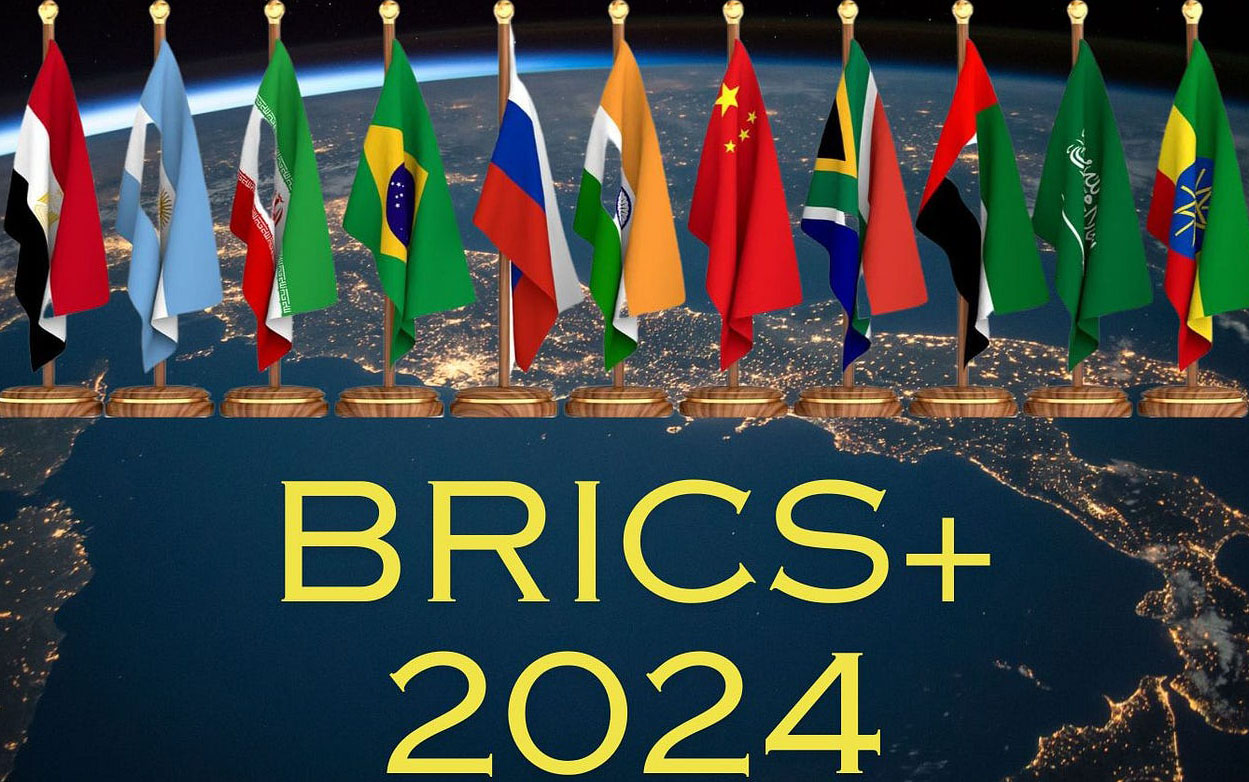

Rebuilding Trust is not a slogan or a PR campaign. It requires deep reforms to global governance to manage geopolitical tensions during a new era of multipolarity. And it is essential to building a safer, more stable, more prosperous world – António Guterres
Asymmetrical power, contested geoeconomics, interwoven complexities and volatilities, across diverse geopolitical domains, and the yawning wealth gap between the Global North and Global South/Developing Economies, together, informed the establishment of the BRICS as a distinct economic bloc. The acronym stands for Brazil, Russia, India, China and South Africa. The first four “BRIC” countries were the founding members in 2009, whilst South Africa joined in 2010 to form “BRICS”.
[ad]
Currently, there are an additional four member countries which include Egypt, Ethiopia, Iran and the United Arab Emirates, together called BRICS+. So far, over 30 countries have either independently applied to join BRICS or been officially invited to join in some capacity. BRICS account for over 40 per cent of global population of approximately 8.2 million people, and 25 per cent of the global economy, which is roughly $110 trillion.
Philosophically, BRICS seek to challenge the United States and Western geopolitical and geoeconomic domination of the global order. For instance, multilateral institutions like the UN Security Council, the World Bank, the International Monetary Fund, the G7, the World Trade Organisation, the European Bank for Reconstruction and Development, the North Atlantic Treaty Organisation, et al, are, it is contended by BRICS and its advocates, disproportionately pro-U.S./Western.
That contention necessarily highlights the important spectre of a zero-sum game, which invariably advances the strategic policy interests of the United States and Westernpowers, to the detriment of Global South/ developing countries.
Hence, the argument for multipolarity. A proposition echoed by Russia’s President, Vladmir Putin, at the 2023 BRICS Summit in South Africa, where he argued that “neoliberalism” was undermining traditional values in developing nations and endangered multipolarity.
[ad]
Putin went further by stressing at the BRICS 2024 Summit in Kazan, Russia, that: “the transition to a more just international system is not easy. Its development is being hampered by forces whose thinking and actions continue to be aimed at dominating everything and everyone.Under the guise of a rules-based order they are imposing on the world, they are actually attempting to contain growing competition and prevent the independent development of countries in Africa, Asia and Latin America that they cannot control.”
What then is multipolarity? It is simply an international paradigm where no singular power nor bloc (unipolarity) wields disproportionate influence in geopolitical and geoeconomic affairs. Smith, et al, in Foreign Policy (2016), characterise multipolarity as an international system shaped by the power of three or more major states.
Conceptually, the allure of multipolarity within the global orthodoxy is unimpeachable, upon the properties of equity, balance of powers, shared rights and responsibilities; as a foundational basis for international cooperation and order. However, the pragmatic counterargument is that sovereign nations exist to defend their citizens and project national interests, within or outside their borders, and, depending upon their power dynamics, at times beyond international law. That striking raison d’etre may well entail acting unilaterally where strategic national interests justify, or in concert with allies; again, as the occasion demands. Plus, informational asymmetry, competing and colliding interests amongst nations, heightens realpolitik which, in practice, has the power to subvert solidarity, itself, a sine qua non for international cooperation.
To put this in some geopolitical context, will the United States and its allies be keen to support BRICS and multipolarity, against the background of Russia’s war of aggression against Ukraine which began on February 24, 2022? No! Likewise, BRICS and the Global South, in the main, do not support Israel in the extant regional war against Hamas in Palestine, Hezbollah in Lebanon and Houthi fighters in Yemen.
The inference from those dynamics is that the basis for international cooperation and multipolarity for BRICS appears insecure on the prospectus of contested geopolitics. That said, the moral justification for BRICs on the grounds of greater equity in the international order is eminently reasonable.
[ad]
Beyond geopolitics, BRICS aim to advance economic cooperation and development amongst their members; enhance global governance and of course, geoeconomic multipolarity and multilateralism. It aims to promote cooperation and partnerships in artificial intelligence, nuclear medicine, infrastructure development and trade realms.
These strategic aims extend to enhancing agriculture, education, food security, energy and natural resources, infrastructure development and science and technology; whilst seeking to enhance global economic stability and prosperity.
In 2015, BRICS established the New Development Bank (NDB), a multilateral development financial institution headquartered in Shanghai, China with an initial capital of $100,000,000. It aims to mobilise resources for infrastructure and sustainable development projects in their countries, other emerging economies and developing countries.
This is with a view to complementing the existing efforts of established multilateral and regional financial institutions and catalysing global growth and development. The bank also offers loans, equity investments and guarantees to public or private initiatives on competitive terms, as well as offering technical assistance on specific projects.
[ad]
The NDB on December 27, 2023, successfully executed its debut $2 billion syndicated loan facility (Syndicated Loan) of $2 billion, whilst receiving commitments totalling $2.59 billion from 15 financial institutions. In that year, NDB and other multilateral development banks (MDBs) confirmed that their global climate finance investments reached a record $125 billion. The combined total exceeded the amount provided in September 2019, when MDBs agreed on joint climate finance priorities at the United Nations Secretary General’s Climate Action Summit.
Importantly too, NDB’s Agreement negates veto powers and operates a one-member-one-vote policy. This is in marked contrast to veto powers at other multilateral institutions like the UN Security Council, where veto powers are exercisable and exercised by the permanent five (P5) super powers – U.S., UK, France, Russia and China.
Strategically, BRICS aim to de-dollarise their economies or reduce the reliance on the USD in international activities, and by so doing foster greater trade volumes and international payments amongst members in their own currencies. The expectation is that the enhanced trade volumes in their domestic currencies will markedly reduce dollar demands, whilst improving their foreign exchange reserves.
Likewise, BRICS+ is gaining ground in regional trade, becoming increasingly focused on commercial transactions between member countries, and enhancing its importance as a trade partner for other emerging markets, especially in the fuel trade. BRICS+ accounts for 37 per cent of the emerging markets fuel trade, a key area of interest for de-dollarisation.
Nigeria for instance, although not yet a member of the BRICS, has expressed a keen desire to de-dollarise its economy, as established by the country’s Finance Minister, Wale Edun, on the margins of discourse at the World Bank/ IMF summit earlier this month.
Current exchange rates hover at approximately $1 to N1,642; a year ago $1 was exchanged for N790, representing a decreaseof 107.8 percent in the value of the naira to the USD. Because the country is largely import-dependent, demand for USD continues to spike to the detriment of the local currency. The logic of de-dollarisation in this illustration is that greater trade across BRICS and its partner nations will cut demand for USD quite significantly.
Notwithstanding the foregoing, BRICS are encumbered by major drawbacks which could call into question the very basis of its strategic priorities on three key grounds. First, BRICS comprise member states with different political antecedents and orthodoxies which itself, poses challenges on issues pertaining to the consistent application of the rule of law, liberty and human rights.
[ad]
Second, to a greater or lesser extent, harnessing technical cooperation between BRICS and Western powers will be necessary at some time.The policy question then becomes whether, and to what extent, the United States/Western powers would be willing to cooperate with BRICS on strategic issues intersecting competitive rivalry and geoeconomics.
Third, geopolitical issues remain enduring concerns between BRICS and the Global North. For instance, following Edward Snowden’s leaking of highly classified U.S. National Security Agency’s international surveillance activities, in collaboration with other Western governments about a decade ago, BRICS, undertook to develop an interoperable subsea cable system through ports in Russia, China, Singapore, India, Mauritius, South Africa, and Brazil.
The intention therein was to thwart U.S. and Western countries’ espionage. The ambitious project was to span 34,000 km at a cost exceeding $1.4 billion. That initiative for the time being at least, has been suspended by BRICS.
Closing, geopolitical tensions between the BRICS and rivals – whether impinging on tensions between the United States and China over Taiwan, U.S. sanctions against Russia, market entry barriers et al – will no doubt emerge and or remain on multiple fronts, given conflicting strategic interests.
Nevertheless, effective diplomacy, leadership, and political pragmatism, will continue to be necessary to reshape the BRICS in the years ahead to foster inter-member and international cooperation, catalyse trade, economic growth, to help facilitate more equitable global governance and the finely poised balance of multipolarity and geopolitics. It is a marathon and not a 100 metres sprint.
Ojumu is the Principal Partner at Balliol Myers LP, a firm of legal practitioners and strategy consultants in Lagos, Nigeria, and the author of The Dynamic Intersections of Economics, Foreign Relations, Jurisprudence and National Development (2023).
[ad]

